

 Popular Countries
 24/7 Support
Published
Salar de Uyuni is one of Bolivia’s best-known natural destinations and is promoted by Bolivia’s Viceministry of Tourism as the largest salt flat in the world. The salt flat covers 10,582 square kilometers and forms part of a wider Potosí visitor route that includes cactus islands, salt communities, highland lagoons, and the Train Cemetery.
What are the main attractions at Salar de Uyuni?
Salar de Uyuni’s core appeal comes from its white salt landscape, Incahuasi, Colchani, and nearby highland attractions in the Potosí region.
- The Viceministry of Tourism describes Salar de Uyuni as a place where the sky and earth appear to merge into one landscape.
- Incahuasi, also known as Isla del Pescado, is one of the notable island formations within the salt flat.
- Colchani is highlighted for salt-based craft and production activity.
- Regional add-ons include the Train Cemetery, Laguna Colorada, and Laguna Verde in or near the wider Potosí visitor circuit.
Bolivia Tourism Context for Salar de Uyuni
Bolivia received 991,184 foreign visitors in 2024, while inbound tourism spending reached $739.94 million.
- Foreign-visitor arrivals were slightly lower than in 2023, when Bolivia recorded 1.01 million foreign visitors.
- Inbound tourism spending increased from $687.87 million in 2023 to $739.94 million in 2024.
- Bolivia’s 2024 foreign-visitor total remained below the 2019 pre-pandemic benchmark of 1.24 million foreign visitors.
| Year | Foreign Visitors to Bolivia | Inbound Tourism Spending |
|---|---|---|
| 2023 | 1,009,247 | $687.87 million |
| 2024 | 991,184 | $739.94 million |
Source · Note: These are Bolivia national inbound tourism figures, included as country context for a major Bolivian destination.
Tourism investment in the Salar de Uyuni and Lagunas de Colores region
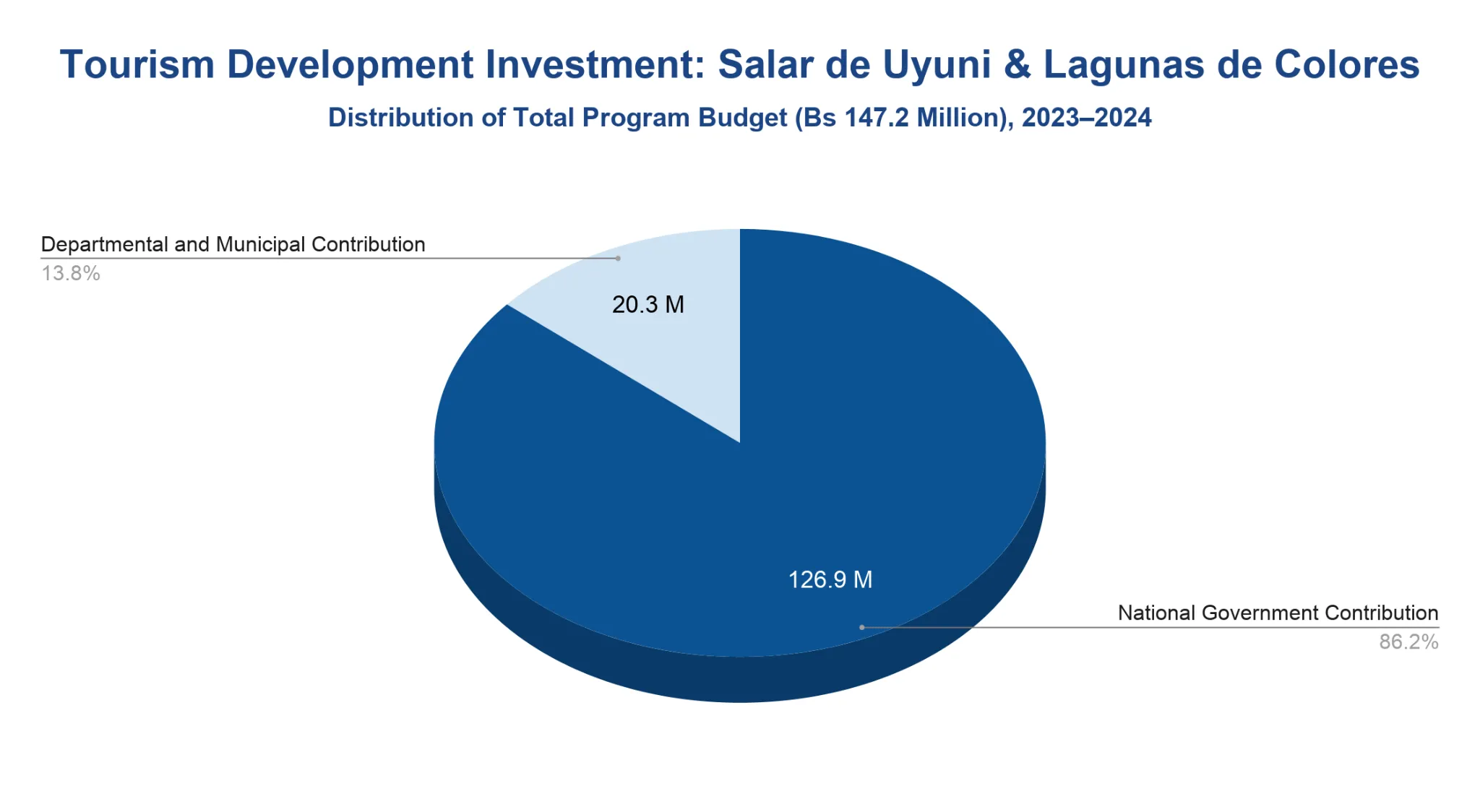
Bolivia’s tourism authorities reported a Bs 147.2 million tourism-development program for the Salar de Uyuni and Lagunas de Colores destination area in June 2023, with follow-up work continuing in 2024.
- The program covers the Salar de Uyuni and Lagunas de Colores destination area.
- The national government committed Bs 126.9 million, with Bs 20.3 million from departmental and municipal counterparts.
- The program benefits 12 municipalities in southwestern Potosí.
- Planned components include tourism infrastructure, support for tourism and artisan services, promotion, and program management.
Related Travel Statistics
Lithium and Tourism at Salar de Uyuni
Salar de Uyuni is also a major lithium resource area, with 21.00 million metric tons of certified lithium resources reported by Yacimientos de Litio Bolivianos.
- Yacimientos de Litio Bolivianos reported 21.00 million metric tons of certified lithium resources in Salar de Uyuni.
- The state lithium company describes certification as part of planning for lithium industrialization and sustainable use.
- Lithium development is an important long-term land-use context for the salt flat alongside tourism.
How popular is Salar de Uyuni internationally?
Salar de Uyuni has received international tourism recognition through the World Travel Awards.
- Salar de Uyuni was nominated for South America’s Leading Tourist Attraction in 2018 and 2019.
- It was also nominated for World’s Leading Regional Nature Destination in 2022.
- World Travel Awards recognized Salar de Uyuni as South America’s Leading Natural Tourist Attraction in 2019.
References
- Bolivia Tourism Destinations, Inbound Tourism and PDUL Program Sources (2023–2025) · turismo.produccion.gob.bo
- Certified Lithium Resources in Salar de Uyuni (2026) · ylb.gob.bo
- Salar de Uyuni Awards and Nominations (2018–2022) · worldtravelawards.com

