
Page last update: 26 March 2026
The US remains one of the most car-dependent nations in the world, with a vehicle fleet that has grown steadily over the past three decades. Today, over 283 million motor vehicles are registered nationwide, a record high that reflects a 47% increase since 1990.
How many registered vehicles are there in the US?
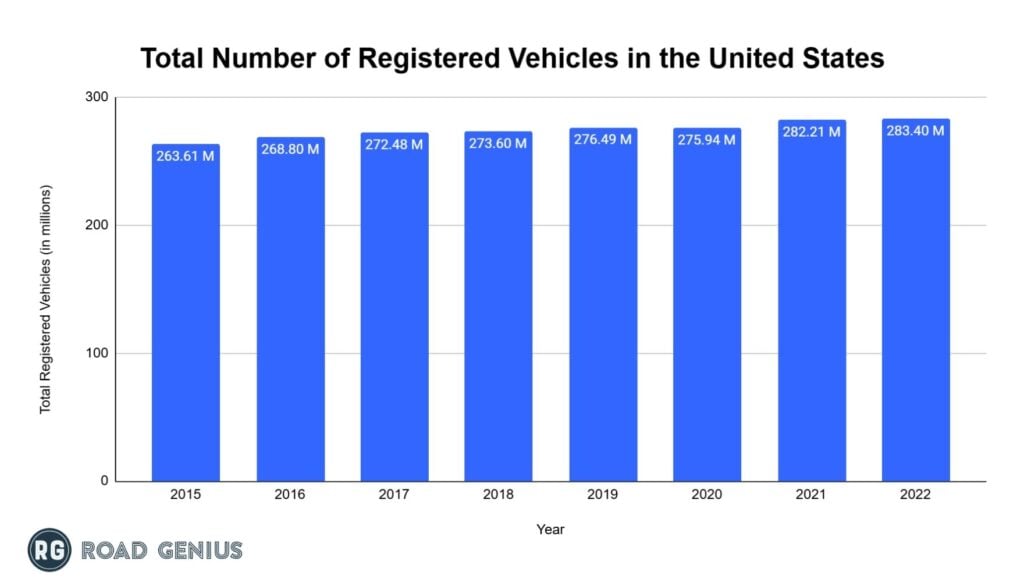
Over 283 million vehicles are registered in the US as of 2022, a 2.5% increase compared to the pre-pandemic level of 276.5 million in 2019.
- Approximately 200 million vehicles were registered in 1990, establishing the early baseline.
- Registrations reached around 225 million to 230 million during 2000, showing steady growth.
- The number climbed to about 250 million by 2010 and reached 276.5 million before the pandemic in 2019.
- During the pandemic year of 2020, the figure was around 275.9 million.
- A total of 283.4 million vehicles were registered in 2022, a 2.5% increase over pre-pandemic levels.
- From 2023 to 2025, with over 288 million projected vehicle registrations, the US fleet will be 4.2% larger than the pre-pandemic total of 276.5 million in 2019.
How many cars are there in the US?
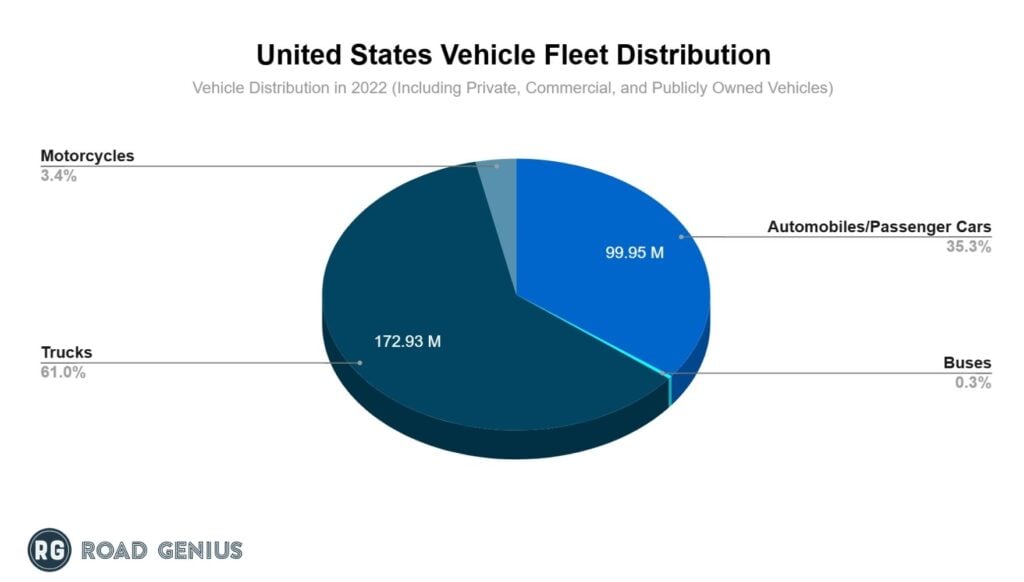
Passenger cars account for about 35% of the US vehicle fleet in 2022, while other vehicle types make up the balance.
- Approximately 100 million vehicles are classified as traditional passenger cars, based on 2022 data.
- Light trucks (including SUVs, pickups, and minivans) constitute roughly 61% of registrations.
- Motorcycles represent around 3% of the fleet, and buses and similar vehicles make up less than 1%.
How many vehicles are currently active on the road?
- Approximately 283.4 million vehicles are active on US roads as recorded in the latest 2022 data.
How has the number of cars on the road changed since previous years?
The US vehicle fleet has expanded from an estimated 200 million in the early 1990s to over 283 million in recent data.
- The net annual increase has been about 1 million to 2 million vehicles.
- The pandemic resulted in a brief plateau in 2020, after which the growth trend continued in subsequent years.
What is the trend in new vs. used car registrations?
- New vehicle sales add roughly 1 to 2 million vehicles each year, while used car transactions are more frequent and involve the transfer of ownership rather than an increase in the overall fleet.
How many cars are registered per capita in the US?
- The US registers about 850 vehicles per 1,000 people, which translates to around 1.2 vehicles for each licensed driver.
How many cars does the average US household own?
The average US household owns approximately 1 to 2 vehicles.
- Households in suburban and rural areas typically own two or more vehicles, while urban households tend to have one or none.
- This average reflects the common pattern of car ownership across American households.
How many Americans own at least one car?
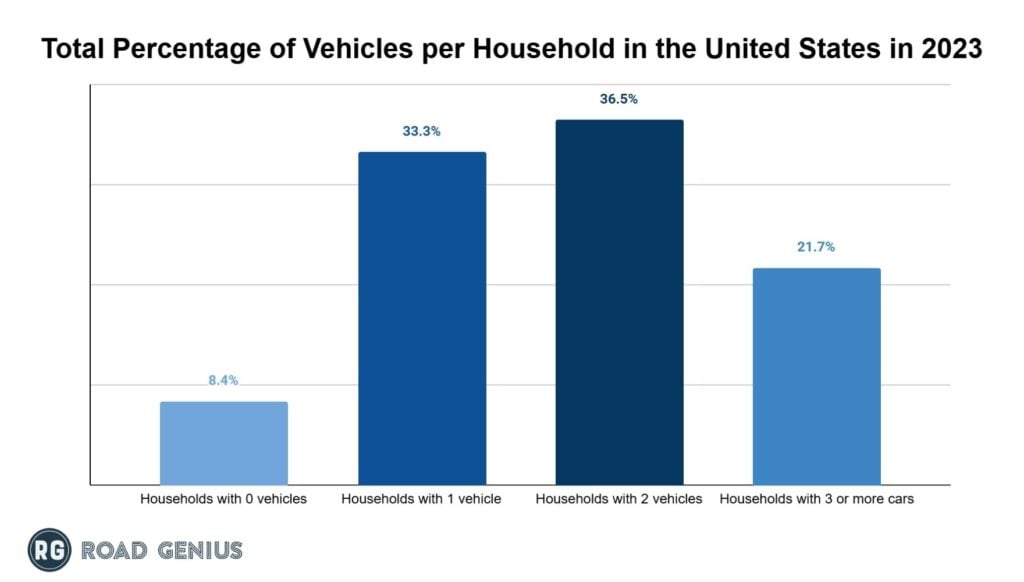
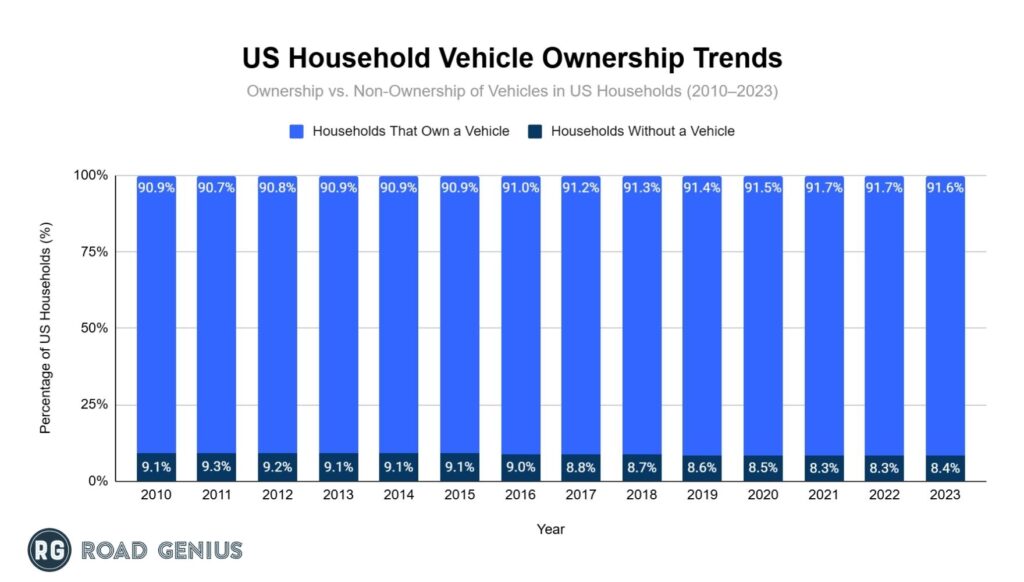
As of 2023, approximately 91.6% of American households owned at least one vehicle.
- Approximately 8.4% of households do not own a car, with the highest car-free rates found in dense urban areas.
How does car ownership vary by age group?
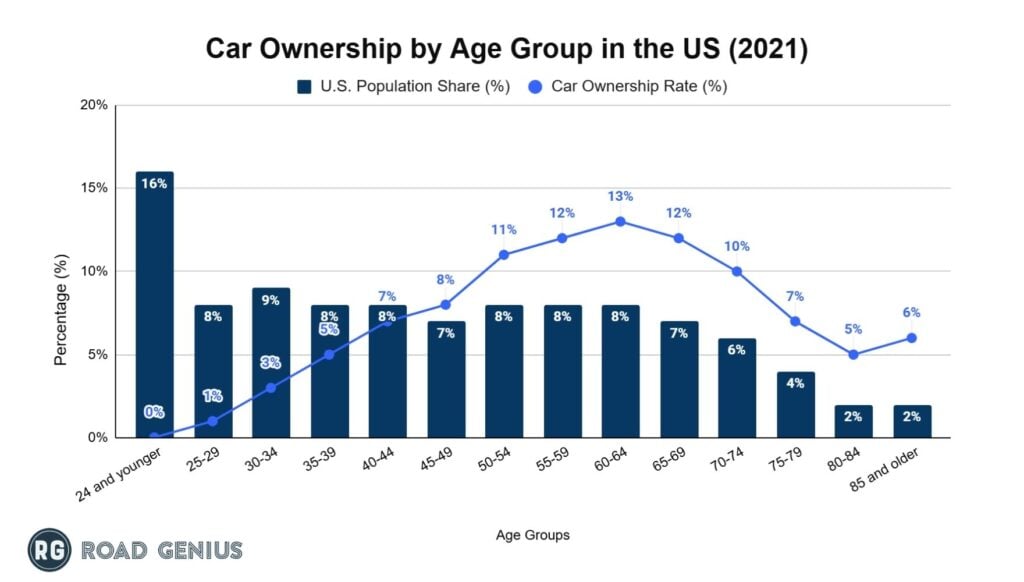
Car ownership increases with age, reaching its highest point in the 50 to 64 age group before dropping in older age groups.
- Young adults (24 and younger) have very low car ownership rates, which matches a decrease in teenagers getting driver’s licenses.
- People aged 30 to 49 have the highest car ownership rates (above 90%), showing that this group relies the most on cars.
- Car ownership rates decrease after age 70, making the 85+ age group have one of the lowest ownership rates (6%).
How does income affect car ownership rates?
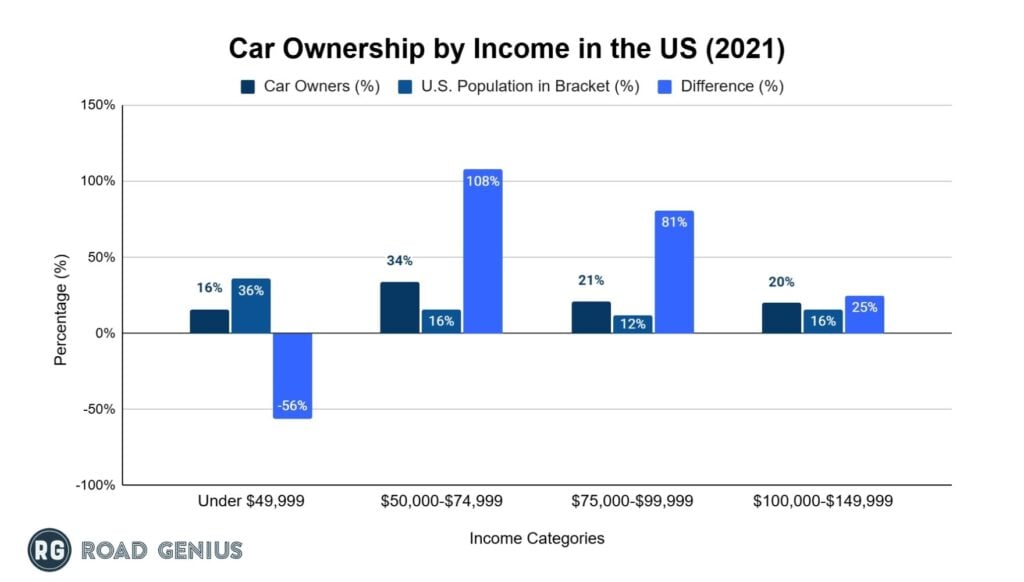
Higher-income households are more likely to own at least one car than lower-income households.
- Only 44% of low-income households (annual earnings under $49,999) owned a vehicle, compared to nearly 100% ownership among high-income households (annual earnings of $75,000 and above).
- Low-income households are 56% less likely to own a car than the national average of 91.6%.
Which states have owned the most vehicles over the years?
California (30.6 million), Texas (23.8 million), and Florida (19.2 million) are the states with the highest number of registered vehicles in 2022, accounting for nearly 26% of all US vehicles.
- With the total of 283.4 million registered vehicles in the US in 2022, California alone made up 10.81% of total registered vehicles.
- When it comes to the growth in vehicle registrations, Louisiana (+17.22%), Utah (+15.62%), Maryland (+14.58%), and South Carolina (+13.91%) had the highest percentage increases.
| Number of Registered Vehicles by US State | ||||||
| State | Registered Vehicles (2018) | Registered Vehicles (2019) | Registered Vehicles (2020) | Registered Vehicles (2021) | Registered Vehicles (2022) | 5-Year % Change (2018–2022) |
| Alabama | 5,300, 199 | 5,288,208 | 5,320,340 | 5,479,971 | 5,464,382 | 3.22% |
| Alaska | 803,684 | 795,275 | 792,826 | 686,142 | 679,125 | -17.10% |
| Arizona | 5,806,313 | 5,982,559 | 6,053,781 | 6,064,542 | 6,090,179 | 1.77% |
| Arkansas | 2,817,145 | 2,902,111 | 2,913,369 | 3,555,142 | 3,569,698 | 18.70% |
| California | 31,022,328 | 31,247,270 | 30,398,249 | 31,349,073 | 31,119,113 | -0.41% |
| Colorado | 5,356,018 | 5,412,404 | 5,350,708 | 5,096,394 | 5,116,858 | -5.78% |
| Connecticut | 2,879,802 | 2,878,548 | 2,867,554 | 2,756,485 | 2,789,423 | -3.20% |
| Delaware | 1,008,468 | 1,016,927 | 1,025,430 | 472,175 | 467,268 | -117.63% |
| Dist. of Col. | 351,933 | 350,463 | 356,537 | 363,287 | 380,801 | 7.97% |
| Florida | 17,496,002 | 17,833,720 | 18,464,506 | 19,180, 165 | 19,663,462 | 9.31% |
| Georgia | 8,512,550 | 8,594,567 | 8,829,596 | 9,072,876 | 9,153,627 | 6.11% |
| Hawaii | 1,267,385 | 1,272,361 | 1,244,935 | 1,235,360 | 1,243,333 | -2.33% |
| Idaho | 1,879,670 | 1,954,528 | 1,917,808 | 1,976,199 | 2,031,332 | 3.78% |
| Illinois | 10,588,910 | 10,691,947 | 10,589,239 | 11,003,729 | 10,334,435 | -3.46% |
| Indiana | 6,190,736 | 6,223,460 | 6,199,901 | 6,241,291 | 6,256,479 | 0.53% |
| Iowa | 3,691,892 | 3,786,328 | 3,787,224 | 3,839,312 | 3,779,422 | -0.18% |
| Kansas | 2,684,010 | 2,682,337 | 2,603,543 | 2,606,313 | 2,588,185 | -3.64% |
| Kentucky | 4,368,285 | 4,383,223 | 4,459,685 | 4,408,730 | 4,291,816 | -2.13% |
| Louisiana | 3,885, 119 | 3,802,746 | 3,861,204 | 3,862,490 | 4,593,542 | 17.22% |
| Maine | 1,125,588 | 1,130,056 | 1,121,106 | 1,387,656 | 1,294,286 | 12.69% |
| Maryland | 4,204,846 | 4,203,994 | 4,212,244 | 4,910,674 | 4,919,054 | 14.54% |
| Massachusetts | 5,061,499 | 5,061,260 | 5,036,686 | 5,207,052 | 5,184,450 | 2.38% |
| Michigan | 8,380,387 | 8,440,065 | 8,453,239 | 9,556,452 | 9,403,708 | 10.25% |
| Minnesota | 5,404,277 | 5,425,885 | 5,690,749 | 5,511,960 | 5,673,333 | 4.36% |
| Mississippi | 2,067,498 | 2,066,681 | 2,058,975 | 2,385,768 | 2,298,929 | 10.10% |
| Missouri | 5,498,675 | 5,534,289 | 5,587,022 | 5,603,939 | 5,373,722 | -2.99% |
| Montana | 1,845,338 | 1,900,806 | 1,952,553 | 2,140,014 | 2,249,485 | 15.50% |
| Nebraska | 1,961,309 | 1,968,479 | 1,935,357 | 1,933,528 | 1,967,125 | -0.07% |
| Nevada | 2,514,338 | 2,546,583 | 2,550,414 | 2,676,143 | 2,672,391 | 4.71% |
| New Hampshire | 1,346,318 | 1,363,379 | 1,357,535 | 1,417,949 | 1,437,151 | 5.13% |
| New Jersey | 6,055,389 | 6,033,015 | 6,006,247 | 6,249,905 | 5,999,667 | -0.56% |
| New Mexico | 1,824,217 | 1,825,421 | 1,783,151 | 1,862,673 | 1,870,380 | 2.40% |
| New York | 11,482,229 | 11,389,158 | 11,324,755 | 9,408,796 | 9,111,362 | -25.00% |
| North Carolina | 8,210,213 | 8,527,388 | 8,739,280 | 8,707,506 | 8,995,906 | 5.21% |
| North Dakota | 899,953 | 903,668 | 899,083 | 925,186 | 1,093,509 | 17.36% |
| Ohio | 10,913,773 | 10,901,279 | 10,592,317 | 10,892,377 | 11,028,755 | 1.16% |
| Oklahoma | 3,699,022 | 3,706,624 | 3,730,247 | 3,353, 167 | 3,345,331 | -10.80% |
| Oregon | 3,942,875 | 3,919,157 | 4,095,442 | 4,010,635 | 4,139,333 | 5.32% |
| Pennsylvania | 10,727,715 | 10,800,315 | 10,690,187 | 10,927,881 | 10,868,829 | 0.63% |
| Rhode Island | 872,344 | 868,942 | 866,584 | 801,654 | 806,142 | -7.79% |
| South Carolina | 4,457,519 | 4,516,143 | 4,561,299 | 5,091,679 | 5,245,829 | 13.91% |
| South Dakota | 1,269,415 | 1,280,969 | 1,294,282 | 1,346,517 | 1,364,513 | 6.12% |
| Tennessee | 5,770,874 | 5,817,887 | 5,855,373 | 6,712,722 | 6,828,011 | 14.79% |
| Texas | 22,186,241 | 23,007,146 | 22,419,490 | 23,012,990 | 23,291,638 | 1.22% |
| Utah | 2,372,800 | 2,430,275 | 2,479,604 | 2,838,505 | 2,876,800 | 15.52% |
| Vermont | 619,694 | 620,428 | 608,197 | 614,340 | 625,664 | 0.84% |
| Virginia | 7,604,646 | 7,647,692 | 7,606,452 | 7,652,036 | 7,763,287 | 1.49% |
| Washington | 7,152,413 | 7,377,028 | 7,257,401 | 7,966,147 | 7,835,063 | 5.85% |
| West Virginia | 1,693,719 | 1,668,113 | 1,657,362 | 1,219,024 | 1,652,896 | -0.92% |
| Wisconsin | 5,683,061 | 5,666,400 | 5,616,271 | 5,769,058 | 5,681,673 | 0.27% |
| Wyoming | 837,024 | 843,671 | 861,028 | 870,969 | 890,285 | 5.24% |
| Total | 273,595,656 | 276,491,174 | 275,936,367 | 282,214,578 | 283,400,986 | 2.44% |
What states have the highest number of vehicles per household?
The state with the highest number of vehicles per household is Montana, where the average is approximately 1.93 vehicles per person.
- Rural and suburban regions in many states show very high household vehicle ownership.
What cities in the US have the lowest car ownership rates?
While most Americans own cars, ownership rates vary by city, especially in urban areas with strong public transportation systems.
- In 2022, approximately 70% of households in the New York-Newark-Jersey City metro area owned a car. This is the lowest car ownership rate among major US cities, but still indicates that 7 in 10 households still own a car.
- Additionally, major metros like Boston, Philadelphia, Chicago, and San Francisco, also had relatively low car ownership rates, though most households still own at least one vehicle.
| US Cities with the Lowest Car Ownership Rates | |||||
| Geographic Area | Vehicle Ownership Rate (%) | Households with 1 Vehicle (%) | Households with 2 Vehicles (%) | Households with 3 or More Vehicles (%) | Estimated Number of Households |
| New York-Newark-Jersey City, NY-NJ-PA Metro Area | 70.00% | 33.00% | 25.00% | 12.00% | 7,321,054 |
| Ithaca, NY Metro Area | 87.00% | 37.00% | 36.00% | 14.00% | 42,984 |
| Boston-Cambridge-Newton, MA-NH Metro Area | 87.00% | 35.00% | 36.00% | 16.00% | 1,913,599 |
| Philadelphia-Camden-Wilmington, PA-NJ-DE-MD Metro Area | 87.00% | 35.00% | 35.00% | 17.00% | 2,419,824 |
| Atlantic City-Hammonton, NJ Metro Area | 88.00% | 34.00% | 35.00% | 19.00% | 106,640 |
| Chicago-Naperville-Elgin, IL-IN-WI Metro Area | 88.00% | 36.00% | 35.00% | 17.00% | 3,654,700 |
| Buffalo-Cheektowaga, NY Metro Area | 88.00% | 38.00% | 36.00% | 14.00% | 497,529 |
| San Francisco-Oakland-Berkeley, CA Metro Area | 89.00% | 34.00% | 34.00% | 21.00% | 1,723,229 |
| Trenton-Princeton, NJ Metro Area | 88.00% | 34.00% | 36.00% | 18.00% | 139,549 |
How does car ownership differ between urban and suburban areas?
- Urban areas tend to have lower car ownership due to extensive public transit options and higher population density, whereas in suburban areas typically 90% of households own a car.
| US Cities with the Highest Car Ownership Rates | |||||
| Geographic Area | Vehicle Ownership Rate (%) | Households with 1 Vehicle (%) | Households with 2 Vehicles (%) | Households with 3 or more Vehicles (%) | Estimated # of Households |
| Daphne-Fairhope-Foley, AL Metro Area | 98.00% | 31.00% | 43.00% | 24.00% | 90,802 |
| Provo-Orem, UT Metro Area | 97.00% | 19.00% | 42.00% | 36.00% | 190,765 |
| St. George, UT Metro Area | 96.00% | 26.00% | 41.00% | 29.00% | 64,151 |
| Ogden-Clearfield, UT Metro Area | 97.00% | 21.00% | 40.00% | 36.00% | 224,208 |
| Twin Falls, ID Metro Area | 96.00% | 26.00% | 37.00% | 33.00% | 41,452 |
| The Villages, FL Metro Area | 97.00% | 59.00% | 29.00% | 9.00% | 64,305 |
| Hilton Head Island-Bluffton, SC Metro Area | 97.00% | 36.00% | 44.00% | 17.00% | 87,908 |
| Greeley, CO Metro Area | 97.00% | 22.00% | 39.00% | 36.00% | 115,536 |
| Colorado Springs, CO Metro Area | 97.00% | 29.00% | 41.00% | 27.00% | 287,411 |
| Boise City, ID Metro Area | 96.00% | 25.00% | 41.00% | 30.00% | 285,188 |
What is the average length of car ownership in the US?
- American consumers typically keep a new car for about 7 years before selling or trading it.
How has car lifespan changed over the years?
- The average age of vehicles on the road increased from approximately 9.6 years in 2002 to 12.6 years by 2023.
How are EVs affecting car ownership trends?
Electric vehicles are projected to represent 40 to 50% of new car sales by 2030.
- In 2023, over 3.5 million electric vehicles (EVs) were registered across the US. California, Florida, and Texas led the nation in EV registrations.
- By 2024, all-electric vehicles accounted for almost 8% of new vehicle registrations in the US.
US Travel Resources
How many people bought cars in recent years?
Nearly 13.8 million new light vehicles were sold in 2022, a decline from 17 million pre-pandemic sales in 2019. Sales in 2023 are showing signs of recovery, though they remain below 2019 levels.
- Used car transactions exceeded 40 million in 2022.
- New car prices have increased by about 25% compared to 2019, contributing to slower new sales.
How much does it cost to have a new car in the US?
- The average new car price exceeded $48,000 in mid-2022, which was a 25% increase from mid-2020.
- Average monthly loan payments for new cars are approximately $686, with some buyers paying over $1,000 per month.
- Transportation costs account for around 16% of the average household’s spending, with 93% of that expenditure related to vehicle expenses.
Car Ownership in the US vs Other Countries
How many of the world’s automobiles belong to Americans?
- Americans own about 19.5% of the world’s passenger vehicles, even though they make up only 4% of the global population.
How does the US car ownership rate compare to Europe and Asia?
- The US registers approximately 850 vehicles per 1,000 people, compared to around 560 per 1,000 in the European Union and much lower rates in many Asian countries.
What role does public transportation play in reducing car ownership?
- Effective public transportation systems reduce the reliance on personal vehicles, which is why cities in Europe and parts of Asia tend to have lower car ownership compared to the US.
Global Statistics Resources
Car Sales:
- Automotive Industry Trends
- Global Car Sales 2024
- Global Car Sales by Brands
- Global Car Sales by Car Models
- Global Car Sales
References
FHWA: Highway Statistics Series 1990-2023
USCB: Available Vehicles in American Households
USCB: Income per Household in the US 2023
