
Page last updated: 13 November 2025
The Eiffel Tower, known as the symbol of France and located in the City of Lights, is one of the most famous monuments in the world.
How many people visit the Eiffel Tower each year?
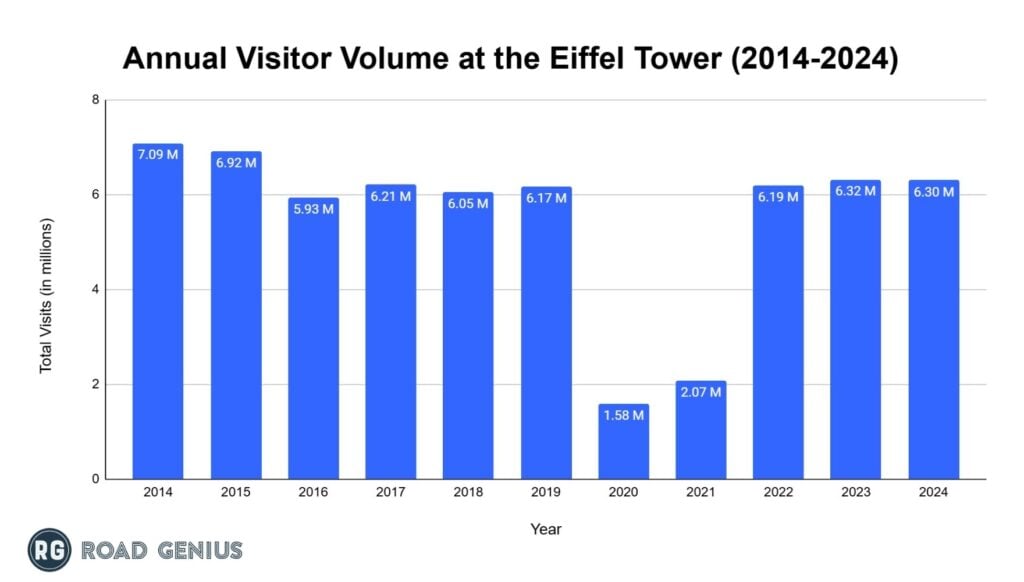
Around 6 to 7 million people visit the Eiffel Tower each year, with international visitors making up 75% of this total.1
- In 2023, the Eiffel Tower attracted 6.3 million tourists, reflecting an 8% rise compared to 6.19 million visitors in 2022 and slightly exceeding the pre-COVID visitation figure of 6.2 million in 2019.
- However, the 2023 visitor number remained about 10% below the peak of 7.09 million visitors recorded in 2014.2
- The Eiffel Tower saw a stable visitor count of 6.3 million in 2024, consistent with the number recorded the previous year.
How many tourists visited the Eiffel Tower in 2024?
In 2024, the Eiffel Tower maintained a high volume of visitors, with approximately 6.30 million tourists.
- This number represented a stability in visitor volume compared to the previous year, demonstrating its enduring appeal.
How many tourists visit the Eiffel Tower each day?
- The Eiffel Tower welcomes an average of 15,000 to 25,000 visitors each day. This number can vary, with higher visitation during peak seasons such as summer and holidays.
How much money does the Eiffel Tower make from tourists?
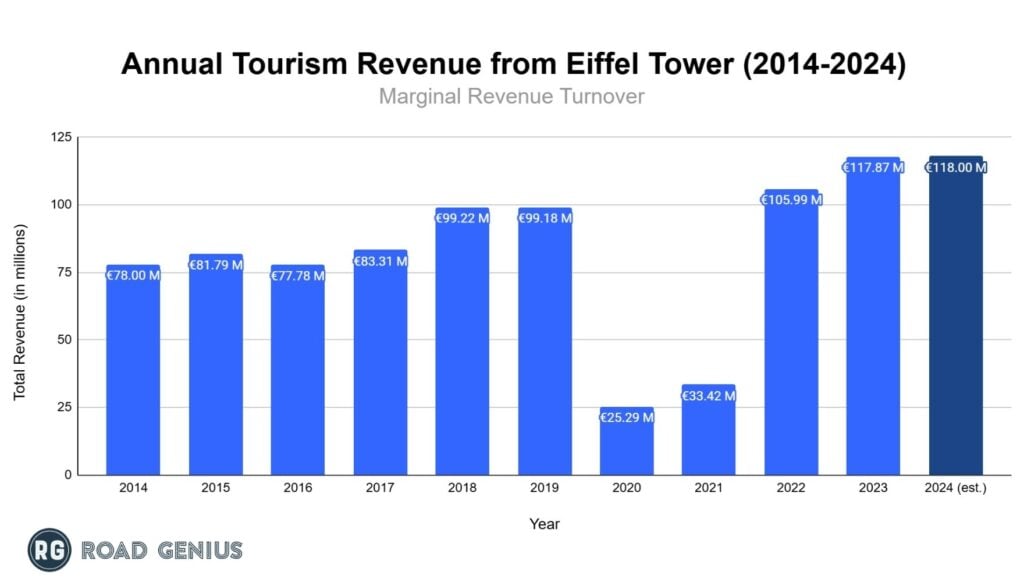
- In 2019, the monument welcomed 6.2 million visitors, generating €99.18 million in revenue.
- However, global health concerns led to a major shift in 2020, with visitor numbers dropping to 1.8 million and revenues declining to €25.29 million as travel restrictions and lockdowns took effect.
- In 2021, the Eiffel Tower showed signs of recovery with an increase in both visitors (2.1 million) and revenue (€33.42 million), although the monument still faced challenges in reaching its pre-pandemic levels.
- The recovery continued in 2022, with 5.85 million visitors contributing to €105.99 million in total revenue.
- Visitor spending increased further to €117.87 million in 2023, a 11.2% increase from the previous year.
While the exact figure for 2024 is not available yet, it is estimated to be around €118 million.
Who visits the Eiffel Tower the most?
Around 81% of the total visitors to the Eiffel Tower in 2024 were international visitors. The remaining 19% were French.
- The United States was the biggest source of international visitors to Eiffel Tower in 2024, with approximately 13% of total visitors.3:
- Among European countries, visitors from the United Kingdom hold first place with approximately 7%, closely followed by Germans and then Spaniards.
How long do visitors spend at the Eiffel Tower?
- Tourists typically spend 1.5 to 3 hours exploring the Eiffel Tower.
Why do people visit the Eiffel Tower?
- People visit the Eiffel Tower for its cultural significance and historical importance. The tower is seen as a symbol of Paris and offers panoramic views of the city. The Eiffel Tower is also associated with romance, making it a popular destination for tourists worldwide.
How popular is the Eiffel Tower as a tourist destination?
The Eiffel Tower remains one of the world’s most iconic landmarks and a major draw for international tourism.
2025
- Ranked among Europe’s most-visited tourist attractions in recent listings (e.g., in a “15 Most-Visited Attractions in Europe [2025 Ranking]” though a precise numerical rank for the Eiffel Tower was not always specified.
2024
- The Eiffel Tower was nominated for the “Europe’s Leading Tourist Attraction 2024” by the World Travel Awards.
- According to a travel-site year-ender piece (“Year Ender 2024: The Most Popular Tourist Attractions…” by Native Planet), the Eiffel Tower is explicitly included as one of the “most popular tourist spots” globally in 2024.
Paris Travel Resources
Price comparisons
Campervan rental costs
One-way car rentals
One-way rentals in France
- One-way rentals from France to Italy
- One-way rentals from France to Spain
- One-way rentals from France to UK
- One-way rentals from Geneva to France
- One-way rentals from Italy to France
- One-way rentals from London to France
- One-way rentals from Nice to Paris
- One-way rentals from Paris to Amsterdam
- One-way rentals from Paris to Barcelona
- One-way rentals from Paris to London
- One-way rentals from Paris to Rome
- One-way rentals from Spain to France
Airports
Car hire at France Airports
- Rent a Car at Paris Airport (CDG)
- Rent a Car at Beauvais Airport (BVA)
- Rent a Car at Bordeaux Airport (BOD)
- Rent a Car at Brive Airport (BVE)
- Rent a Car at Calvi Airport (CLY)
- Rent a Car at Figari Airport (FSC)
- Rent a Car at Lyon Airport (LYS)
- Rent a Car at Marseille Airport (MRS)
- Rent a Car at Nice Airport (NCE)
- Rent a Car at Toulouse Airport (TLS)
- Rent a Car at Tours Airport (TUF)
What are some interesting facts about the Eiffel Tower?
Here are some facts about the Eiffel Tower that visitors should know:
- What is the Eiffel Tower?
- The Eiffel Tower, known as “La Tour Eiffel” in French, is a wrought-iron lattice tower. It is one of the most recognisable landmarks in the world and serves as a symbol of French architectural and engineering achievement.
- Where is the Eiffel Tower located?
- The Eiffel Tower is located on the Champ de Mars at 5 Avenue Anatole France in the 7th arrondissement of Paris, on the left bank of the Seine River.
- When was the Eiffel Tower built?
- The construction of the Eiffel Tower started in January 1887 and finished on March 31, 1889. It was opened to the public on May 15, 1889.
The tower was constructed in 2 years, 2 months, and 5 days. This was considered a major technological achievement at the end of the 19th century.
- Why was the Eiffel Tower built?
- The Eiffel Tower was initially intended to be a temporary structure as the entrance arch for the 1889 World’s Fair in Paris, held to celebrate the 100th anniversary of the French Revolution. It was meant to showcase France’s industrial strength and engineering skills.
- Who built the Eiffel Tower?
- The Eiffel Tower was designed and built by the engineering company of Gustave Eiffel. The design team included engineers Maurice Koechlin and Émile Nouguier, along with architect Stephen Sauvestre.
- How tall is the Eiffel Tower?
- The Eiffel Tower stands at 330 metres (1,083 feet) tall, including its antennas. Originally, it was 312 metres (1,024 feet) tall.
- What is the Eiffel Tower made of?
- The Eiffel Tower is constructed from 18,038 iron parts, which are held together by 2.5 million rivets. The total weight of the metal structure is 7,300 tons.
- What colour is the Eiffel Tower?
- The Eiffel Tower is painted in a colour called “Eiffel Tower Brown,” which is a bronze-like shade. It is repainted every seven years to maintain its appearance and protect the iron.
- How many people died building the Eiffel Tower?
- No workers died during the construction of the Eiffel Tower. This was due to the safety measures used during its construction, which were rare at that time.
- What role has the Eiffel Tower played in telecommunications?
- The Eiffel Tower played an important role in early telecommunications. It served as a military radio post in 1903 and was used to broadcast the first public radio program in 1925.
What time does the Eiffel Tower light up or sparkle?
- The Eiffel Tower lights up every evening with its golden lighting, which is activated automatically at dusk by sensors.
- The sparkling magic ends at 1 AM during the winter and at 2 AM in the summer months when the lights of the Eiffel Tower are turned off.
- In addition, the tower sparkles for five minutes at the beginning of each hour from nightfall until 1 AM or 2 AM. The sparkling effect is created by 20,000 bulbs, which enhance its nighttime allure.4
What happened to the Eiffel Tower in 2024?
- In 2024, the Eiffel Tower played a significant role during the Paris Olympic Games, serving as a backdrop for spectacular light shows and events during the opening ceremony. This event showcased the Eiffel Tower as a global symbol of celebration and unity during the Olympics.5
- Additionally, the Tower’s lighting system was updated to include energy-efficient LED lights, aligning with Paris’s commitment to reducing its carbon footprint. The Eiffel Tower’s lights are now turned off earlier than in previous years, at 11:45 PM, as part of the city’s energy-saving measures.
Europe Travel Resources
- Austria Statistics
- Belgium Statistics
- Croatia Statistics
- Denmark Statistics
- France Statistics (incl. Paris, Disneyland Paris, Louvre Museum, Notre Dame)
- Georgia Statistics
- Germany Statistics (incl. Berlin)
- Greece Statistics (incl. Parthenon)
- Iceland Statistics
- Italy Statistics (incl. Florence, Milan, Rome, Venice)
- Netherlands Statistics (incl. Amsterdam)
- Norway Statistics
- Portugal Statistics (incl. Lisbon)
- Spain Statistics (incl. Barcelona, Madrid, Mallorca)
- Sweden Statistics
- Switzerland Statistics
- UK Statistics (incl. Edinburgh, Glasgow, London, Oxford, Scotland)
References
- SETE: Société d’Exploitation de la Tour Eiffel – 2014 to 2022 in Figures ↩︎
- HNH: Numbers of visits to the Eiffel Tower in 2023 ↩︎
- SETE: Numbers of visits to the Eiffel Tower in 2015 – Visitor Profiles ↩︎
- PTT: A Guide to Eiffel Tower’s Stunning Light Display ↩︎
- NBC: Opening Ceremony for the Olympic Games in Paris ↩︎
