
Page last updated: 19 December 2025
Israel, a land rich in history, culture, and breathtaking landscapes, offers a timeless journey through sacred sites, innovative cities, and the resilient spirit of its people.
How many people visit Israel each year?
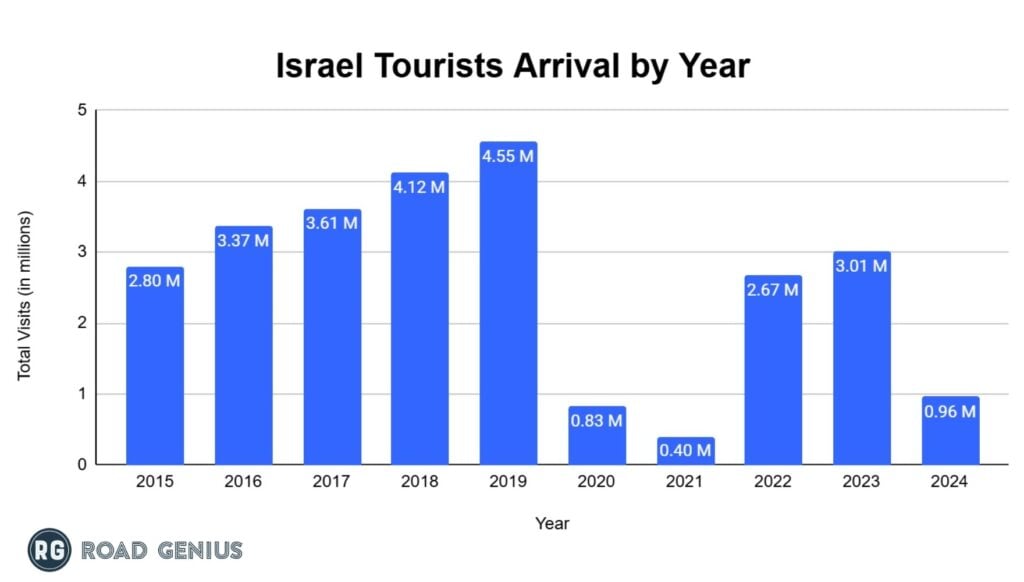
Israel attracts over 3 millions of international visitors annually, but tourism has fluctuated over the past decade due to global events, regional conflict, and ongoing instability. 1
- In 2019, Israel reached a record of 4.55 million international visitors. As the COVID-19 pandemic began in 2020, inbound travel collapsed by 82%, dropping to 832,500. Tourism fell even further in 2021, reaching just 396,000 million visitors.
- A strong recovery began in 2022, with numbers rising to 2.67 million, and continued into 2023, which ended with 3.01 million international arrivals. Despite substantial improvement, this was still 33% below 2019 levels.
- In 2024, tourism in Israel decreased again by 68.1% totalling to 961,700 visitors for the entire year, marking one of the lowest totals in modern Israeli tourism history.
Why Was Tourism in Israel So Low in 2024?
Tourism numbers in 2024 dropped to just 961,700 visitors, making it one of the slowest years for Israel’s tourism industry in more than a decade. Several major factors contributed to this decline:
1. Ongoing War and Security Concerns
The continuation of the Israel, Hamas war throughout 2024 created significant security risks. Many popular tourist destinations, such as the south, parts of the north, and areas near conflict zones, were either restricted, evacuated, or deemed unsafe. This led many travelers to postpone or cancel trips.
2. Strict Travel Advisories From Major Countries
Governments around the world issued “Do Not Travel” or “Avoid Non-Essential Travel” warnings for Israel. These advisories heavily impact leisure travel, group tours, cruise itineraries, and pilgrimage trips, all of which make up a large portion of Israel’s tourism market.
3. Reduced International Flights
In 2024, many airlines suspended or reduced flights to and from Tel Aviv due to safety concerns. Limited availability, higher ticket prices, and rerouted flights made visiting Israel more difficult and expensive.
4. Insurance Limitations for Travelers
Travel insurance providers in many countries stopped offering coverage for trips to Israel during the conflict. Without insurance, many tourists simply could not travel, especially older visitors and organized tour groups.
5. Cancellation of Large Pilgrimage Groups
Israel typically sees millions of Christian, Jewish, and Muslim pilgrims each year. In 2024, most pilgrimage groups canceled their trips, severely affecting overall visitor numbers. Holy Land tours, one of Israel’s biggest tourism segments, were mostly halted.
Israel Tourism Recovery Statistics 2025: Monthly Breakdown
Updated with the latest available data.
Tourism to Israel in 2025 shows clear signs of recovery after the sharp declines seen in 2024 totalling to 2.83 million visitors arriving in Israel from January to October of 2025.
- While geopolitical conditions still influence international travel, the first nine months of 2025 demonstrate a steady upward trend in tourist arrivals, especially from January through May.
Below is a complete month-by-month breakdown of Israel’s 2025 tourist arrivals based on the most recent data.
| 2025 Monthly Visitors to Israel | |
| Month | Tourists Arrival (in 000’s) |
| Jan | 257.4 |
| Feb | 307.0 |
| Mar | 351.9 |
| Apr | 355.2 |
| May | 376.4 |
| Jun | 322.9 |
| Jul | 270.2 |
| Aug | 284.2 |
| Sep | 304.1 |
| Oct | 89.7 |
| Nov | Data Not Yet Available |
| Dec | Data Not Yet Available |
How much do tourists spend in Israel each year?
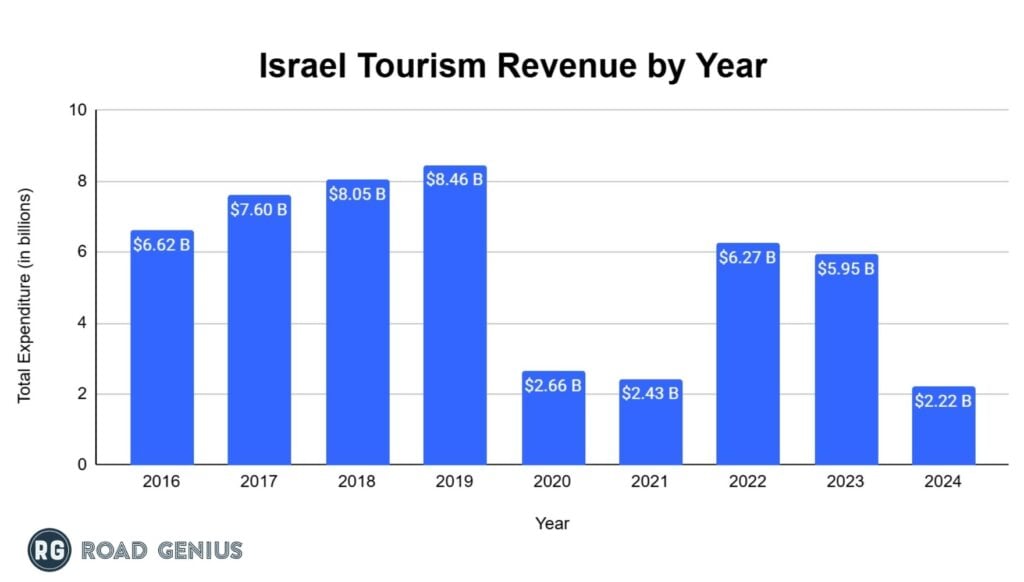
2024 saw a major decrease in tourist numbers in Israel totalling to $2.22 billion, due to security concerns and global travel advisories, directly reducing spending from foreign visitors.2
- Inbound tourist expenditure in Israel generated $8.46 billion in 2019.
- This number decreased to $2.6 billion in 2020 due to coronavirus travel restrictions and fewer international visitors. This dropped by 8% in 2021 to $2.4 billion.
- Israel recovered in international tourism revenue in 2022 with $6.27 billion. However, international tourism revenue decreased to $5.95 billion in 2023 due to economic issues (a 5% decrease).
- The most significant drop occurred in 2024, when tourism revenue fell to $2.22 billion. This represents a 62.7% decrease compared to 2023, reflecting a decline in visitor numbers, reduced airline activity, and the broader impact of ongoing regional conflict.
How Much Did People Spend in Israel in 2024?
In 2024, international tourists spent an estimated $2.22 billion in Israel. This marked one of the lowest tourism expenditure levels in over a decade, reflecting the significant decline in visitor arrivals due to regional conflicts.
- Compared to 2023, when inbound tourism revenue reached $5.95 billion, spending in 2024 fell by 62.7%.
How much does it cost to visit Israel?
The average cost to visit Israel comes out to about $2,312 per traveler for the entire trip.
- That amount typically covers everything a visitor needs like accommodation, food, local transportation, attractions, guided tours, and personal spending. Most travelers reported that the biggest expenses were hotel stays and transportation, followed by dining and entry fees to popular sites.
Note: This average was determined by dividing the total tourism revenue for 2024 by the number of visitors.
Which country visits Israel the most?
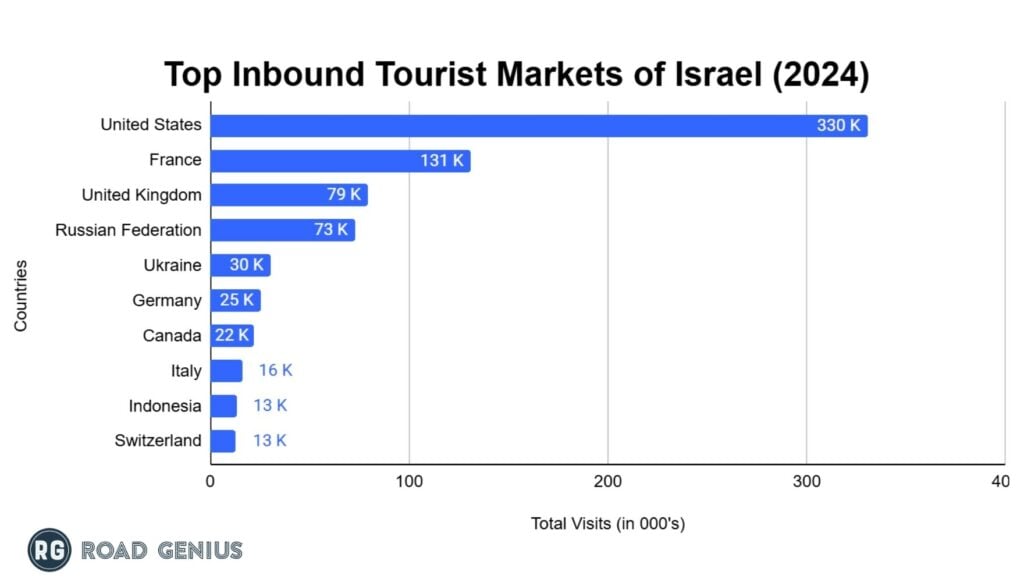
In 2024, the United States remained the largest source of foreign visitors to Israel, followed by France, the United Kingdom, the Russian Federation, and Ukraine.
- Despite the overall decline in tourism due to regional instability, these countries continued to contribute the highest number of international arrivals.
- The United States was the leading source of international visitors to Israel in 2024, contributing 853,300 arrivals and accounting for 28% of all top-market tourists.
- France ranked as the second-largest tourism market, sending 216,700 visitors and holding an 11% share of the top-10 inbound markets.
- The United Kingdom accounted for 185,500 visits, giving it a 9% market share.
How long do visitors stay in Israel?
Recent data shows that international visitors typically stay around 8 to 10 nights in Israel, depending on their trip purpose and itinerary.
- Before the war, the average length of stay was reported at about 8.3 nights in 2023, down from roughly 10.9 nights in 2022.
- Full, official figures for the entire year 2024 have not yet been released, but industry reports estimated that while the number of tourists fell, those who did visit still tended to spend about a week to a week and a half in the country, especially pilgrims and long-haul travelers.
Israel Travel Resources
Economic Impact – Israel Tourism Statistics
Israel’s tourism sector experienced a significant downturn in 2024
- International tourists spent $2.22 billion in Israel in 2024. This represents a 62.7% decrease compared to the $5.95 billion generated in 2023.
- Despite this decline, spending patterns indicate that visitors who did arrive in 2024 still contributed significantly to hospitality, transportation, and local tourism services.
- Despite this decline, spending patterns indicate that visitors who did arrive in 2024 still contributed significantly to hospitality, transportation, and local tourism services.
- Approximately 200,000 people are working in Israel’s tourism-related industries by 2024 and increase to 250 in the mid 2025.
- This includes jobs in hotels, restaurants, tour operations, attractions, transportation, and travel services.
What were the peak tourist months in Israel in 2024?
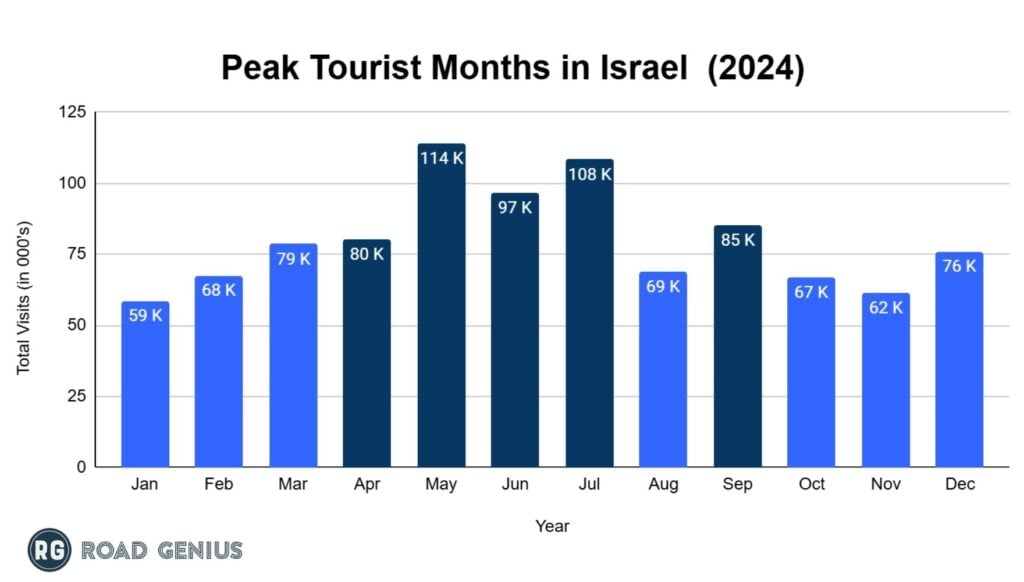
Tourism patterns in 2024 were very different from previous years due to regional instability and reduced international travel. However, seasonal trends still played a noticeable role in when visitors chose to travel.
- May was the most visited month of 2024, attracting 114,000 tourists thanks to warm spring weather, early European school breaks, outdoor festivals, and increased pilgrimage travel during the late-spring season.
- July welcomed 108,000 visitors, boosted by global summer holidays, family travel, and peak beach tourism across Tel Aviv, Eilat, and the Mediterranean coasts.
- June drew 97,000 tourists, supported by major cultural events such as Tel Aviv Pride, summer festivals, and pleasant early-summer conditions before peak heat.
- September saw 85,000 arrivals, driven by Rosh Hashanah, early autumn trips, and religious pilgrimage travelers taking advantage of cooler temperatures.
- April attracted 80,000 visitors due to mild spring weather, Passover, Christian pilgrimage periods, and the blooming season, making it a popular month for cultural and religious travel.
Shifts in Israel’s Peak Tourist Months Due to the Pandemic and Gaza Conflict
- In the pre-pandemic years of 2018 and 2019, tourism was stable, with the peak months being March, May, and November.
- 2022 experienced a significant drop in visitor numbers due to travel restrictions and safety concerns stemming from the pandemic.
- Due to the ongoing conflict between Israel and Gaza in 2023, international tourism declined even further.

How popular is Israel as a tourist destination?
In 2025, Israel continued to receive accolades including Waldorf Astoria Jerusalem again won “Israel’s Leading Hotel 2025.3
- Also in 2024, local tourism companies secured awards: Bein Harim Tourism Services was awarded “Israel’s Leading Tour Operator 2024”.
- In 2023, Israel was ranked 8th in the world for medical tourism by the Medical Tourism Index, which highlighted the large number of tourists visiting the Dead Sea and medical tourists seeking fertility treatments.
- Israel also scored 74 out of 100 due to zero rainy days in the summer season, and was rated the best summer vacation destination in
Israel Travel Statistics – International & Domestic Tourism
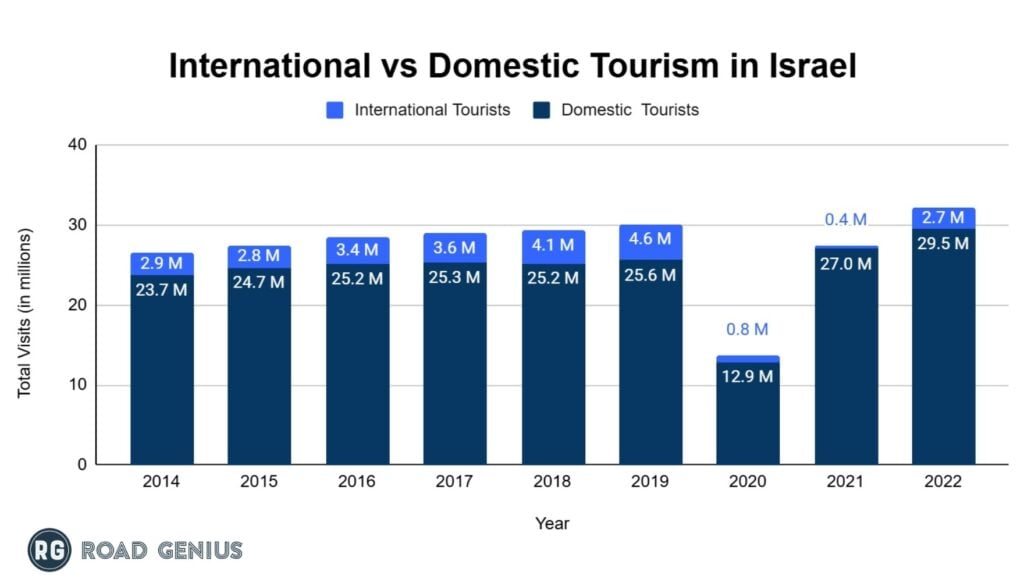
- In 2022, 29.5 million domestic visitors travelled to Israel, making up 92% of the total tourists while international tourists amounted to 2.67 million.
2024 domestic tourism has not been publicly available.
Most Visited and Most Popular Cities in Israel
While detailed city-by-city visitor numbers for 2024 have not yet been released, multiple tourism sources consistently identify the following cities as Israel’s most visited and most popular destinations:
- Jerusalem
- Jerusalem is widely regarded as Israel’s most visited city, attracting millions of tourists in a typical year. Visitors come to experience iconic religious and historical sites such as the Old City, the Western Wall, the Church of the Holy Sepulchre, the Mount of Olives, and ancient archaeological landmarks.
- Tel Aviv
- As Israel’s second most visited city, Tel Aviv is celebrated for its Mediterranean beaches, Bauhaus “White City” architecture (a UNESCO World Heritage Site), energetic nightlife, and its proximity to the historic port city of Jaffa.
- Haifa
- Haifa is a major port city and a significant Bahá’í pilgrimage destination, known for the stunning Bahá’í Gardens, panoramic views from Mount Carmel, and a relaxed coastal atmosphere.
- Akko (Acre)
- Akko is a UNESCO-listed World Heritage port city, recognized for its ancient Crusader fortifications, Old City walls, vibrant markets, and its deep spiritual importance within the Bahá’í Faith.
- Safed (Tzfat)
- Safed, one of Judaism’s Four Holy Cities, is famous for its Kabbalah heritage, ancient synagogues, and its artistic hillside Old City surrounded by the forests and mountains of the Upper Galilee.
- Other Popular Tourist Hubs
- Additional highly visited destinations in Israel include Eilat, Tiberias, Nazareth, Beersheba, and Ashkelon, which are known for their resorts, desert landscapes, pilgrimage sites, and historical attractions.
Africa Travel Statistics Resources
Asia Travel Statistics Resources
- China Statistics
- Dubai Statistics
- Hong Kong Statistics
- India Statistics
- Indonesia Statistics (incl. Bali)
- Japan Statistics (incl. Hokkaido, Okinawa, Osaka, Tokyo)
- Malaysia Statistics
- Saudi Arabia Statistics
- Singapore Statistics
- South Korea Statistics
- Sri Lanka Statistics
- Thailand Statistics (incl. Bangkok)
- Turkey Statistics
