
Page last update: 24 March 2026
Hyundai is a South Korean multinational automotive manufacturer known for producing innovative, reliable, and affordable vehicles globally.
How many cars does Hyundai sell globally each year?
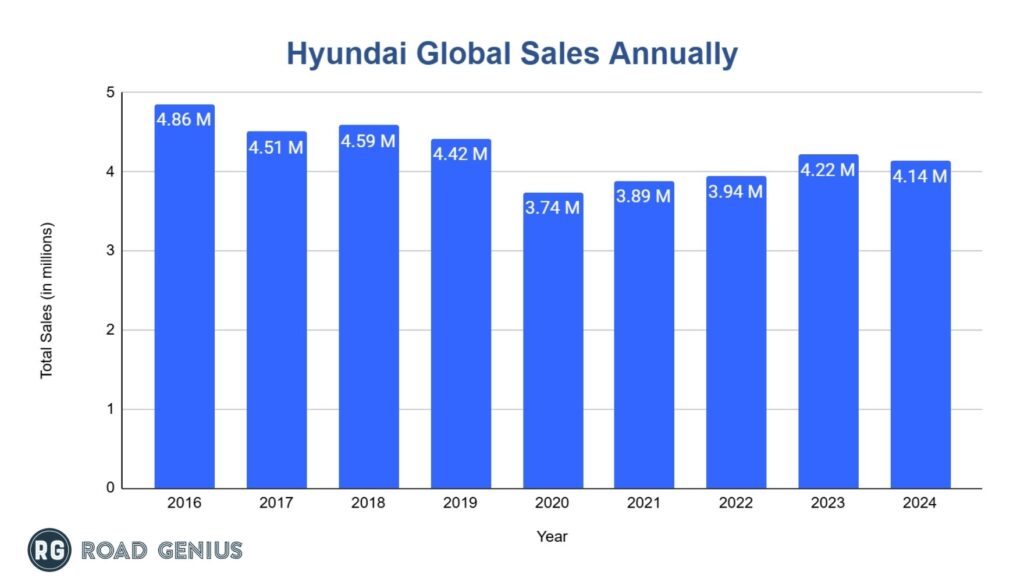
Hyundai sold 4.14 million cars in 2024.
- In 2019, Hyundai sold 4.42 million units of cars globally. However, with the onset of the pandemic in 2020, sales dropped to 3.74 million.
- By 2021, the figure slightly improved to 3.89 million and continued to recover in 2022, with 3.94 million cars sold.
- In 2024, Hyundai’s global sales reached 4.14 million units, a 1.9% decrease from 2023 (4.22 million) and 6.3% below 2019 levels.
How many cars did Hyundai sell in 2025?
- 1.70 million units of cars were sold from January to May of 2025.
- Note these are preliminary figures from Hyundai Sales Report and may be subject to revision as more data becomes available.
| Hyundai Car Sales January – May 2025 | |
| Month (2025) | Global Sales (Units) |
| January | 310,399 |
| February | 322,339 |
| March | 365,812 |
| April | 353,338 |
| May | 351,174 |
| YTD Total (Jan–May) | 1,703,062 |
When did Hyundai have the best sales?
- Hyundai recorded its best sales year in 2014, reaching a total of 4.96 million units sold, marking the highest annual sales figure in the last decade.
Hyundai Annual Statistics: Total Cars Sold
In 2024, Hyundai sold a total of 4.14 million cars globally, with domestic sales accounting for 17% of the total vehicle sales (705,010), and international sales making up 83% of the total (3,436,781 units).
- International Sales
- International sales experienced consistent growth, increasing from 2.96 million in 2020 to 3.45 million in 2023.
- This consistent year-on-year increase resulted in a peak of 3.45 million international sales in 2023.
- International sales experienced consistent growth, increasing from 2.96 million in 2020 to 3.45 million in 2023.
- Domestic Sales:
- Domestic sales reached their highest point in 2020 with 787,854 cars and declined to 688,884 cars in 2022, followed by a recovery to 762,077 sales in 2023.
- The domestic market demonstrated stability, with sales remaining in the range of 688,884 to 787,854 cars over the past five years (2020-2024).
- Domestic sales reached their highest point in 2020 with 787,854 cars and declined to 688,884 cars in 2022, followed by a recovery to 762,077 sales in 2023.
| Domestic and International Sales Breakdown | |||
| Year | International Sales | Domestic Sales | Total Global Sales |
| 2016 | 4,201,407 | 656,526 | 4,857,933 |
| 2017 | 3,818,895 | 687,380 | 4,506,275 |
| 2018 | 3,865,697 | 721,078 | 4,586,775 |
| 2019 | 3,680,802 | 741,842 | 4,422,644 |
| 2020 | 2,955,660 | 787,854 | 3,743,514 |
| 2021 | 3,164,143 | 726,838 | 3,890,981 |
| 2022 | 3,255,695 | 688,884 | 3,944,579 |
| 2023 | 3,454,821 | 762,077 | 4,216,898 |
| 2024 | 3,436,781 | 705,010 | 4,141,791 |
Which countries have the highest Hyundai car sales?
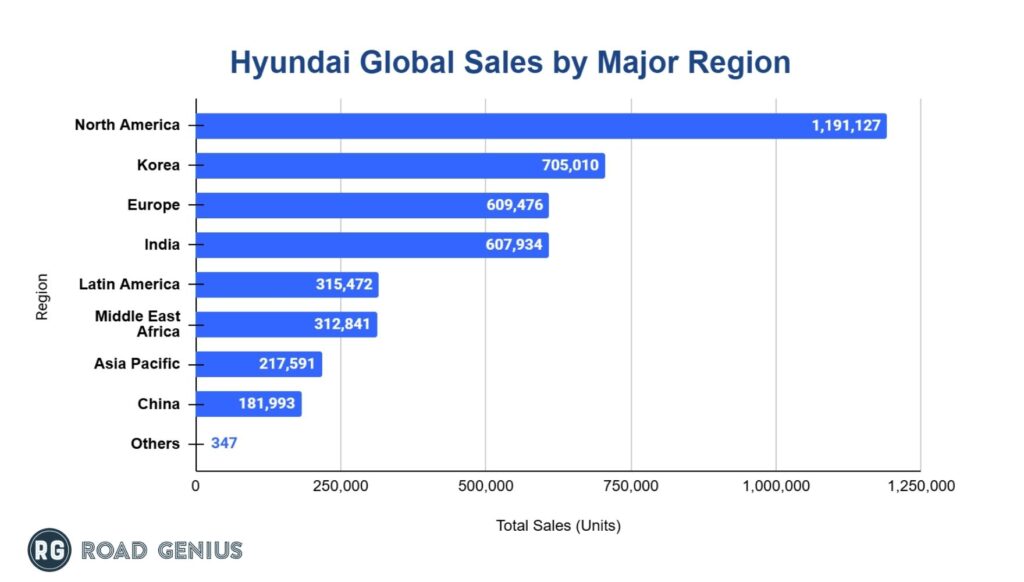
- North America has the highest number of Hyundai sales, with 1,191,127 units sold in 2024.
- Korea follows with 705,010 sold, and Europe with 609,476 units sold.
How much revenue does Hyundai make from car sales globally?
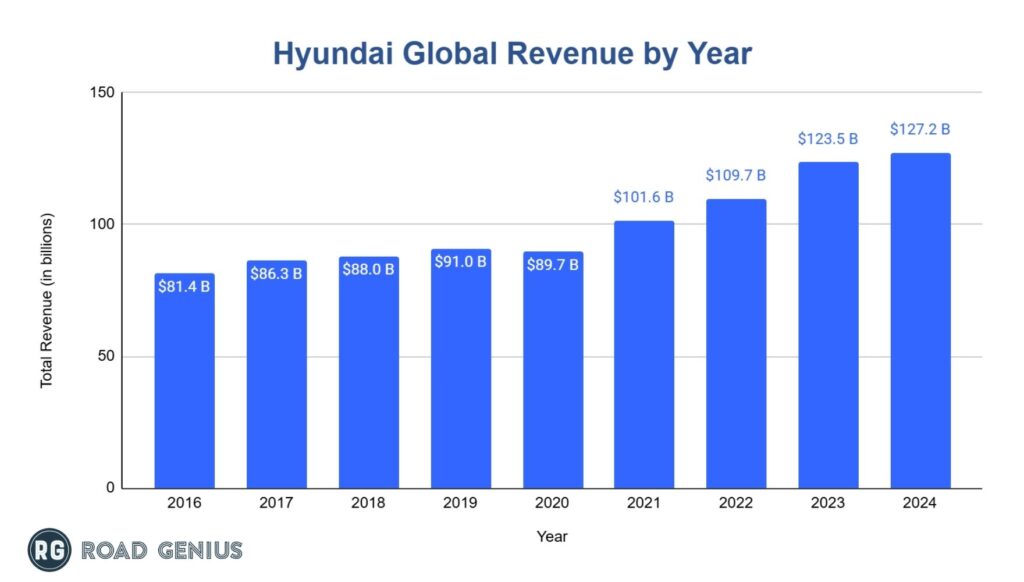
Hyundai Motor Corporation generated a revenue of $127.2 billion in 2024, a 3.0% increase from 2023 and 39.8% above 2019 levels.
- Hyundai generated $91.0 billion in revenue in 2019. However, when the pandemic hit in 2020, this decreased by less than 1.5% to $89.7 billion.
- Revenue increased in 2021 and 2022, with $101.6 billion and $109.7 billion generated in revenue, respectively.
- In 2023, Hyundai’s revenue increased to $123.5 billion, exceeding the 2019 figure by 35.7%.
What is Hyundai’s market share in the automotive industry?
- Hyundai’s market share in the automotive industry is approximately 5.55%, making it the sixth-highest global seller.
- This market share is determined by dividing Hyundai’s global sales of 4.14 million vehicles by total global car sales of 74.6 million units.
What models does Hyundai offer?
Hyundai offers a diverse range of vehicle models that cater to various market segments, including sedans, SUVs, commercial vehicles, and electric vehicles. Here’s an overview of the current models available:
- Sedans
- Hyundai Elantra
- Hyundai Sonata
- Hyundai Ioniq 6
- SUVs and Crossovers
- Hyundai Tucson
- Hyundai Santa Fe
- Hyundai Palisade
- Hyundai Venue
- Hyundai Bayon
- Commercial Vehicles
- Hyundai H-100
- Hyundai Staria
- Electric Vehicles
- Hyundai Ioniq 5
- Hyundai Ioniq 7
- Other Models
- Hyundai Creta
- Hyundai Nexo (FCEV)
What were Hyundai’s best selling models?
The Hyundai Tucson was the best-selling Hyundai model in 2024, selling approximately 634,297 cars globally, making it Hyundai’s top-selling model overall.
The Hyundai Elantra / Avante sold around 368,402 cars, placing it second in Hyundai model sales globally.
| Hyundai’s Best Selling Models 2024 | |
| Brand | Sales (Estimated Global Units) |
| Tucson | 634,297 |
| Elantra / Avante | 368,402 |
| Creta / Alcazar | 348,740 |
| Kona / Kauai | 285,233 |
| Santa Fe | 279,886 |
| i10 / Xcent / Aura | 279,687 |
| Venue | 192,027 |
| i20 | 169,013 |
| Sonata | 167,634 |
| Palisade | 165,745 |
How many electric cars has Hyundai sold?
In 2024, an estimated 218,687 electric vehicles were sold by Hyundai globally.
- The percentage of EV sales increased steadily each year, starting at 1.45% in 2019 and growing to 5.30% in 2022.
- EVs became a larger part of their sales in 2024, growing by 3.83 percentage points over the five years since 2019, despite a 0.72 point dip from the 6.00% share in 2023.
| Hyundai EV Sales Year on Year | |||
| Year | Total Sales (units) | Percentage of EV Sales | EV Sold |
| 2019 | 4,425,528 | 1.45% | 64,170 |
| 2020 | 3,744,737 | 2.62% | 98,112 |
| 2021 | 3,890,726 | 3.63% | 141,233 |
| 2022 | 3,944,579 | 5.30% | 209,063 |
| 2023 | 4,216,898 | 6.00% | 253,014 |
| 2024 | 4,141,791 | 5.28% | 218,687 |
Note: Hyundai reported only the percentage of EV sales. Total EV sold are estimated by multiplying the total sales by the reported percentage
Who owns Hyundai?
- Hyundai is owned by the Hyundai Motor Company, which operates as part of the larger Hyundai Motor Group. This conglomerate not only includes Hyundai but also owns Kia and Genesis, making it a significant player in the global automotive industry.
Where are Hyundai cars made?
Hyundai vehicles are produced at 12 manufacturing facilities in 10 countries, including:
- Ulsan Plant (Ulsan, South Korea)
- Asan Plant (Asan, South Korea)
- Gwangju Global Motors (Gwangju, South Korea)
- Hyundai Motor Manufacturing Alabama (HMMA) (Montgomery, United States)
- Hyundai Motor Brasil (HMB) (Piracicaba, Brazil)
- Hyundai Motor Manufacturing Czech (HMMC) (Nošovice, Czech Republic)
- Hyundai Motor Türkiye (Hyundai Assan Otomotiv, HMTR) (İzmit, Turkey)
- Hyundai Motor India (HMIL) (Irungattukottai & Sriperumbudur, India)
- Hyundai Motor Manufacturing Indonesia (HMMI) (Cikarang, Indonesia)
- Hyundai Motor Group Innovation Center in Singapore (HMGICS) (Jurong, Singapore)
- Beijing Hyundai Motor Company (BHMC) (Shunyi District, Beijing, China)
- Hyundai Thanh Cong Manufacturing Vietnam (HTMV) (Ninh Bình, Vietnam)
Global Statistics Resources
Car Sales:
Car Sales by Brands
Car Sales by Models
EV Sales:
- Global EV Sales by Automaker
- Global EV Sales by Country (incl. AU, CA, CH, DE, JP, NO, UK)
- Global EV Sales by Type
- EV Statistics by Automaker (incl. BYD, Tesla)
Tourism:
Reference
HIR: Hyundai Sales Report
