
Page last update: 25 March 2026
The U.S. car rental industry plays a key role in transportation, driven by tourism, business travel, and changing mobility needs.
What Is the Size of the Car Rental Market in the US?
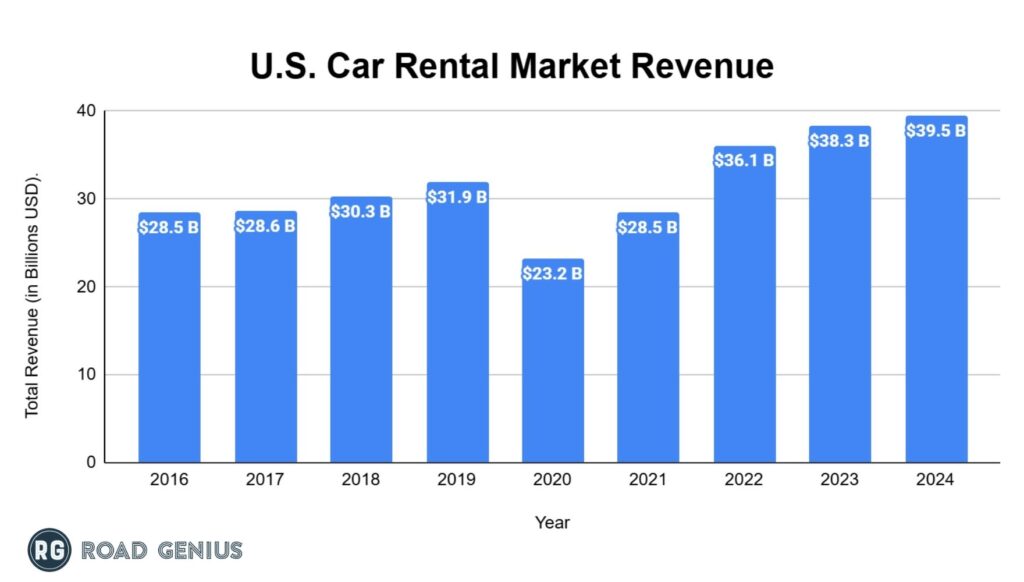
The U.S. car rental market was valued at $39.5 billion in 2024 and is projected to grow at a 4.8% CAGR from 2025 to 2034.
How much is the Market Revenue of Car Rental in the US each year?
Over $39.5 billion in market revenue was generated by the car rental market in the US in 2024.
- In 2019, the market revenue totaled $31.9 billion. However, due to the pandemic, this revenue dropped by 27% to $23.2 billion in 2020.
- The market increased in 2021, reaching $28.5 billion, and continued to recover in 2022, totaling $36.1 billion, followed by $38.3 billion in 2023.
- With a 3.1% projected increase in 2024, the market remained 24% higher than pre-pandemic levels.
How Many Car Rental Companies Are There in the US?
As of January 2025, the US car rental industry includes 2,480 businesses.
- However, the industry experienced a slight decline with a CAGR of -0.1% from 2020 to 2024, according to IBISWorld.
Car Rental Market Trends and Growth in the US
How Many Cars are Sold in Car Rental Fleets in the US?
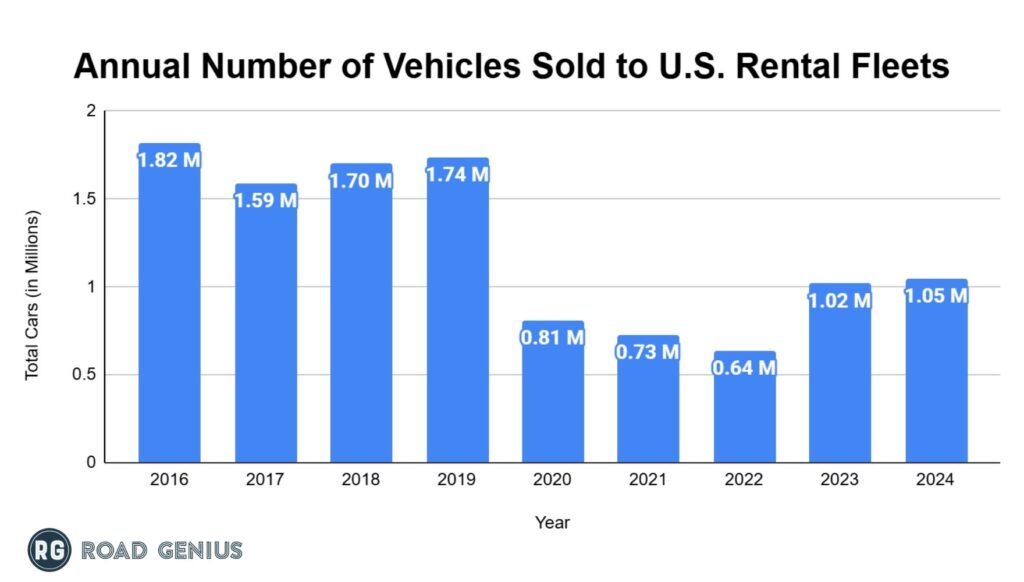
The number of vehicles sold to fleets in the US reached 1.05 million in 2024.
- In 2019, fleet vehicle sales totaled 1.74 million. However, due to the pandemic, fleet sales dropped by 53.4% to 810,000 in 2020.
- Sales further declined in 2021, reaching 730,000, and continued to decrease in 2022, hitting a low of 640,000.
- In 2023, the market began to recover, with fleet vehicle sales increasing to 1.02 million, followed by 1.05 million in 2024, reflecting a 2.9% year-over-year increase.
- Despite the 39.7% drop compared to pre-pandemic levels in 2019, the 2024 fleet sales marked a steady recovery.
How Many Cars are in Service in the US?
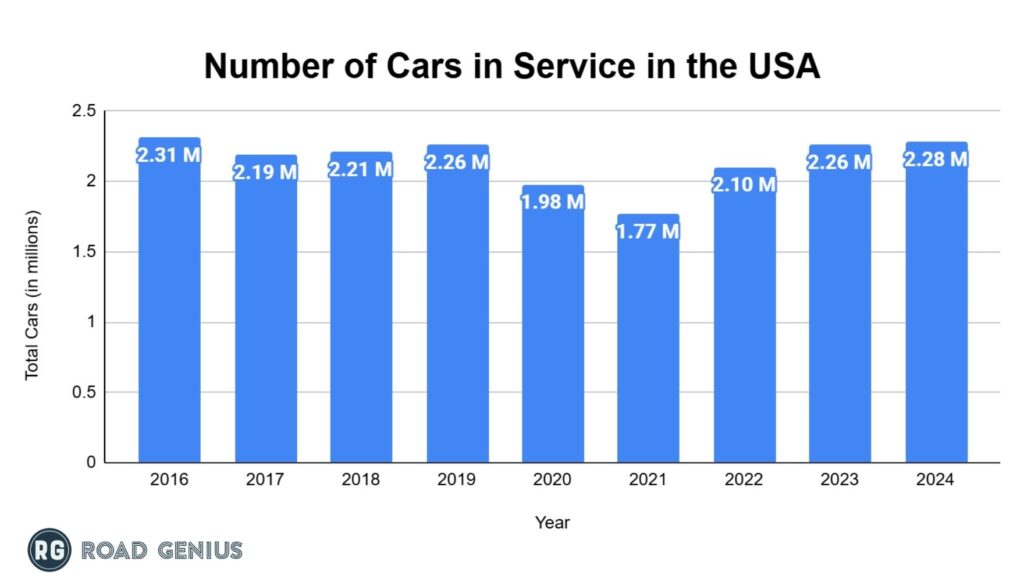
The number of cars in service in the US reached 2.28 million in 2024.
- In 2019, the total number of cars in service stood at 2.26 million. However, due to the pandemic, this figure dropped by 12.4% to 1.98 million in 2020.
- The decline continued in 2021, reaching 1.77 million. The market increased in 2022, reaching 2.10 million.
- By 2023, the number of cars in service had fully recovered to 2.26 million, followed by a slight increase to 2.28 million in 2024, reflecting a 0.9% year-over-year growth.
- By 2024, the number of cars in service is 1% higher than pre-pandemic levels, totaling 2.28 million.
What Are the Latest Car Rental Market Trends in the US?
The electric car rental market, a new trend in the US, is projected to reach $10.90 billion by 2025, with a 14.5% CAGR through 2030, driven by increasing consumer demand for eco-friendly transportation and the expansion of EV rental fleets.
- Rental car aggregator services are reshaping the industry by improving price transparency and simplifying the booking process, increasing competition among traditional rental companies.
- The rise of alternative car rental options is also notable, with peer-to-peer rentals (e.g. Turo) and subscription-based services gaining traction. Additionally, ride-sharing services like Uber and Lyft continue to challenge traditional rentals, particularly in urban areas, prompting companies to adjust pricing and enhance customer service.
What Are the Most Common Reasons for Renting a Car?
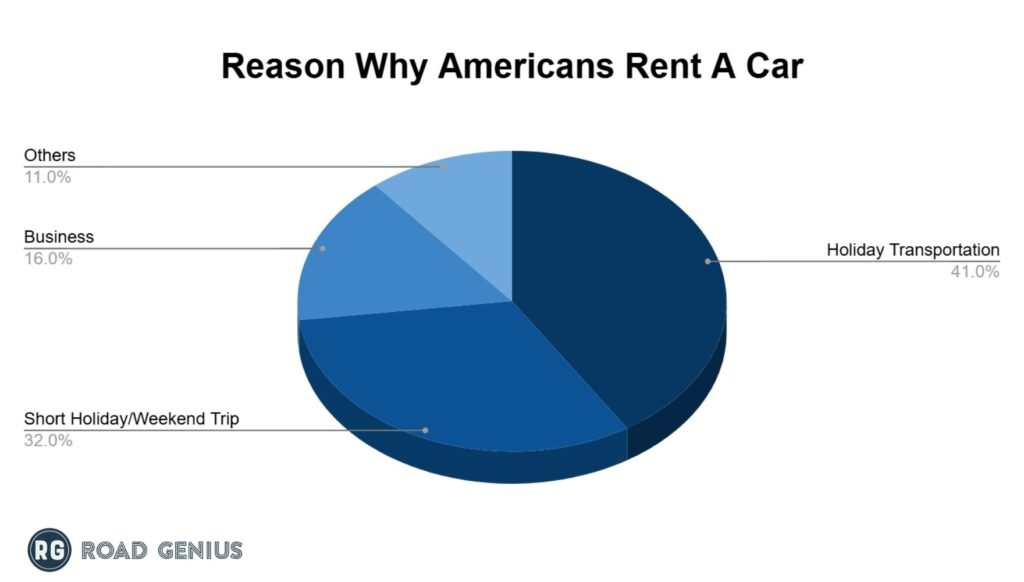
The majority of car rentals in the US are driven by leisure travel, with holiday transportation including road trips accounting for 41% of total rentals in 2023. Short holiday and weekend trips follow closely, making up 32% of rentals.
- Business travel contributes to 16% of rentals and the remaining 11% fall under other reasons.
Car Rental Pricing and Vehicle Categories in the US
What Are the Different Car Rental Size Charts Available?
Luxury cars, such as Luxury sedans ($120–$200/day, 4-5 passengers) and SUVs ($90–$120/day, 5-7 passengers), offer premium comfort and advanced features, making them ideal for high-end travel.
- On the budget-friendly end, Mini cars ($30–$50/day, 2-4 passengers) and Economy cars ($40–$60/day, 4 passengers) provide affordable rental options for solo travelers or small groups seeking cost-effective transportation.
| Car Size Chart and Average Price per Day | |||
| Car Size | Passengers | Luggage Capacity | Average Price per Day |
| Mini | 2-4 | 1-2 small bags | $30 – $50 |
| Economy | 4 | 1 big bag, 1 small bag | $40 – $60 |
| Compact | 4-5 | 2 big bags, 1 small bag | $50 – $70 |
| Intermediate | 5 | 2 big bags, 2 small bags | $60 – $80 |
| Standard | 5 | 2 big bags, 2 small bags | $70 – $90 |
| Full-Size | 5 | 3 big bags | $80 – $100 |
| SUVs | 5-7 | 3 big bags | $90 – $120 |
| Luxury | 4-5 | 2 big bags | $120 – $200 |
| Minivan | 7-9 | 4-5 big bags | $100 – $150 |
Note: The vehicle categories and average daily rates in this table were compiled for reference purposes and may differ from official classifications.
How Do Car Rental Prices Compare Across the US?
The most affordable weekly car rentals are in Miami, where the average price is $377.07, and Las Vegas, with an average of $422.94, making these cities budget-friendly options for travelers.
- On the higher end, Chicago has the most expensive weekly rental rate at $624.71, followed by Denver at $577.65, reflecting higher demand and market conditions.
| Average Weekly Price by States | |
| City | Average Weekly Rental Price |
| Miami | $377.07 |
| Las Vegas | $422.94 |
| Orlando | $449.00 |
| Atlanta | $455.00 |
| Charlotte | $473.28 |
| Houston | $475.55 |
| Los Angeles | $493.24 |
| Phoenix | $520.51 |
| Dallas-Fort Worth | $541.34 |
| San Francisco | $544.10 |
| New York (JFK) | $564.99 |
| Denver | $577.65 |
| Chicago | $624.71 |
Who Are the Biggest Car Rental Companies in the US?
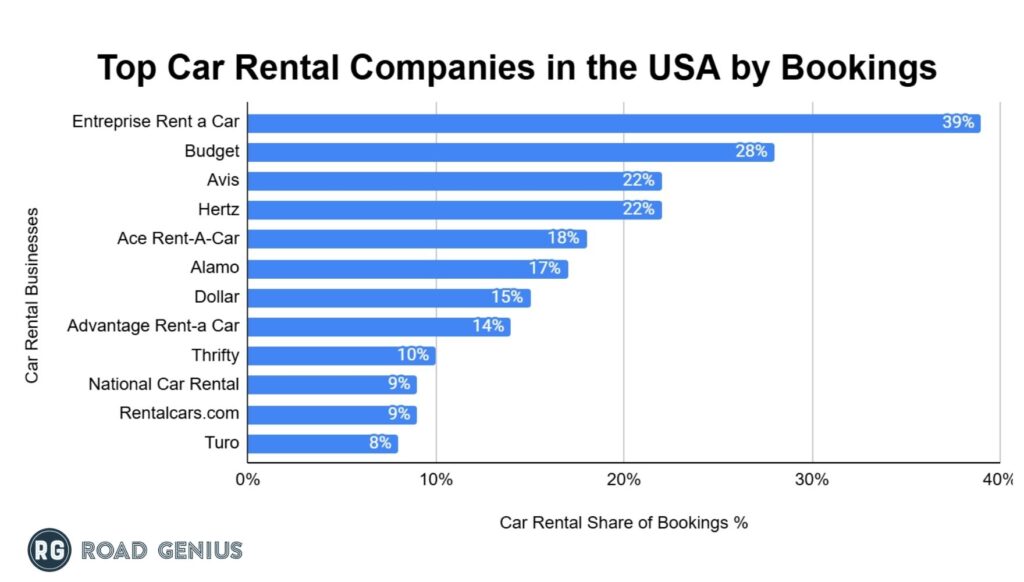
- Enterprise Rent-A-Car leads the U.S. car rental market by bookings, with 39% share.
- Budget ranks second with 28% of bookings, making it one of the strongest rental brands in the market.
- Avis and Hertz are tied next, each holding 22% of bookings.
- Ace Rent-A-Car also has a notable presence with 18%, followed by Alamo at 17%.
- Dollar accounts for 15% of bookings, while Advantage Rent-a-Car holds 14%.
Note: These percentages reflect the share of consumers who have booked with each brand. Because many travelers rent from multiple companies over time, the total exceeds 100%
What Are the Best Car Rental Companies in the US?
The top car rental company in the U.S. is Enterprise Rent-A-Car with a J.D. Power satisfaction score of 866. It has been praised for its exceptional customer service and wide vehicle selection.
- National Car Rental follows closely with a score of 865, earning high marks for pricing transparency, vehicle quality, and a loyalty program that allows customers to skip lines.
- Alamo Rent A Car is a budget-friendly option with a score of 862, known for well-maintained vehicles and strong value for money.
- Hertz, one of the oldest rental companies, scores 845 and stands out for its diverse vehicle selection and convenient pickup process, though customer service reviews are mixed.
US Travel Resources
Car Rental FAQs & Insights in the US
Does Avis Track Their Rental Cars?
Avis does indeed track their rental cars, primarily for fleet management purposes. According to their policies, Avis uses tracking devices to monitor the vehicle’s location, speed, and condition.
- Avis employs GPS-based and telematics systems to gather information about their vehicles. These systems can provide real-time location data and monitor various vehicle parameters.
Do Rental Cars Have Cameras in Them?
Some rental cars may have exterior or driver-assist cameras, but their presence and functionality can vary significantly among rental companies and specific vehicles.
- Vehicles with Interior Cameras are rarely used in rental cars due to privacy concerns. When present, they may be used for monitoring passenger behavior, ensuring vehicle safety, or assessing damage upon return.
- Vehicles with Exterior Cameras are equipped with dashcams or parking cameras that enhance safety and security.
How Long Do Rental Car Companies Keep Their Cars?
Rental car companies typically keep their vehicles for about 18 months to 2 years before selling them off or sending them to auction.
- Mileage Considerations: Most rental cars are retired from the fleet when they reach approximately 50,000 to 80,000 miles.
- Maintenance Issues: Rental companies aim to avoid significant maintenance issues that arise as vehicles age. Keeping cars for about 18 months helps minimize these risks.
What are the most common fuel types used in rental vehicles in the US?
In the US, gasoline is still the most common fuel type in rental vehicles. Hertz’s U.S. support page says that most rental vehicles in the United States use regular unleaded gasoline.
After that, the next most common options are hybrids and then electric vehicles (EVs). Major rental brands including Enterprise, Alamo, Avis, and Hertz all offer dedicated hybrid categories, which shows hybrids are now a fairly common part of rental fleets.
What Is the Future Outlook for the Car Rental Industry in the US?
The U.S. car rental industry is expected to grow steadily in 2025. Market size is estimated to reach $40.6 billion, with 1.16 million new vehicles projected to be sold to rental fleets. Total cars in service are also expected to rise to 2.45 million, highlighting continued demand in the car rental market.
Global Statistics Resources
Car Ownership
Car Sales:
Car Sales by Brands
Car Sales by Models
EV Sales:
- Global EV Sales by Automaker
- Global EV Sales by Country (incl. AU, CA, CH, DE, JP, NO, UK)
- Global EV Sales by Type
- EV Statistics by Automaker (incl. BYD, Tesla)
Tourism:
Reference
ARNFB: US Car Rental Vehicles in Service/Revenue/CarSale Sold to Fleets
NMU: Car Rental Share of Booking by Brand 2023
BYG: Reason for Renting a car in US
NWA: Average Weekly Price by States
