

 Popular Countries
 24/7 Support
Published 9 Sept 2026
How many people visit the Colosseum each year?
The Colosseum Archaeological Park has attracted over 12 million visitors in recent years.
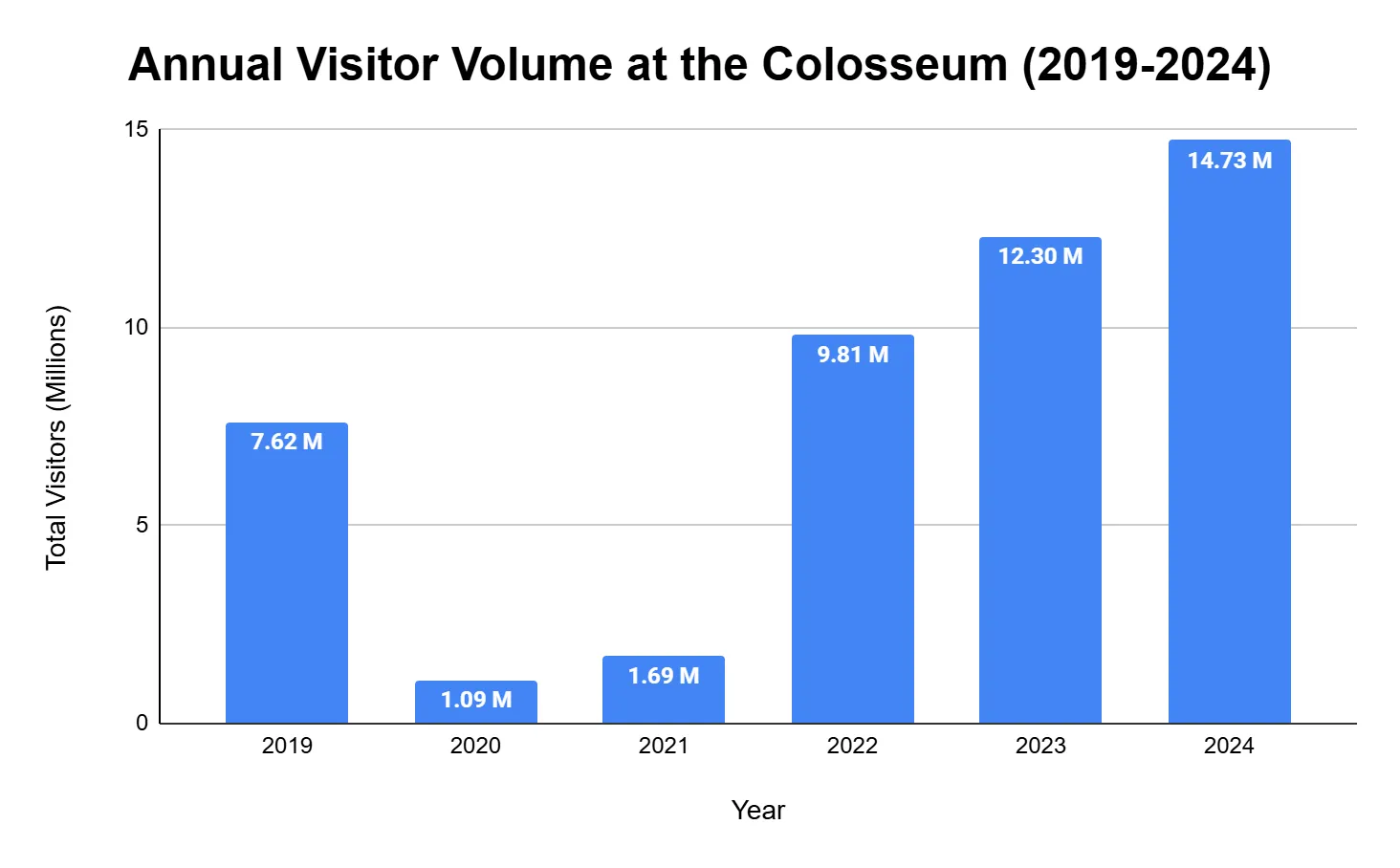
- The Colosseum Archaeological Park welcomed 7.62 million visitors in 2019 before the pandemic.
- Visitor numbers plummeted to just 1.09 million in 2020 during pandemic-related closures and travel restrictions, representing an 85.7% decline.
- Tourism began recovering with 1.69 million visitors in 2021, a 55% increase from the previous year but still well below pre-pandemic levels.
- Visitation surged to 9.81 million in 2022, exceeding the pre-pandemic figure of 2019 by 28.7% and showing an increase of more than five times from 2021.
- Visitation further increased by 25.4% to 12.30 million in 2023.
- The Colosseum reached a record-breaking 14.73 million visitors in 2024, a 19.8% increase from 2023.
How many people visited the Colosseum in 2024?
- The Colosseum Archaeological Park received approximately 14.73 million visitors in 2024, marking a strong post-pandemic recovery with a 19.8% increase from 2023's figures.
How many people visited the Colosseum in 2023?
- The Colosseum Archaeological Park recorded 12.30 million visitors in 2023, representing a 25.4% increase from 2022's attendance.
How many people visit the Colosseum per day?
Over 40,000 visitors entered the Colosseum Archaeological Park daily on average in 2024, compared to about 20,000 daily visitors in 2019.
- Before the pandemic, the daily average was approximately 20,000 visitors in 2019.
- At the height of pandemic restrictions in 2021, daily averages fell to just 520 international visitors per day.
How much ticket revenue does the Colosseum generate each year?
The Colosseum Archaeological Park is one of Italy’s highest-grossing state cultural attractions.
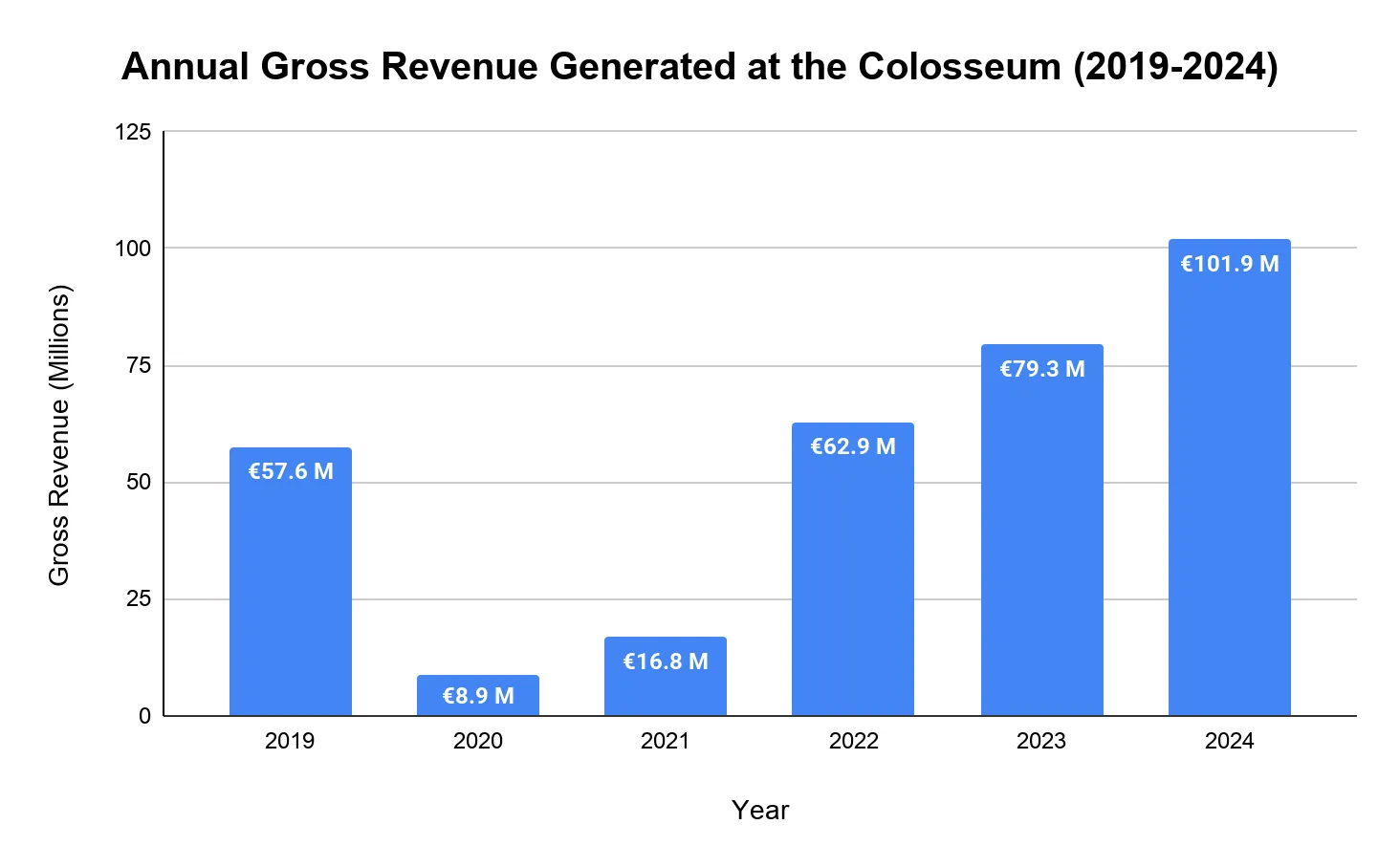
- In 2024, it generated €101.9 million in gross ticket receipts, up 28.4% from €79.3 million in 2023.
- Before the pandemic, gross ticket receipts were €57.6 million in 2019.
- They fell sharply to €8.8 million in 2020, then began recovering with €16.8 million in 2021 and €62.9 million in 2022.
How much did visitors spend at the Colosseum in 2024?
- The Colosseum Archaeological Park generated €101.9 million in gross ticket receipts in 2024, up 28.4% from the previous year.
How much did visitors spend at the Colosseum in 2023?
- Visitors generated over €79.3 million in gross ticket receipts for the Colosseum Archaeological Park in 2023
How much does it cost to visit the Colosseum?
- The official 24h Colosseum, Roman Forum and Palatine full-entry ticket costs €18 for adults.
- A €2 reduced fare applies to eligible EU citizens aged 18 up to the day of their 25th birthday.
- Official guided or educational visit prices vary by product; current examples include lower-priced educational visits as well as special guided experiences such as evening or underground tours.
Which countries visit the Colosseum the most?
Official Colosseum visitor statistics do not publish a country-of-origin breakdown, so the country mix is best estimated using Rome tourism arrivals as proxy data. Based on 2024 arrivals in Rome hotels/RTA, the largest international source markets were:
- United States: 2,069,804 arrivals
- United Kingdom: 663,336 arrivals
- Germany: 639,051 arrivals
- Spain: 511,264 arrivals
- France: 498,020 arrivals
When is the best or most popular time to visit the Colosseum?
The peak visitation period for the Colosseum is during the summer months, with June through August seeing the highest visitor numbers, while January and February experience the lowest crowds.
- December typically shows increased visitation due to holiday travel, particularly between Christmas and New Year.
- April (Easter period) also experiences very high visitation, serving as the start of the high season.
- January consistently ranks as the least busy month.
- The shoulder seasons of March, May, September, October, and November offer a balance between good weather and somewhat manageable crowds.
How popular is the Colosseum as a tourist destination?
- The Colosseum ranked #2 among global attractions in TripAdvisor's 2023 "Best of the Best" awards, second only to Barcelona's Sagrada Familia1.
- It earned its place among the "New Seven Wonders of the World" in 2007, joining iconic sites like the Great Wall of China and Taj Mahal2.
- The Colosseum is included within UNESCO’s Historic Centre of Rome World Heritage property, which was inscribed in 1980 and extended in 19903.
Why do people visit the Colosseum?
Visitors are primarily drawn to the Colosseum for its historical significance, architectural marvel, and iconic status as a must-see landmark.
- The desire to experience the historical and cultural significance of ancient Rome is cited as a primary motivation, with visitors wanting to stand where gladiators fought and emperors watched.
- Many tourists view the Colosseum as an iconic bucket-list destination that is considered mandatory when visiting Rome.
- The architectural and engineering achievement of the 2,000-year-old structure attracts those interested in ancient building techniques and design.
- Popular culture representations in films like "Gladiator," documentaries, and other media create familiarity and curiosity about the site.
- Educational purposes drive visits from students, academics, and those seeking to better understand Roman civilization and history.
Related Travel Statistics
- Florence Tourism Statistics
- Italy Tourism Statistics
- Leaning Tower of Pisa Tourism Statistics
- Milan Tourism Statistics
- Rome Tourism Statistics
- St. Peter’s Basilica Tourism Statistics
- Pantheon Tourism Statistics
- Venice Tourism Statistics
What are the main attractions in the Colosseum Archaeological Park?
The Colosseum Archaeological Park encompasses several connected ancient sites beyond just the amphitheater itself, all accessible with a standard ticket.
- The Colosseum itself (Flavian Amphitheater) forms the centerpiece, featuring its distinctive arched tiers, reconstructed arena floor and exposed underground chambers (hypogeum).
- The Roman Forum preserves the ruins of ancient Rome's civic center, including temples, basilicas and ceremonial arches along the Via Sacra.
- Palatine Hill houses the ruins of imperial palaces, the Palatine Museum, and offers panoramic views of the surrounding archaeological areas.
- The Domus Aurea (Nero's Golden House), though requiring separate special guided tours, is technically part of the archaeological park.
- The Arch of Constantine, while freely accessible outside the ticketed area, is considered part of the overall Colosseum visit experience.
Additional Colosseum Tourism Statistics
- There were 7.06 million paid visitors and 7.67 million free visitors in 2024.
- The Colosseum maintains around a 4.5/5 star rating from hundreds of thousands of reviews on TripAdvisor, despite challenges like crowds and queues.
- A new online booking system (the Italian Museums app/website) was implemented in 2023 to streamline ticket purchases and manage the growing visitor numbers.
References
- Tripadvisor Best of the Best Travel Experiences 2023 · tripadvisor.mediaroom.com ↑
- New7Wonders of the World announcement (Lisbon, 7 July 2007) · world.new7wonders.com ↑
- Historic Centre of Rome — UNESCO World Heritage List (No. 91) · whc.unesco.org ↑
- Italian Ministry of Culture — Colosseum visitor figures (2022–2023) · lamilano.it
- Colosseum ticket prices — Parco archeologico del Colosseo · colosseo.it
- Visitor arrivals in Rome hotels — Comune di Roma, Annuario del Turismo 2024 · comune.roma.it

