

 Popular Countries
 24/7 Support
Updated
The Canadian car rental market is part of the broader automotive equipment rental and leasing industry, which includes the rental and leasing of passenger cars, vans, trucks, trailers, buses, and recreational vehicles without drivers. The industry has recovered from the pandemic period, but recent growth has slowed as operating costs, vehicle prices, tourism demand, and fleet conditions continue to shape the market.
Car Rental Industry Statistics in Canada
What is the automotive equipment rental and leasing market size in Canada?
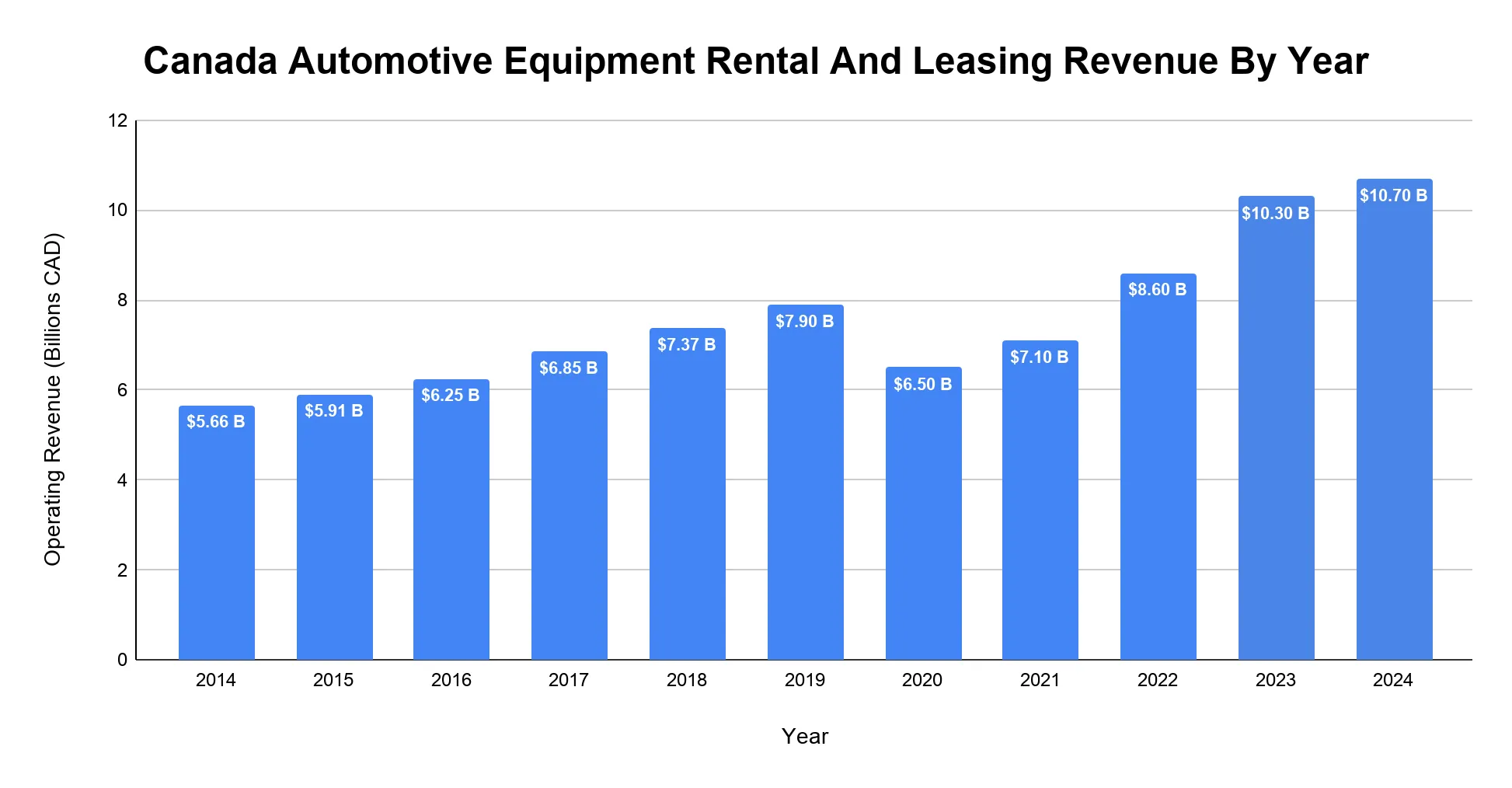
- The automotive equipment rental and leasing industry in Canada generated CAD $10.7 billion in operating revenue in 2024, up 4.3% from 2023.
What Is the annual automotive equipment rental and leasing revenue in Canada?
Canada’s automotive equipment rental and leasing industry generated CAD $10.7 billion in operating revenue in 2024.
- Operating revenue was CAD $5.66 billion in 2014 and rose to CAD $7.9 billion by 2019.
- Revenue fell to CAD $6.5 billion in 2020 as the pandemic reduced travel demand and disrupted rental activity.
- The industry recovered to about CAD $8.6 billion in 2022, exceeding the pre-pandemic level.
- Revenue reached about CAD $10.3 billion in 2023 and increased again to CAD $10.7 billion in 2024.
- The 2024 increase was slower than earlier recovery-year growth, as operating expenses rose faster than revenue.
How many automotive equipment rental and leasing establishments are there in Canada?
Canada had 5,294 automotive equipment rental and leasing establishments in 2025.
- Of these establishments, 1,881 had employees.
- Another 3,413 were non-employer or indeterminate establishments.
- Ontario had the largest count, with 757 employer establishments and 1,297 non-employer or indeterminate establishments.
- Quebec followed with 301 employer establishments and 660 non-employer or indeterminate establishments.
- British Columbia had 288 employer establishments and 623 non-employer or indeterminate establishments.
| Province / Territory | Employer Establishments | Non-Employer / Indeterminate Establishments |
|---|---|---|
| Ontario | 757 | 1,297 |
| Quebec | 301 | 660 |
| British Columbia | 288 | 623 |
| Alberta | 251 | 556 |
| Canada | 1,881 | 3,413 |
Car Rental Market Trends and Growth in Canada
How is rental vehicle demand changing in Canada?
Tourism-related demand for vehicle rentals in Canada increased by 3.7% in the first three quarters of 2025 compared with the same period in 2024.
- The increase was driven by domestic demand, which rose by 6.0% over the same period.
- Foreign demand for vehicle rentals fell by 2.9% in the first three quarters of 2025.
- International air arrivals with an overnight stay fell by 1.7% in 2025 compared with the previous year.
- Lower overnight air arrivals at major airports such as Toronto Pearson and Montréal-Trudeau may limit rental revenue growth.
What does official fleet data show about rental vehicles in British Columbia?
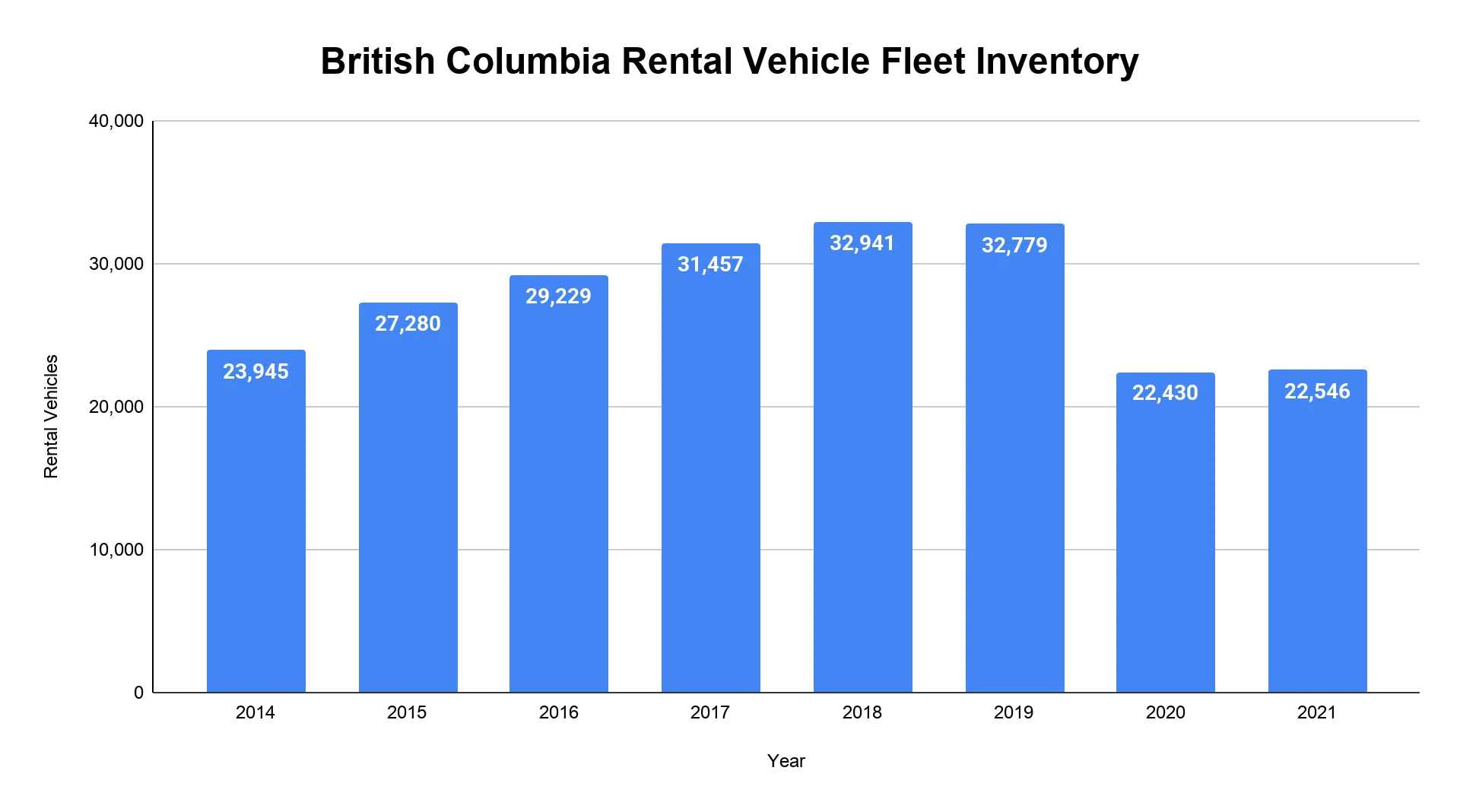
British Columbia’s rental vehicle fleet averaged 32,779 vehicles in 2019 before falling to 22,430 in 2020.
- The province’s rental vehicle fleet more than doubled from 15,758 vehicles in 2010 to 32,779 vehicles in 2019.
- The fleet fell by about 31.5% in 2020 as travel and business demand declined.
- Fleet inventory remained below its pre-pandemic level in 2021, averaging 22,546 vehicles.
- Statistics Canada noted that British Columbia was the first regional case study and that other regional estimates would be presented as data became available.
What are the latest car rental market trends in Canada?
Several trends shaped Canada’s automotive equipment rental and leasing industry in 2024 and early 2025.
- Operating revenue reached CAD $10.7 billion in 2024, but growth slowed to 4.3% from the previous year.
- Passenger vehicle rental prices fell by 11.5% in 2024, although they remained 29.8% higher than in 2019.
- E-commerce sales accounted for 39.9% of total industry sales in 2024, up from 38.9% in 2023.
- Business clients accounted for 57.3% of sales in 2024, while individuals and households accounted for 39.0%.
- Tourism-related demand for vehicle rentals rose by 3.7% in the first three quarters of 2025, supported by stronger domestic demand.
Vehicle Types and Rental Categories in Canada
What vehicle categories are available for car rentals in Canada?
Canadian rental companies offer several vehicle categories, including cars, sport utility vehicles (SUVs), vans, and trucks. Vehicle availability, seating, and luggage capacity vary by company, location, model, and booking date.
- Enterprise lists rental cars in Canada for 2–5 people and 2–4 bags.
- Its SUV category covers 4–8 people and 2–7 bags.
- Vans can cover up to 12 people and 7 bags, depending on the model and location.
How have car rental prices changed in Canada?
Passenger vehicle rental prices in Canada fell by 11.5% in 2024 after the elevated pricing period of 2022 and 2023.
- Despite the 2024 decline, passenger vehicle rental prices remained 29.8% higher than in 2019.
- Statistics Canada linked earlier elevated rental prices to supply chain shortages and limited new-vehicle availability.
- The decline in used vehicle prices in 2024 also affected fleet economics and operating costs.
Leading Car Rental Companies in Canada
Canada’s car rental market includes several major international rental groups and brands.
- Avis Budget Group operates brands including Avis, Budget, and Zipcar.
- Enterprise Mobility owns Enterprise Rent-A-Car, National Car Rental, and Alamo Rent A Car, and its Canadian subsidiary acquired Discount Car and Truck Rentals in 2020.
- Hertz Global Holdings operates rental brands including Hertz, Dollar, Thrifty, and Firefly.
Consumer Behavior and Rental Preferences
What are the most common reasons for renting a car in Canada?
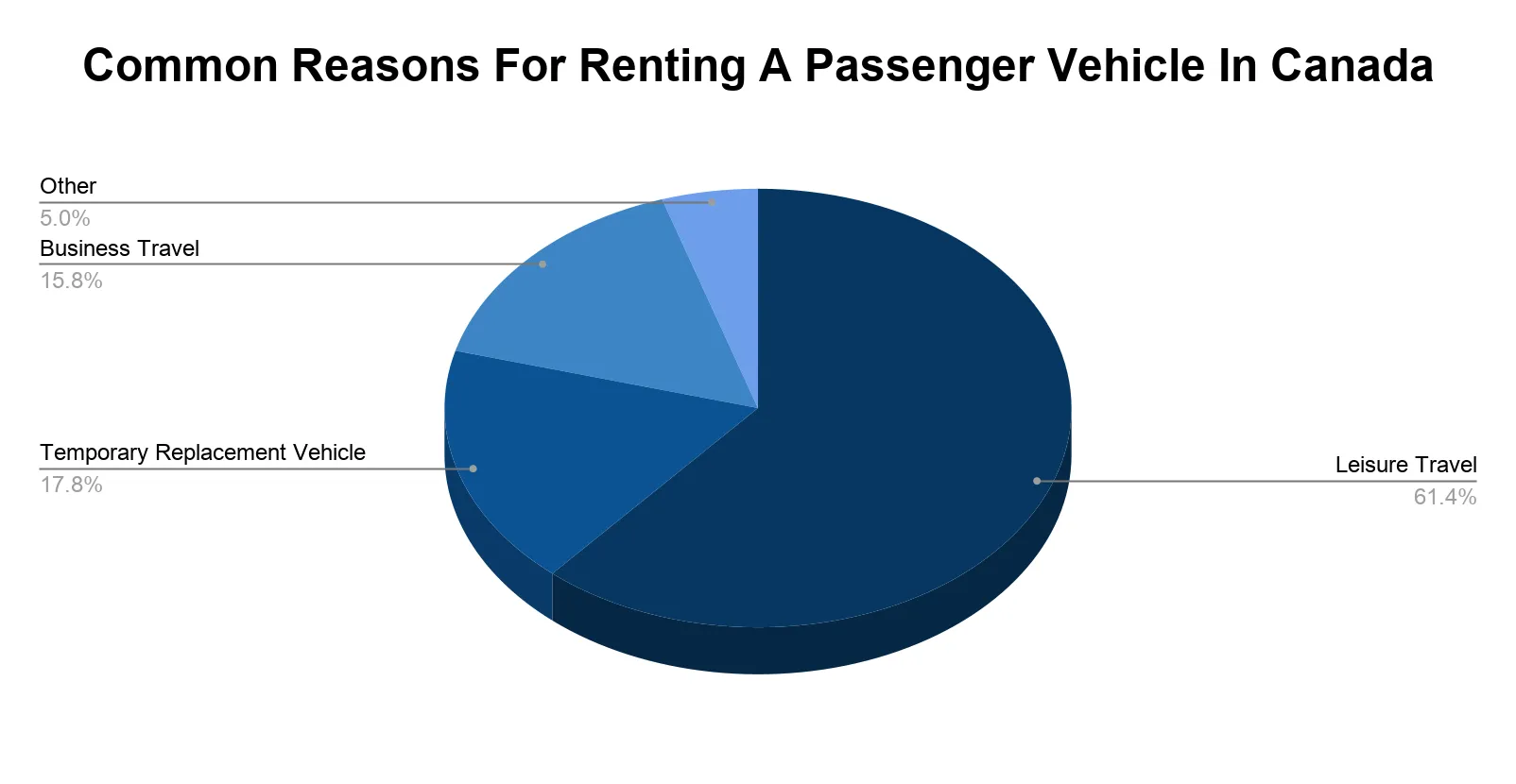
A Canadian survey found that 62% of passenger-vehicle renters rented for leisure purposes.
- Business trips accounted for 16% of surveyed renters.
- Temporary replacement vehicles accounted for 18% of surveyed renters.
- Other purposes accounted for 5% of surveyed renters.
- Leisure renters were associated with longer trips, including out-of-town vacations or road trips.
Related Statistics
- Electric Car Rental Statistics in China
- Electric Car Rental Statistics: United States
- Car Rental Statistics in France
- Car Rental Statistics in Germany
- Car Rental Statistics in Ireland
- Car Rental Statistics in Norway
- Electric Car Rental Statistics: New Zealand
- Car Rental Statistics in Portugal
- Electric Car Rental Statistics: UK
- Car Rental Statistics in the US
Which Canadian cities are most searched for car hire?
Toronto was the most searched Canadian car-hire city on KAYAK’s United Kingdom site, accounting for 34% of Canada car-hire searches.
- Toronto accounted for 34% of KAYAK searches by users looking to hire a car in Canada.
- Calgary followed with 21% of searches.
- Vancouver accounted for 20% of searches.
- These figures show search interest on KAYAK, not actual rental transactions or market share.
- Search shares can vary by KAYAK market page and crawl date.
What does British Columbia data show about rental vehicle turnover?
Statistics Canada’s British Columbia case study found that rental businesses in the province generally did not keep rental vehicles for more than a year on average in the decade before and during the pandemic period.
- The British Columbia rental vehicle fleet had clear seasonal patterns, with companies typically adding vehicles in the second quarter to meet peak demand.
- In later quarters, rental businesses usually reduced inventory, especially in the fourth and first quarters.
- Fleet turnover decisions were linked to factors such as kilometres driven, model type, and vehicle age.
- During the pandemic, fleet inventories fell sharply and remained below pre-pandemic levels in 2021.
- Statistics Canada also noted that supply constraints may have pushed rental companies to turn inventory over less quickly than before.
What do British Columbia fleet patterns show about seasonal rental demand?
Official British Columbia rental fleet data show that rental companies typically add vehicles in the second quarter to prepare for higher seasonal demand.
- British Columbia’s rental fleet showed similar seasonal patterns from year to year before the pandemic.
- Rental businesses typically added vehicles in the second quarter to meet peak demand.
- Companies usually reduced fleet inventories in the fourth and first quarters.
- The pattern points to stronger spring and summer fleet demand, while late-year and early-year months generally had lower rental fleet levels in the provincial case study.
What is the future outlook for vehicle rental demand in Canada?
Statistics Canada described 2025 indicators for Canada’s automotive equipment rental and leasing industry as generally soft.
- Tourism-related demand for rental vehicles increased by 3.7% in the first three quarters of 2025 compared with the same period in 2024.
- The increase came from domestic demand, which rose by 6.0%.
- Foreign demand fell by 2.9% over the same period.
- International arrivals to Canada by air with an overnight stay fell by 1.7% in 2025 compared with the previous year.
- Fewer visitors to major airports such as Toronto Pearson and Montréal-Trudeau may limit vehicle rental revenue growth.
References
- Rental and Leasing Revenue, Prices, Demand Outlook, and Fleet Data (2014–2025) · statcan.gc.ca
- Automotive Equipment Rental and Leasing Establishment Data (2025) · ised-isde.canada.ca
- Enterprise Rental Vehicle Categories and Capacity Guide (2026) · enterprise.ca
- Avis Budget Group Rental Brand Portfolio (2026) · avisbudgetgroup.com
- Enterprise Mobility Canadian Brand Acquisition Details (2020) · enterprisemobility.com
- Hertz Rental Brand Portfolio (2026) · hertz.com
- Passenger Vehicle Rental Purpose Survey (2016) · ctrf.ca
- Car Hire Search Share by Canadian City (2026) · kayak.co.uk

