

 Popular Countries
 24/7 Support
Updated
The United Kingdom’s electric car rental sector is becoming easier for renters to use as electric vehicle (EV) choice improves and public charging expands. Demand is still uneven, but the market is moving in a positive direction for city trips, business travel, and renters who want to try electric driving.
How does the wider car rental sector shape electric rental adoption?
The United Kingdom’s vehicle rental sector operates around 450,000 cars and vans across more than 1,500 branches, giving rental companies a large role in how quickly electric vehicles reach short-term drivers.
- The rental sector operates through more than 1,500 branches, which makes branch charging and fleet availability important for EV rental growth.
- Business customers accounted for 67% of car rental volumes in BVRLA’s September 2024 rental operator survey.
- Business customers accounted for 84% of light commercial vehicle rental volumes in the same survey.
- The British Vehicle Rental and Leasing Association (BVRLA) reported EV utilisation around 10% lower than comparable internal combustion engine (ICE) vehicles.
- BVRLA reported EV holding costs at around double the level of comparable ICE vehicles.
Note: The 67% figure applies to car rental volumes, while the 84% figure applies to light commercial vehicle rental volumes.
How many electric rental vehicles are on the road?
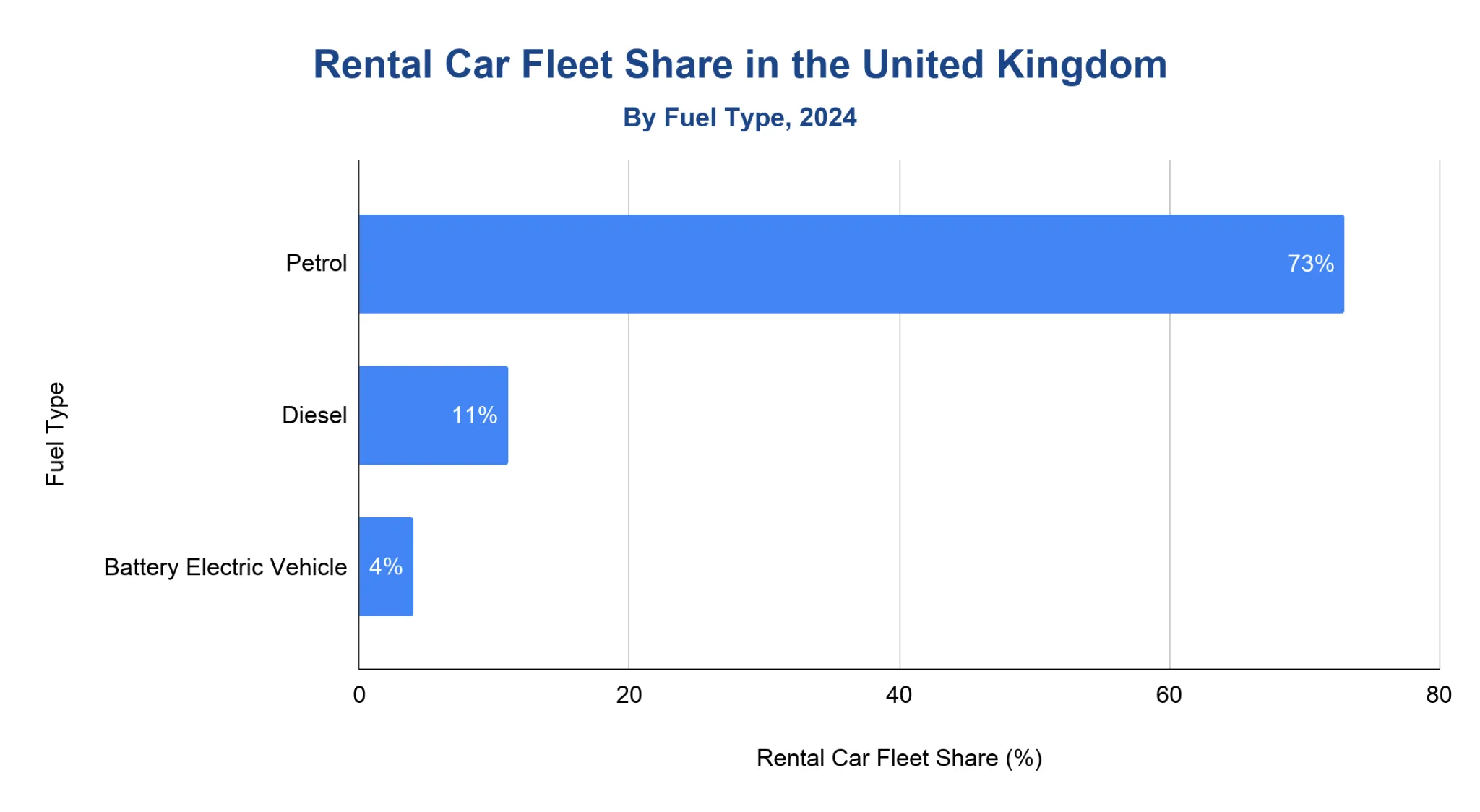
Battery electric vehicles (BEVs) made up 4% of the United Kingdom car rental fleet in the 2024 BVRLA Rental Credentials reporting.
- The electric car rental fleet grew by more than 200% from 2022 to the 2024 BVRLA-reported period.
- Petrol vehicles accounted for 73% of the car rental fleet in 2024, compared with 11% for diesel vehicles.
- Europcar UK reported that battery electric vehicles and plug-in hybrid electric vehicles (PHEVs) made up 12% of its rental fleet by the end of 2023.
- Europcar customers drove more than 3.5 million electric rental miles in 2023.
Who rents electric cars in the United Kingdom?
Business customers accounted for 67% of United Kingdom car rental volumes in BVRLA’s September 2024 rental operator survey, while 48% of rental needs came from day-to-day life activities in BVRLA Societal Impact Research 2024.
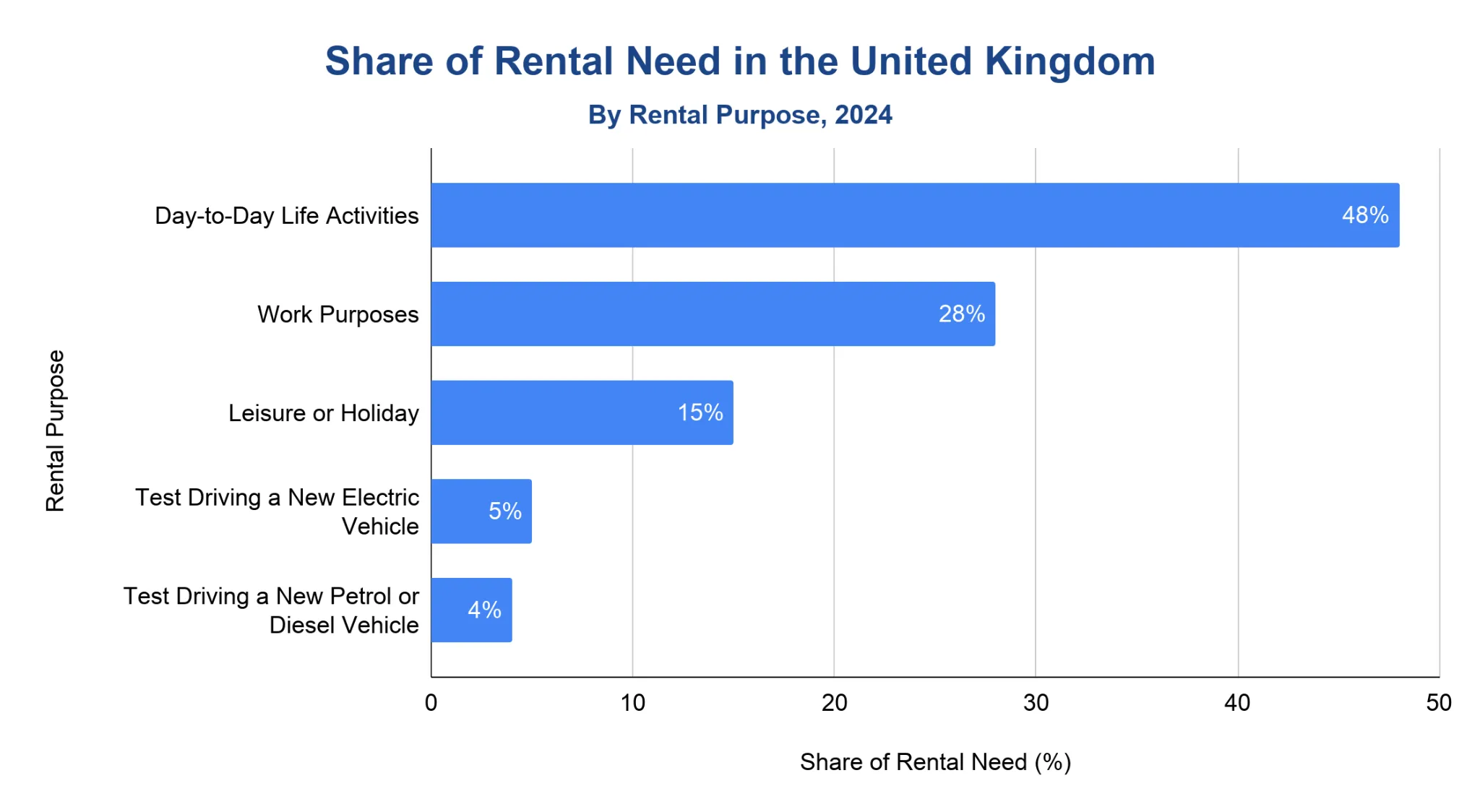
- Day-to-day life activities accounted for 48% of rental needs in 2024, the largest share in BVRLA’s rental-purpose data.
- Work-related rental needs accounted for 28% of rental needs in 2024, compared with 15% for leisure and holiday use.
- Test driving a new EV accounted for 5% of rental needs in 2024, compared with 4% for test driving a new petrol or diesel vehicle.
- Around two-thirds of EV renters reported a positive EV rental experience.
- 22% of EV renters said they would avoid electric vehicles in the future.
Note: The rental-purpose shares describe overall rental demand in 2024, while the EV experience figures describe EV renters.
Cost to Rent and Run an Electric Car in the United Kingdom
Europcar UK introduced EV price parity for business account customers in April 2025, matching electric car and van rental rates to equivalent petrol or diesel vehicles.
- Zapmap’s May 2026 Price Index put standard and standard-plus public charging at 54 pence per kilowatt-hour (p/kWh), equal to about 16 pence per mile.
- Rapid and ultra-rapid public charging cost 79 p/kWh, equal to about 24 pence per mile.
- Pay-as-you-go prices among the top 10 rapid networks ranged from 63 p/kWh to 92 p/kWh in May 2026.
- London’s Congestion Charge increased to £18 from 2 January 2026.
- Electric cars registered for Auto Pay receive a 25% Congestion Charge discount, reducing the charge to £13.50.
Note: Zapmap’s May 2026 charging figures are pay-as-you-go public charging estimates.
Where is the United Kingdom best equipped for electric car rentals?
London had 340.0 public EV chargers per 100,000 residents on 1 April 2026, compared with the United Kingdom average of 171.9.
- Scotland had 228.5 public EV chargers per 100,000 residents on 1 April 2026, and Wales had 179.3.
- Northern Ireland had 59.4 public EV chargers per 100,000 residents on 1 April 2026, the lowest figure in the selected comparison.
- Scotland had 57.2 rapid-or-above chargers per 100,000 residents on 1 April 2026, compared with the United Kingdom average of 39.5.
- London had 27.0 rapid-or-above chargers per 100,000 residents on 1 April 2026.
- In England and Wales, 82.8% of public EV chargers were in urban areas and 17.2% were in rural areas.
| Region or Country | Public Electric Vehicle Chargers Per 100,000 People, 1 April 2026 | Rapid or Above Chargers Per 100,000 People, 1 April 2026 |
|---|---|---|
| United Kingdom | 171.9 | 39.5 |
| London | 340.0 | 27.0 |
| Scotland | 228.5 | 57.2 |
| Wales | 179.3 | 39.6 |
| Northern Ireland | 59.4 | 18.4 |
Source · Rapid or above means chargers rated 50 kilowatts (kW) and above.
Is the United Kingdom ready for electric car road trips?
The United Kingdom had 119,080 public EV chargers on 1 April 2026, including 27,372 rapid-or-above chargers.
- The United Kingdom added 3,028 public EV chargers in the first quarter of 2026, after adding 13,281 in 2025.
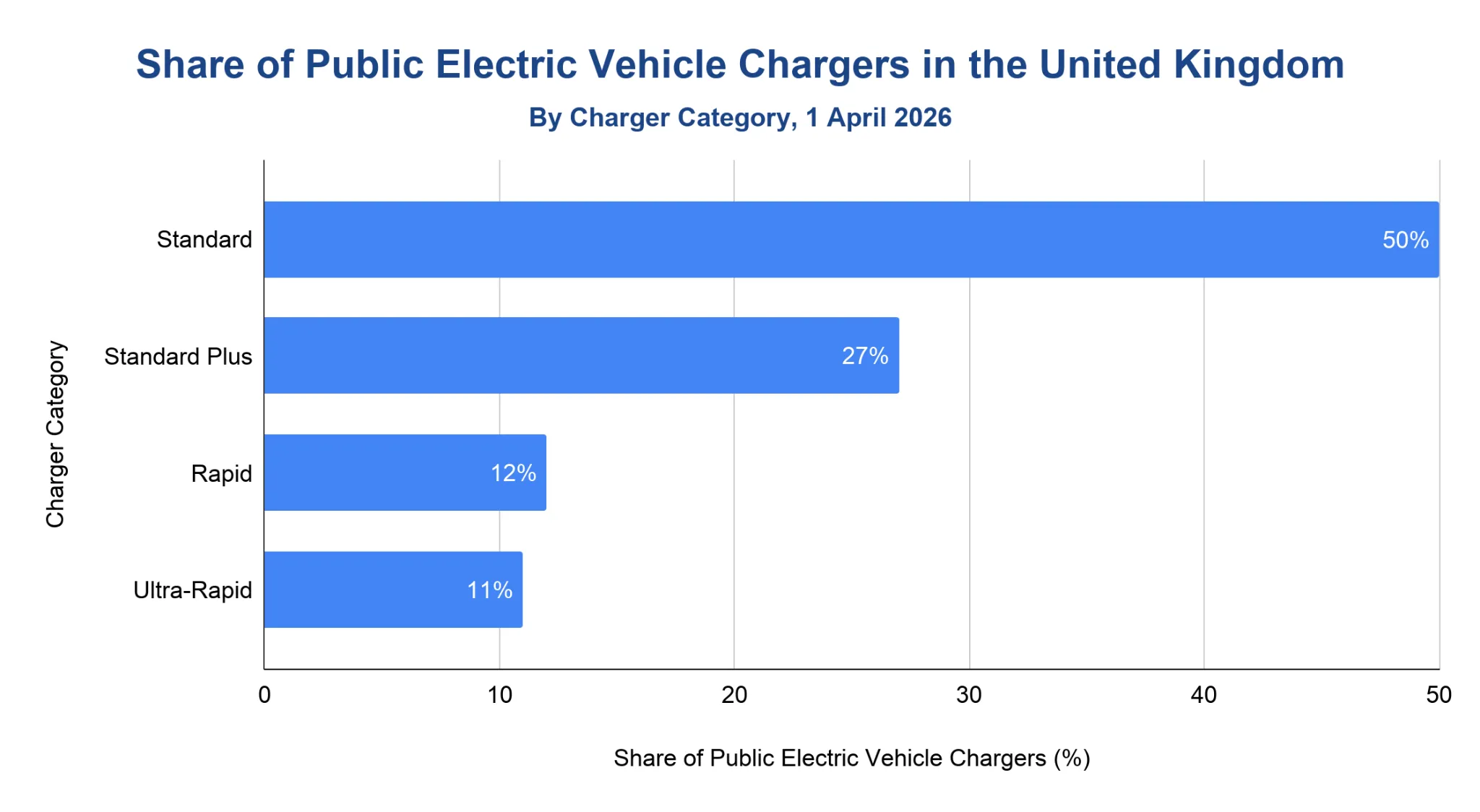
- Standard chargers made up 50% of public EV chargers on 1 April 2026, while standard-plus chargers made up 27%.
- Rapid chargers made up 12% of public EV chargers on 1 April 2026, and ultra-rapid chargers made up 11%.
- Destination chargers accounted for 52% of public EV chargers on 1 April 2026, compared with 32% for on-street chargers, 11% for en-route chargers, and 5% for other location types.
- Charging was available at 97% of motorway service areas.
Note: The Department for Transport classifies rapid chargers as 50 kW to less than 150 kW and ultra-rapid chargers as 150 kW and above.
- Electric Car Rental Statistics in China
- Electric Car Rental Statistics: United States
- Car Rental Statistics in Canada
- Car Rental Statistics in France
- Car Rental Statistics in Germany
- Car Rental Statistics in Ireland
- Car Rental Statistics in Norway
- Electric Car Rental Statistics: New Zealand
- Car Rental Statistics in Portugal
- Car Rental Statistics in the US
Outlook for Electric Car Rentals in the United Kingdom
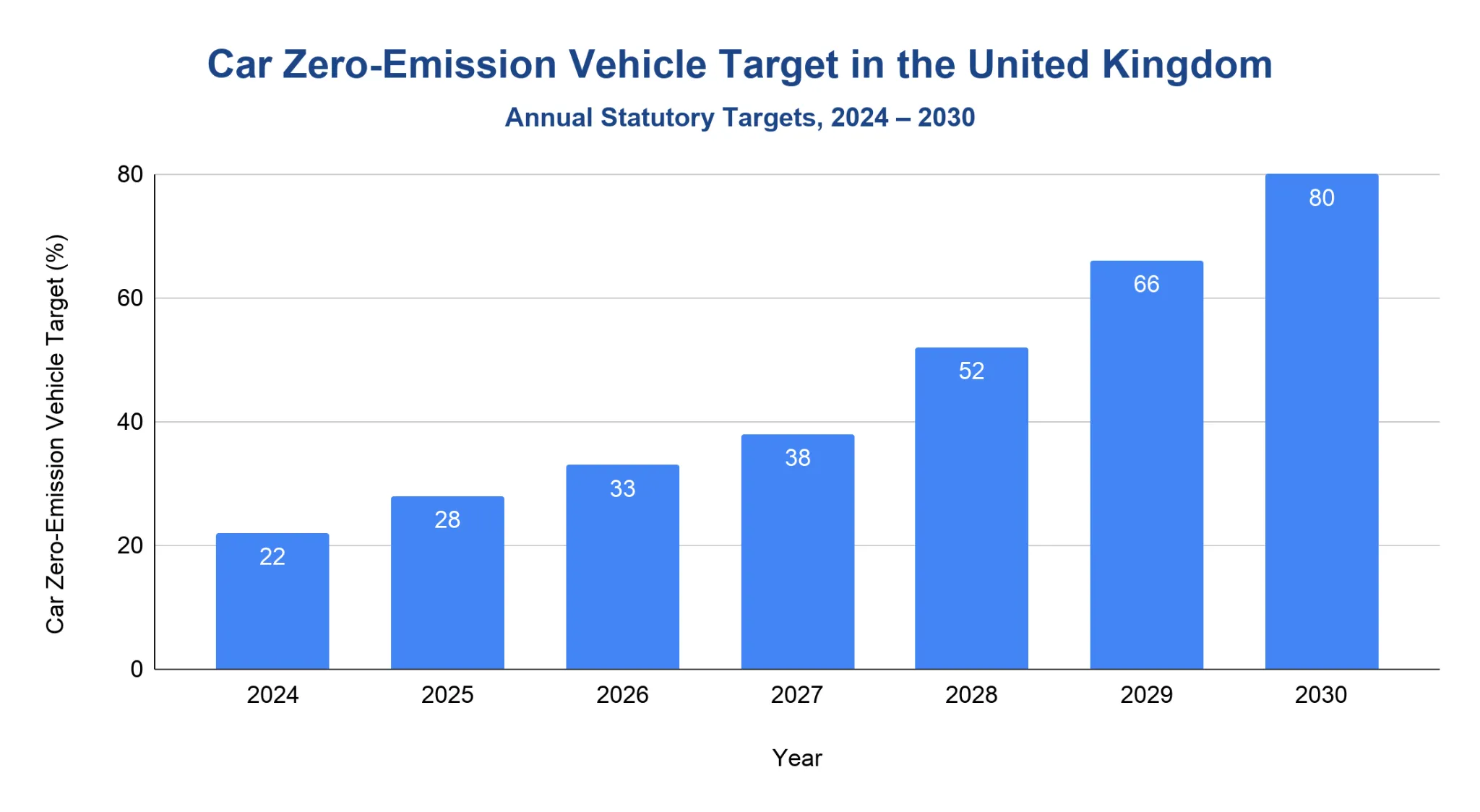
The Zero-Emission Vehicle (ZEV) Mandate requires 33% of manufacturers’ new car registrations to be zero emission in 2026, rising to 80% by 2030.
- The car ZEV target rose from 22% in 2024 to 28% in 2025, then increased to 33% in 2026.
- The target rises to 38% in 2027, 52% in 2028, and 66% in 2029.
- The target reaches 80% in 2030.
- BVRLA reported rental EV utilisation around 10% below comparable ICE vehicles.
- BVRLA reported EV holding costs at around double the level of comparable ICE vehicles.
Note: ZEV Mandate targets apply to manufacturers’ new car registrations, while the 10 percentage-point utilisation gap applies to rental operators’ EV fleet experience.
References
- British Vehicle Rental and Leasing Association (BVRLA) · bvrla.co.uk
- Europcar UK · europcar.co.uk
- Transport for London (TfL) · tfl.gov.uk
- Zapmap · zapmap.com
- GOV.UK · gov.uk

