

 Popular Countries
 24/7 Support
Published
China’s electric car rental market is being shaped by a larger national car-rental sector, rapid new energy vehicle (NEV) adoption, rental-company electrification programs, and a nationwide charging network built for long-distance electric travel.
How large is China’s rental market base for electric cars?
China’s broader passenger car-rental market is the operating base for electric rental cars, and it reached renminbi (RMB) 158.5 billion in 2025, nearly double its RMB 87 billion level in 2020.
- China’s car-rental market growth from RMB 87 billion in 2020 to RMB 158.5 billion in 2025 equaled an increase of about 82.2%.
- Boston Consulting Group (BCG) and eHi estimated that China’s car-rental market would grow at about a 13% compound annual growth rate from 2020 to 2025.
- Short-term rental revenue rose from RMB 16 billion in 2020 to RMB 68 billion in 2025, a 325% increase.
- Long-term rental revenue increased from RMB 71 billion in 2020 to RMB 91 billion in 2025, a 28.2% increase.
- Short-term rental’s share of total rental revenue rose from 18.4% in 2020 to 42.8% in 2025, a gain of 24.4%.
| Year | Long-Term Rental Revenue (RMB Billion) | Short-Term Rental Revenue (RMB Billion) | Total Rental Revenue (RMB Billion) |
|---|---|---|---|
| 2020 | 71 | 16 | 87 |
| 2021 | 75 | 21 | 96 |
| 2022 | 79 | 28 | 107 |
| 2023 | 82 | 38 | 120 |
| 2024 | 87 | 51 | 138 |
| 2025 | 91 | 68 | 159 |
Source · Note: Electric rental cars use the same rental-company networks, booking channels, and fleet-procurement cycles as other passenger rental vehicles. The table uses whole RMB billion values from the BCG and eHi exhibit; the source gives the 2025 total as RMB 158.5 billion.
How fast is China moving toward electric vehicles?
By the end of June 2025, China had 36.89 million new energy vehicles (NEVs) on the road, including nearly 25.54 million battery electric vehicles (BEVs).
- China registered 5.62 million NEVs in the first half of 2025, up 27.86% year on year.
- NEVs accounted for 44.97% of all new automobile registrations in China during the first half of 2025.
- NEVs represented 10.27% of China’s overall automobile fleet by the end of June 2025.
- BEVs accounted for 69.23% of China’s NEV stock at the end of June 2025.
- NEV sales reached 12.87 million units in 2024 and represented 40.9% of all new car sales, up 9.3% from 2023.
Note: In China’s policy terminology, NEVs include BEVs, plug-in hybrid electric vehicles (PHEVs), and fuel-cell vehicles. H1 refers to the first half of the calendar year.
How are rental companies adding electric and clean-energy vehicles in China?
In 2025, CAR Inc. expanded its NEV rental push through a strategic procurement partnership with BYD, while eHi reported clean-energy and hybrid fleet activity across a large national rental network.
- CAR Inc. and BYD signed a strategic cooperation agreement in May 2025 centered on a major vehicle procurement plan for the 2025 summer vacation season.
- CAR Inc. said it would scale up purchases of BYD models, including the Qin PLUS DM-i PHEV and the Fang Cheng Bao Bao 8 sport utility vehicle.
- The first CAR Inc. and BYD vehicle batch was deployed to rental fleets during the 2025 May Day holiday.
- CAR Inc. operated a fleet of 160,000 vehicles, served more than 1.75 million registered users, and covered more than 300 cities at the time of the BYD announcement.
- eHi had more than 130,000 vehicles at the end of March 2025, served more than 500 cities, and stated that clean and hybrid-energy cars were set to make up 11% of its fleet by the end of 2021.
Note: Company fleet figures describe total fleet size. The term “clean and hybrid-energy cars” is broader than BEVs and may include conventional hybrids as well as plug-in models.
Who is driving car-rental demand in China?
China recorded 5.615 billion domestic trips in 2024, creating a large travel base for car-rental and self-drive demand.
- Domestic tourism trips increased 14.8% year on year in 2024.
- Domestic travelers spent more than RMB 5.75 trillion in 2024, up 17.1% from 2023.
- Beijing, Guangzhou, Chengdu, and Shanghai were the top four car-rental tourist destinations during the 2024 Spring Festival holiday.
- China Auto Rental orders with lease terms of 10 days or more increased by more than 30% during the 2024 Spring Festival holiday.
- People born in the 1990s and 2000s accounted for about 50% of car-rental customers during the 2024 Spring Festival holiday, while average daily NEV rentals rose by about 300% compared with the same holiday period a year earlier.
Note: Spring Festival figures describe a holiday travel period when leisure trips, long rentals, and family travel are more concentrated than during ordinary travel weeks.
Where are electric rentals best supported by infrastructure in China?
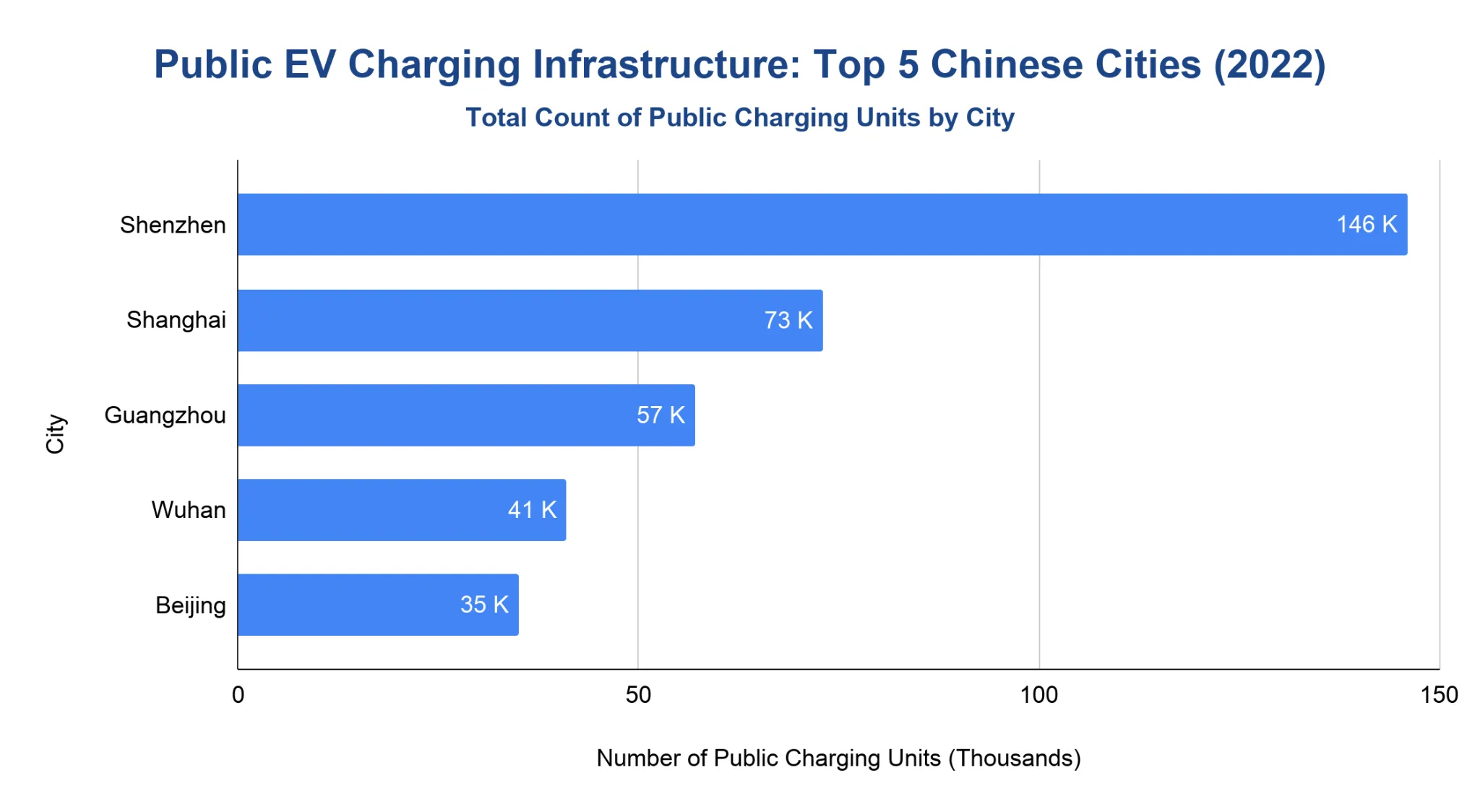
China’s strongest electric vehicle road-trip support is concentrated in developed cities; in 2022, the top 15 Chinese cities accounted for 57% of national public charger stock.
- The top five cities globally by public charger stock in 2022 were Shenzhen, Shanghai, Guangzhou, Wuhan, and Beijing.
- Shenzhen led the city ranking with 146,000 public chargers in 2022.
- Shanghai had 73,000 public chargers in 2022, more than double Beijing’s 35,000.
- Guangzhou had 57,000 public chargers in 2022, while Wuhan had 41,000.
- In a separate 2024 Spring Festival tourist destination ranking, Beijing, Guangzhou, Chengdu, and Shanghai were the top four car-rental destinations.
Note: The graph shows the Charger Stock Ranking for public chargers in 2022. The final bullet refers to a separate Tourist Destination Ranking for car-rental demand during the 2024 Spring Festival holiday.
Is China ready for electric road trips?
China had nearly 17.35 million electric vehicle (EV) charging facilities by the end of August 2025, including about 4.32 million public facilities and 13.03 million private facilities.
- China had 12.82 million charging facilities at the end of 2024, up 49% year on year.
- Total charging facilities rose to nearly 17.35 million by the end of August 2025, up 53.5% year on year.
- Public EV charging facilities reached about 4.32 million by the end of August 2025, up 37.8% year on year.
- Private charging facilities reached 13.03 million by the end of August 2025, up 59.6% year on year.
- Charging facilities in highway service areas reached 35,000 piles by the end of 2024, covering 98% of service areas nationwide, while China’s 2027 charging plan targets 28 million charging facilities and public charging capacity above 300 million kilowatts.
| Period | Total Facilities (Million) | Public Facilities (Million) | Private Facilities (Million) |
|---|---|---|---|
| End-2024 | 12.82 | 3.58 | 9.24 |
| End-August 2025 | 17.35 | 4.32 | 13.03 |
Source · Note: Charging facilities, charging piles, chargers, and charging sites can refer to different infrastructure measures. This section follows the official facility-count terminology used in the cited national statistics.
More Statistics
- Electric Car Rental Statistics: United States
- Car Rental Statistics in Canada
- Car Rental Statistics in France
- Car Rental Statistics in Germany
- Car Rental Statistics in Ireland
- Car Rental Statistics in Norway
- Electric Car Rental Statistics: New Zealand
- Car Rental Statistics in Portugal
- Electric Car Rental Statistics: UK
- Car Rental Statistics in the US
Electric Car Rental Policies in China
China’s NEV purchase-tax support runs through 2027, with full purchase-tax exemption through 2025 and a 50% reduction in 2026-2027.
- Passenger NEVs purchased in 2024 and 2025 are exempt from purchase tax up to RMB 30,000 per vehicle.
- Passenger NEVs purchased in 2026 and 2027 receive a 50% purchase-tax reduction up to RMB 15,000 per vehicle.
- Hainan plans to ban sales of fuel cars by 2030, making the island province a major leisure-travel market with a defined clean-vehicle transition timeline.
- The national 2027 charging plan focuses on urban fast-charging networks, expressway service-area upgrades, rural charging gaps, and residential charging access.
Note: Purchase-tax incentives apply to eligible NEV purchases. For rental fleets, the practical effect depends on each company’s procurement schedule, model mix, and vehicle eligibility.
Outlook for Electric Car Rentals in China
The strongest forward signals are China’s RMB 158.5 billion car-rental market total for 2025, its 36.89 million NEVs on the road by mid-2025, and the national target of 28 million charging facilities by 2027.
- NEVs accounted for 44.97% of new automobile registrations in the first half of 2025, giving rental companies a much larger electric vehicle supply base than in earlier adoption phases.
- CAR Inc.’s 2025 partnership with BYD connects rental-fleet electrification with procurement, operations, data integration, and used-car management.
- China had nearly 17.35 million EV charging facilities by the end of August 2025, improving the infrastructure base for self-drive leisure trips and intercity rentals.
- Highway charging coverage reached 98% of service areas by the end of 2024, strengthening the case for longer-distance electric rentals.
- Policy incentives through 2027 and Hainan’s 2030 fuel-car sales ban give rental operators clearer planning signals for NEV purchasing and charging access.
Note: The outlook brings together the main operating signals for electric car rentals: market size, national vehicle adoption, rental-company procurement, charging coverage, and policy timing.
References
- BCG: Car-Rental Market Forecast (2020-2025) · bcg.com
- China EV Charging and NEV Policy · english.www.gov.cn
- SCIO: New-Energy Vehicle Sales Share (2024) · english.scio.gov.cn
- CHD: Rental Fleet Partnership (2025) · chinadaily.com.cn
- CSPI: Fleet Scale & Market Position (2023-2025) · cspi-ratings.com
- EHI: Clean-Energy Fleet Statement (2021) · en.1hai.cn
- PPL: Holiday Rental Demand (2024) · en.people.cn
- ICCT: City Charger Stock (2022) · theicct.org
- STA: New-Energy Vehicle Tax Policy (2024-2027) · chinatax.gov.cn
- XIN: Hainan Vehicle Policy (2030) · english.news.cn

