

 Popular Countries
 24/7 Support
Updated
Germany’s car rental market shows a post-pandemic recovery pattern in fleet stock and vehicle registrations, while rental-car prices rose much faster than overall consumer prices by 2022. The clearest available figures connect the market to business activity, tourism recovery, fleet renewal, price pressure, and changing vehicle categories.
What is the official turnover of Germany’s car rental sector?
Germany’s car rental sector generated around €34.7 billion in turnover in 2020 through companies offering car rental services.
- The turnover figure shows that car rental is part of a large vehicle-rental and mobility services market, rather than only a short-term travel rental category.
- The sector employed around 31,900 people in 2020.
- Around 4,400 companies offered car rental services in Germany in 2020.
- This works out to about €7.89 million in turnover per company, based on the rounded company and turnover figures.
- It also works out to about €1.09 million in turnover per employee, based on the rounded employment and turnover figures.
Note: The turnover figure covers companies offering car rental, so it is broader than a simple short-term car rental revenue estimate.
How many car rental companies operate in Germany?
Around 4,400 companies offered car rental services in Germany in 2020.
- These companies employed around 31,900 people in 2020.
- That works out to about 7 employees per company, based on the rounded company and employment figures.
- The company count should be read as a business count for car rental activity, not as a count of brands, branches, airport desks, or rental locations.
- One rental company can operate through multiple offices, counters, or online booking channels.
Note: Company counts and rental-location counts measure different things. A company count shows how many businesses operate in the sector, not how many places customers can rent from.
Car Rental Market Trends and Growth in Germany
Passenger Cars Registered as Self-Drive Rental Vehicles in Germany
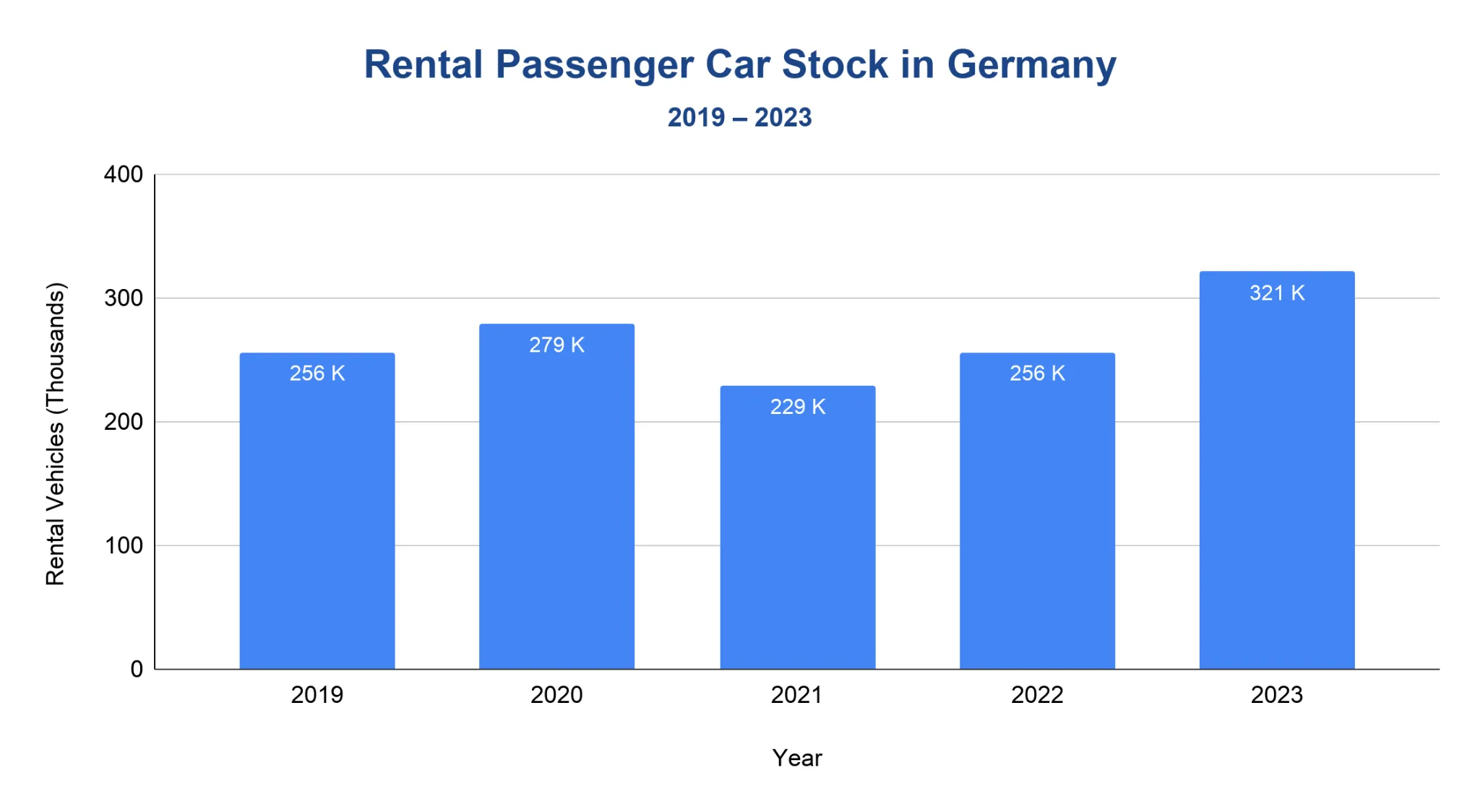
Germany had about 321 thousand passenger cars registered as self-drive rental vehicles as of 1 January 2023.
- The rental passenger-car stock stood at about 256 thousand vehicles on 1 January 2019.
- It increased to about 279 thousand vehicles on 1 January 2020, just before the COVID-19 pandemic fully affected the market.
- The stock dropped to about 229 thousand vehicles on 1 January 2021.
- It returned to about 256 thousand vehicles on 1 January 2022, roughly back to its 2019 level.
- The 2023 figure of about 321 thousand vehicles was the highest value in five years, indicating a strong post-pandemic fleet rebuild.
Note: The stock count is measured on 1 January of each year, so the value represents the fleet at the start of the year rather than the average fleet across the year.
New Passenger-Car Registrations by Rental and Carsharing Operators
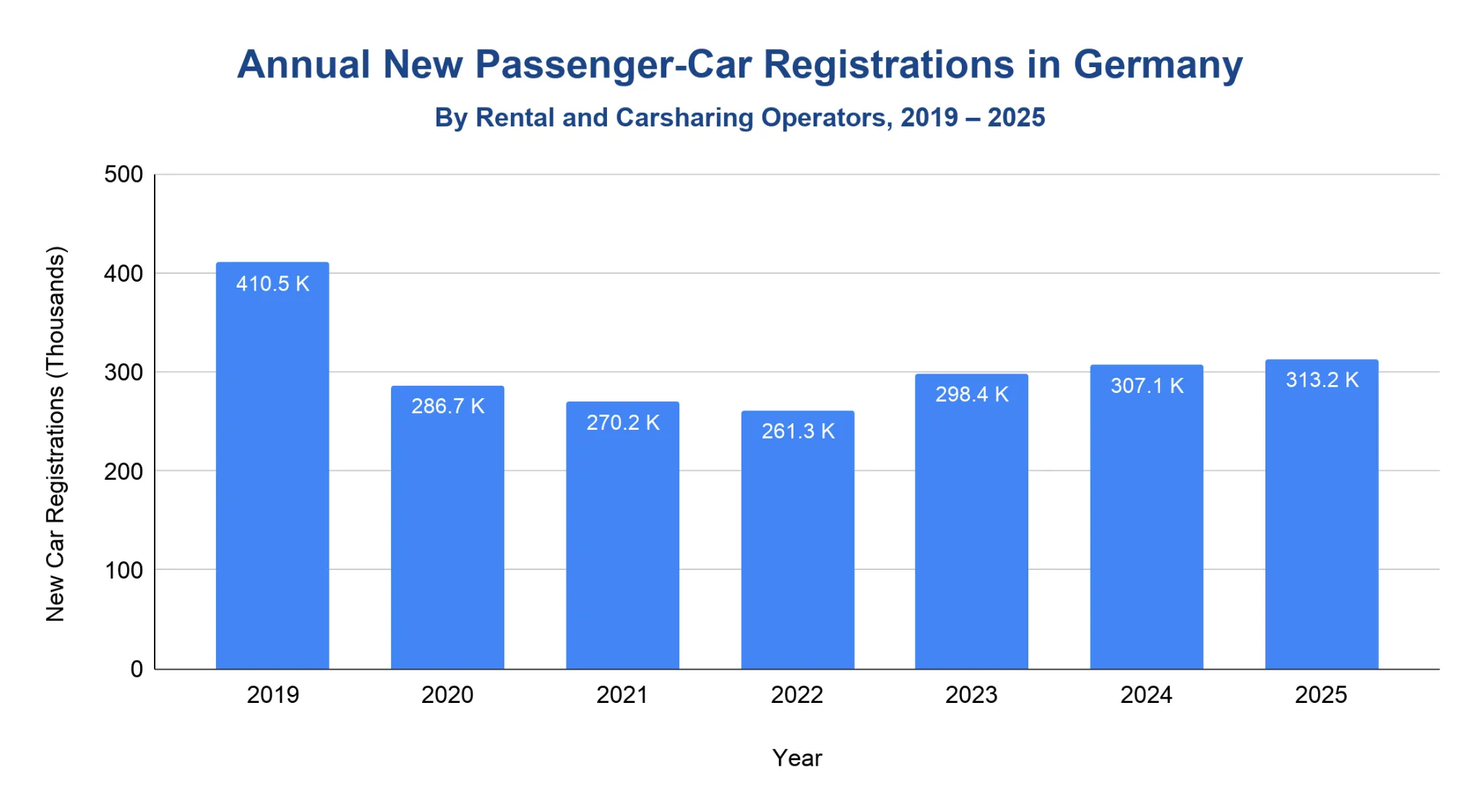
Rental companies and carsharing operators registered 313,235 new passenger cars in Germany in 2025.
- New passenger-car registrations by rental companies and carsharing operators reached 410,457 in 2019, before the pandemic.
- The total fell to 286,697 in 2020, then continued to fall to 270,239 in 2021 and 261,328 in 2022.
- Registrations recovered to 298,434 in 2023 and rose again to 307,132 in 2024.
- The 2025 total increased to 313,235, up 2% from 2024.
- Even after three years of recovery, the 2025 total was still 23.7% below the 2019 pre-pandemic level.
Note: These figures include both rental companies and carsharing operators, so they show the broader rental and shared-mobility registration category.
Rental and Carsharing Registration Trends in Germany
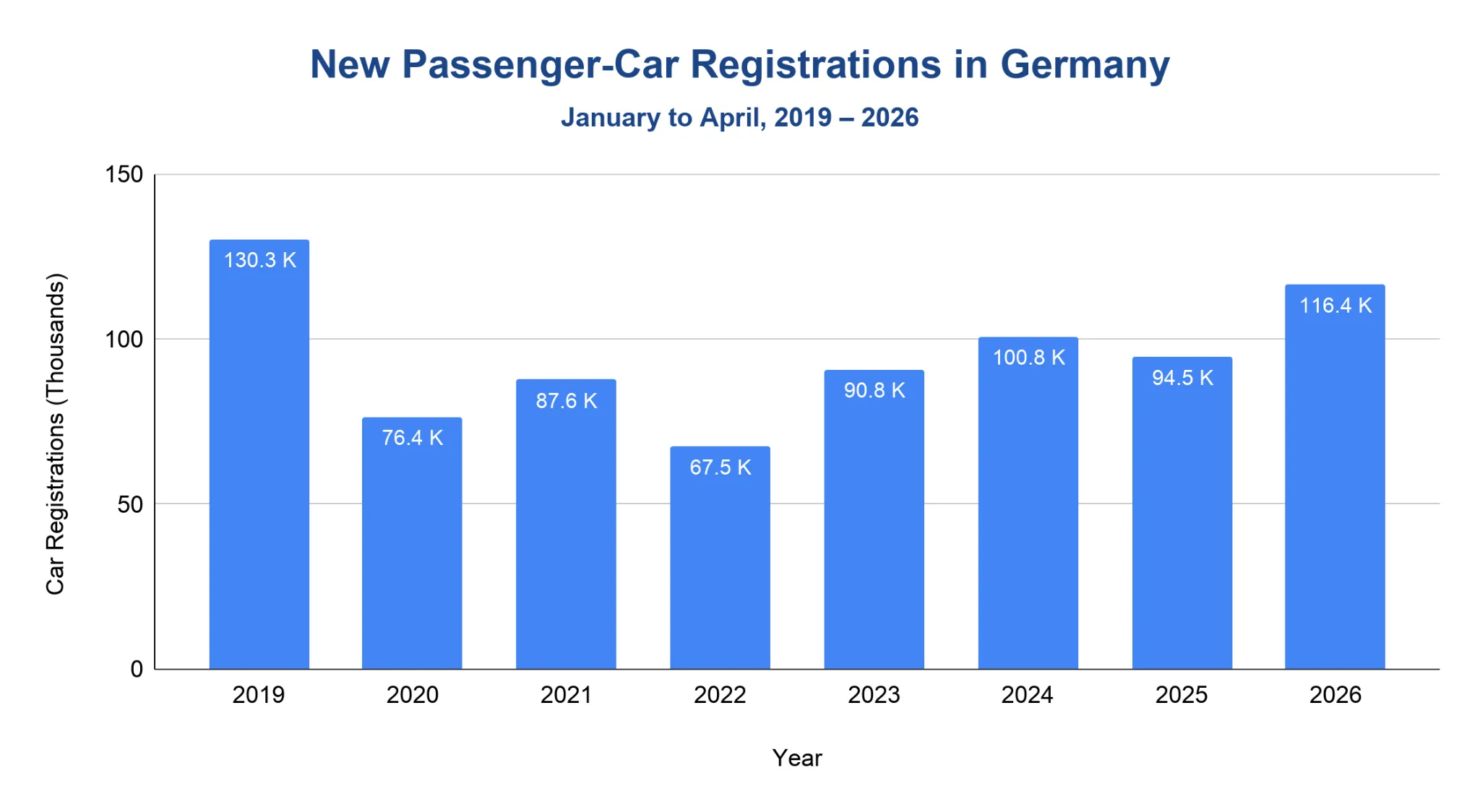
Germany’s early-year rental and carsharing registration data improved in 2026, but the market was still below the same pre-pandemic period in 2019.
- From January to April 2019, rental companies and carsharing operators registered 130,246 new passenger cars.
- The same period dropped to 76,360 registrations in 2020, then rose to 87,644 in 2021.
- The January–April total fell again to 67,538 in 2022, the lowest point in this same-period series.
- Registrations improved to 90,790 in 2023 and 100,790 in 2024, before easing to 94,537 in 2025.
- The January-April 2026 total reached 116,421, about 23% higher than 2025 but still about 11% below 2019.
Note: January-April figures are useful for comparing the same part of each year, but they should not be treated as full-year totals.
How does tourism indicate potential car rental demand in Germany?
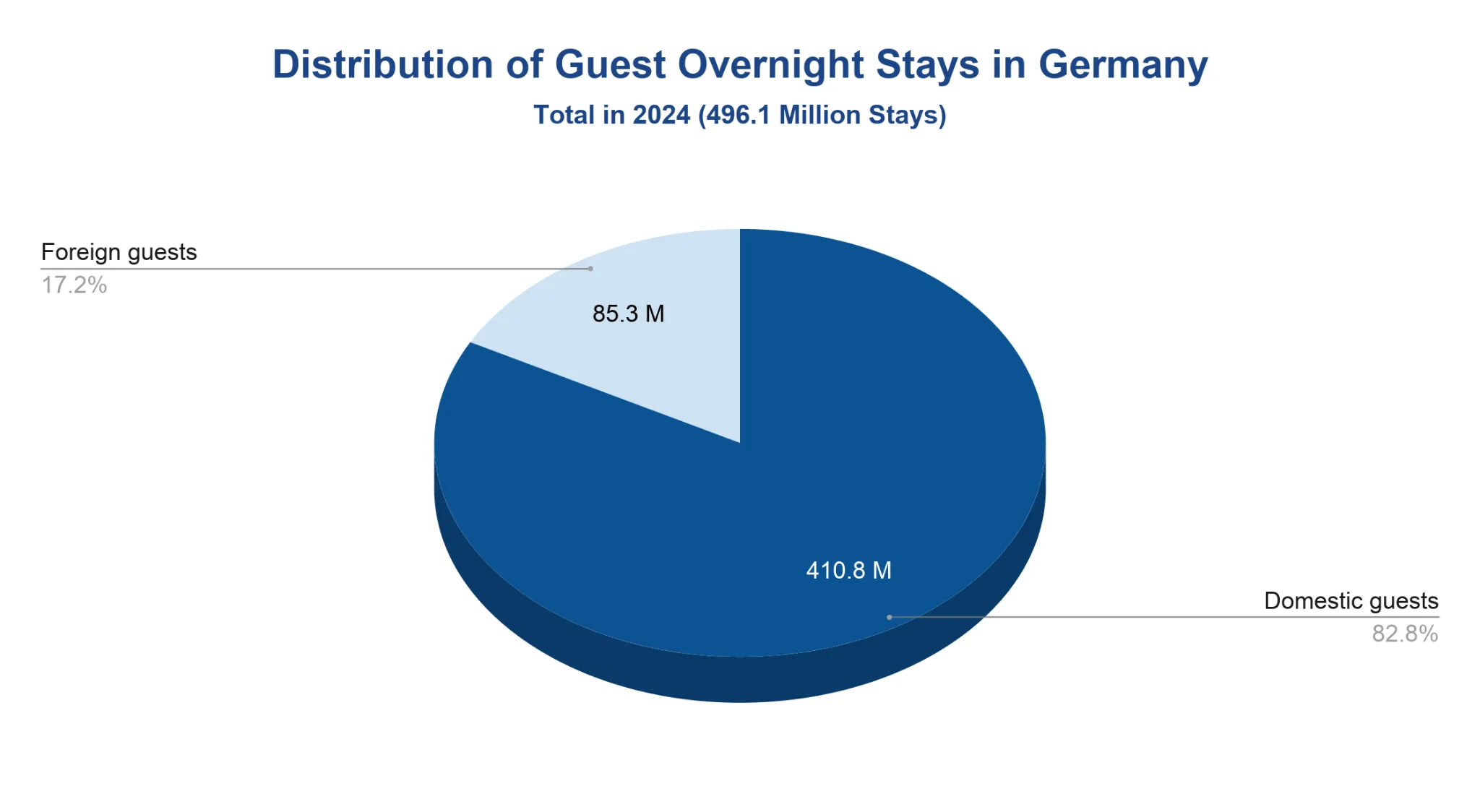
Germany recorded 496.1 million accommodation overnight stays in 2024, setting a new tourism record.
- Total overnight stays were 1.9% higher than in 2023.
- The 2024 total was 0.1% above the previous pre-pandemic record from 2019.
- Domestic overnight stays reached 410.8 million in 2024, exceeding the 2019 level by 1.3%.
- Overnight stays by guests from abroad reached 85.3 million in 2024, up 5.4% from 2023.
- International guest overnight stays remained 5.1% below 2019, showing that domestic travel recovered more fully than inbound travel.
Note: Overnight stays show the size of Germany’s travel market, which can support rental demand, especially for airport, leisure, and intercity trips.
What vehicle categories are available from car rental companies in Germany?
Rental companies in Germany offer categories ranging from compact cars to sport utility vehicles (SUVs), estates, vans, and premium models.
- Compact sedan examples include a VW Golf or similar with 5 seats.
- Medium-class and premium sedans, such as an Audi A3 or Mercedes-Benz E-Class or similar, also list 5 seats.
- SUV examples, such as an Audi Q2, VW Tiguan, and BMW X5 or similar, list 5 seats.
- Van examples include 7-seat and 8-seat categories, such as a VW Caddy Maxi or Mercedes-Benz V-Class Long or similar.
- Vehicle availability can vary by location, booking period, and fleet mix.
| Category | Example | Seats |
|---|---|---|
| Compact sedan | VW Golf | 5 |
| Medium elite sedan | Audi A3 | 5 |
| Premium elite sedan | Mercedes-Benz E-Class | 5 |
| Compact elite SUV | Audi Q2 | 5 |
| Standard SUV | VW Tiguan | 5 |
| Luxury elite SUV | BMW X5 | 5 |
| Standard van | VW Caddy Maxi | 7 |
| Premium elite van | Mercedes-Benz V-Class Long | 8 |
Source · Note: Rental companies usually show example models by category, but the exact model can vary depending on location and availability.
How did rental car prices change in Germany?
Rental-car prices in Germany were relatively stable through 2020, but the price trend changed strongly from 2021 into 2022.
- In the 2020 annual average, rental-car prices rose by 0.8%, close to the 0.5% increase in overall consumer prices.
- From May 2021, rental-car price inflation moved into double-digit rates.
- By May 2022, rental-car prices were 48.7% higher than in May 2021.
- Overall consumer prices rose by 7.9% over the same May-to-May period.
- Compared with the 2015 price level, rental-car prices were 60% higher by May 2022, while overall consumer prices were 17.3% higher.
Note: The 2015 comparison shows how much prices had risen from a common starting point.
Top Car Rental Companies in Germany
Sixt’s Car Rental Business in Germany and Internationally
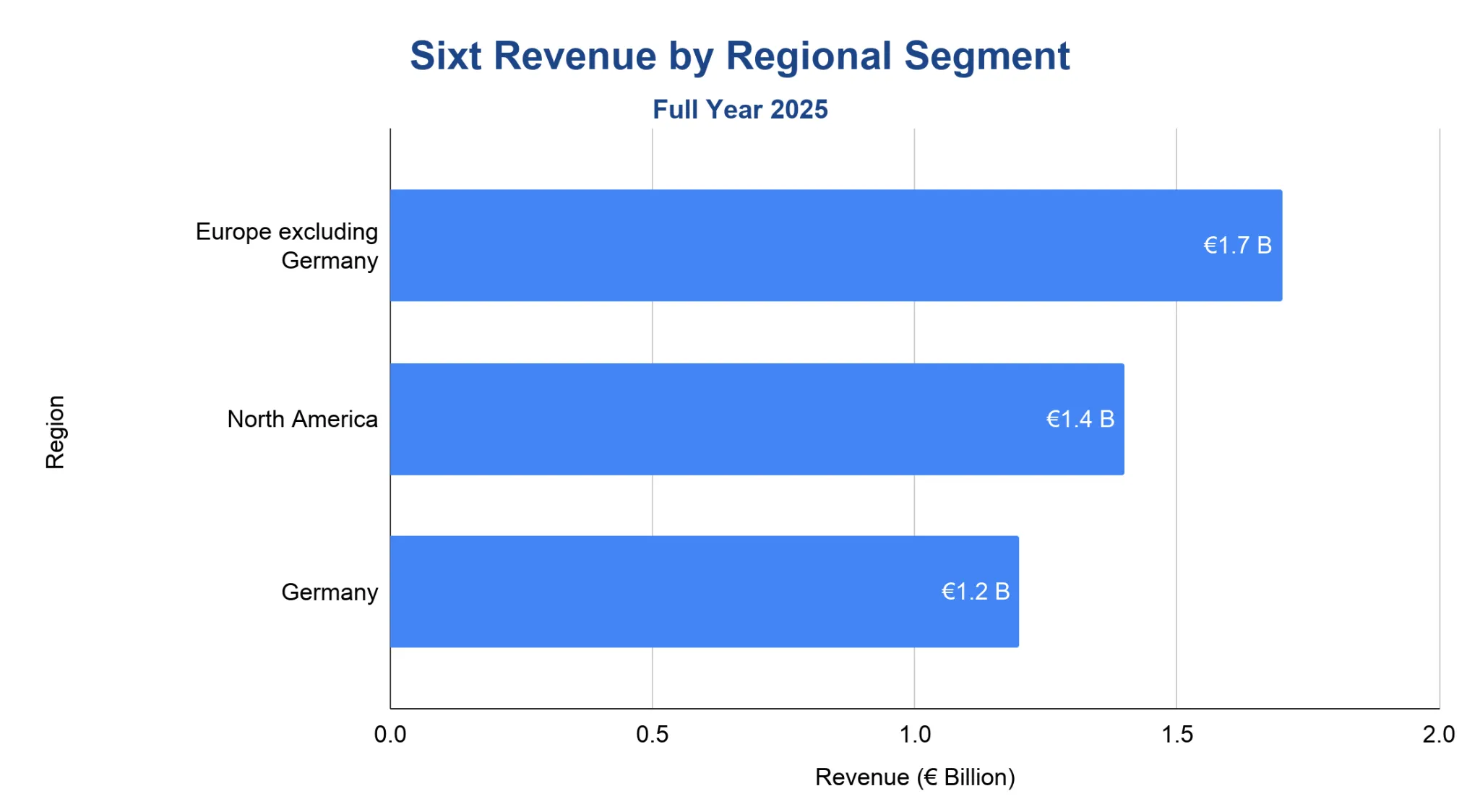
Sixt had €4.3 billion in group revenue in 2025, with Germany remaining one of its reported regional segments.
- Sixt had group revenue of €4.3 billion in 2025, up 7.5% from 2024.
- The Germany segment generated €1.2 billion in revenue in 2025.
- Europe excluding Germany generated €1.7 billion in revenue in 2025.
- North America generated €1.4 billion in revenue in 2025.
- Sixt’s average fleet reached 196,900 vehicles in 2025, up 6.9% from 2024.
Which car rental company won major travel awards in Germany?
Sixt was named Best Car Rental Company in Germany, Europe, and worldwide at the 2024 Business Traveller Awards.
- The award was based on a reader survey of more than 1,600 German business travellers.
- Sixt ranked first in the Germany, Europe, and worldwide car-rental categories.
- The 2024 award marked the third consecutive year in which Sixt received that recognition.
- Customer awards are useful for understanding brand recognition, but they are different from market-share rankings.
Note: Awards and review scores measure customer recognition or satisfaction samples, not company size or market share.
- Electric Car Rental Statistics in China
- Electric Car Rental Statistics: United States
- Car Rental Statistics in Canada
- Car Rental Statistics in France
- Car Rental Statistics in Ireland
- Car Rental Statistics in Norway
- Electric Car Rental Statistics: New Zealand
- Car Rental Statistics in Portugal
- Electric Car Rental Statistics: UK
- Car Rental Statistics in the US
What does Sixt’s outlook suggest about the car rental industry?
Sixt expects further company revenue growth in 2026, while Germany’s tourism recovery continues to support the broader travel market.
- Sixt had €4 billion in group revenue in 2024.
- Group revenue increased to €4.3 billion in 2025, giving the company another revenue record.
- Sixt expects group revenue of €4.45 billion to €4.60 billion in 2026.
- The company expects an earnings-before-tax margin of around 10% in 2026.
- Fleet discipline remains important because rental fleets need to balance demand, utilisation, vehicle costs, and resale conditions.
| Year | Revenue |
|---|---|
| 2024 | €4 billion |
| 2025 | €4.3 billion |
| 2026 Outlook | €4.45 billion to €4.6 billion |
Source · Note: Sixt’s outlook is company-specific, so it is best read as a signal from one major rental company rather than a forecast for the entire German car rental industry.

