

 Popular Countries
 24/7 Support
Published
The United States electric car rental industry is on the rise, with battery electric vehicles (BEVs) increasingly available through several major rental providers in the U.S. As official EV-only rental revenue is not publicly available, this article uses total U.S. passenger car rental and leasing revenue as market context, then focuses on company EV fleet actions, rental policies, business-traveler surveys, and public charging infrastructure.
How large is the U.S. car rental revenue base around electric rentals?
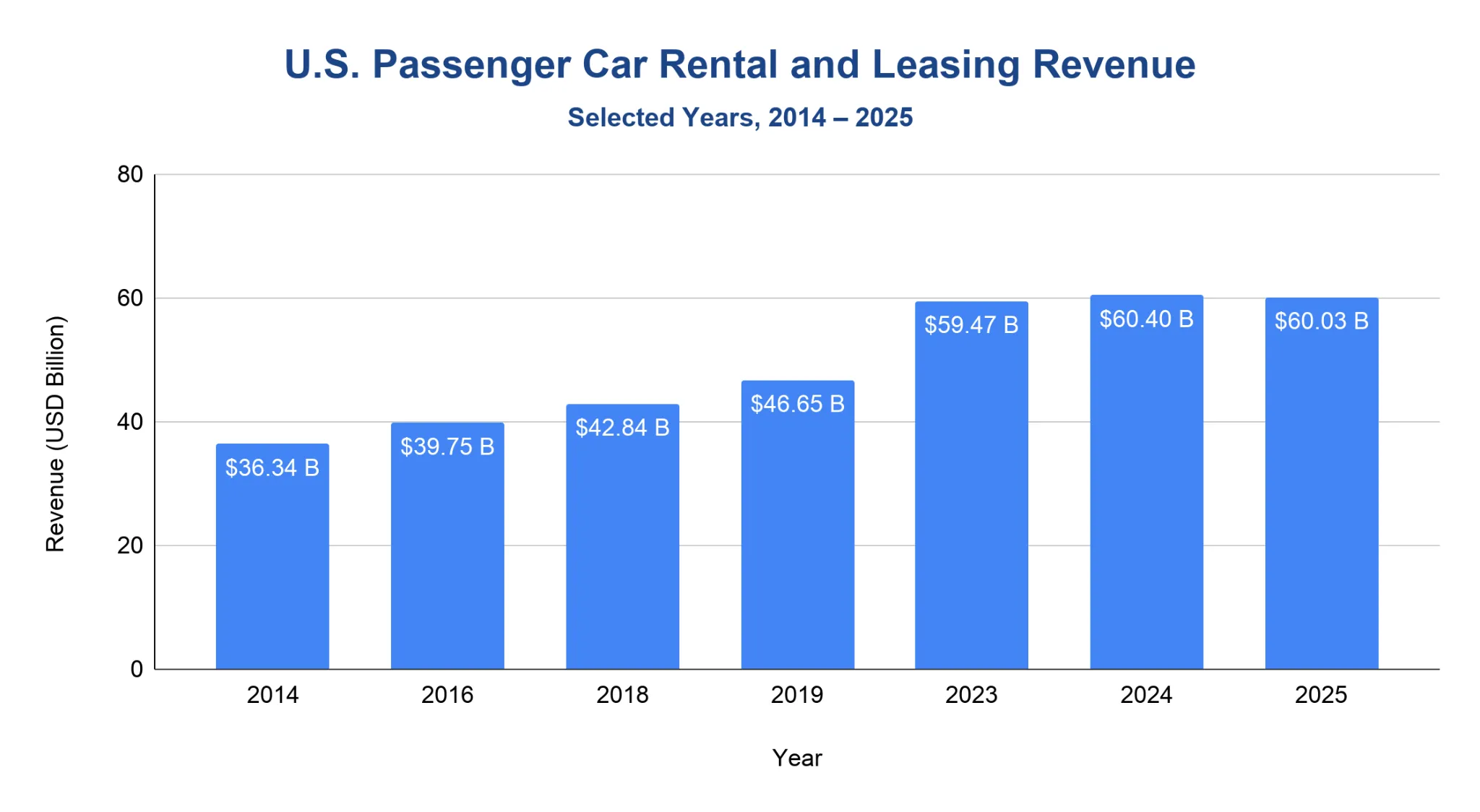
U.S. passenger car rental and leasing establishments subject to federal income tax generated $60.03 billion in total revenue in 2025, giving EV rentals a large national market in which to grow.
- The revenue base increased from $36.34 billion in 2014 to $60.03 billion in 2025.
- Before the pandemic, the industry generated $46.65 billion in revenue in 2019.
- By 2023, revenue had reached $59.47 billion, which was $12.82 billion above the 2019 level.
- The market declined slightly after 2024, moving from $60.4 billion in 2024 to $60.03 billion in 2025.
Note: This section uses total U.S. passenger car rental and leasing revenue as market context. It is not EV-only rental revenue.
Which rental companies offer electric cars in the United States?
Major rental companies list electric cars at select U.S. locations, including Tesla, Polestar, and Chevrolet Bolt models.
- Hertz lists EV rentals in North America and shows Tesla and Polestar vehicles as examples.
- Enterprise lists a Fullsize Elite Electric Sedan class at select locations, with Polestar 2 and Tesla Model 3 options.
- Avis lists EV rentals at select U.S. locations and shows Tesla Model 3 and Chevrolet Bolt examples.
- SIXT lists U.S. EV rental availability in markets such as Los Angeles, New York City, Miami, Fort Lauderdale, San Diego, and Houston.
Note: EV availability depends on the rental company, location, date, and vehicle class.
How many electric rental vehicles have been publicly reported?
Hertz provides the clearest company-specific EV rental-fleet datapoint: in 2024, it moved to sell about 20 thousand EVs from its U.S. fleet.
- The planned 2024 sale represented about one-third of Hertz’s global EV fleet at the time.
- Based on that share, the company’s global EV fleet was roughly 60 thousand vehicles before the sale.
- Hertz linked the reduction to demand, rental margins, depreciation, and damage costs.
- In 2022, Hertz and Polestar announced a plan for Hertz to buy up to 65 thousand EVs over five years.
| Year | Company | Public EV Fleet |
|---|---|---|
| 2022 | Hertz / Polestar | Up to 65 thousand EVs planned over five years |
| 2024 | Hertz | About 20 thousand EVs planned for sale |
| 2024 | Hertz | Sale equal to about one-third of global EV fleet |
Source · Note: Hertz data is company-specific. It should not be read as total U.S. EV rental fleet stock.
How do electric rental costs and return rules work?
EV rental pricing varies by company and trip details, but return-charge rules are clearly listed by major rental providers.
- Avis and Budget rent EVs with at least 70% battery charge and require the same level at return.
- A returned EV below 70% charge but 10% or above can trigger a $35 fee at Avis and Budget.
- The fee can rise to $70 when the returned EV battery level is less than 10%.
- Avis and Budget state that EVs must be returned to the original rental location.
- The American Automobile Association (AAA) listed the U.S. public EV charging average at $0.417 per kilowatt-hour (kWh) on June 1, 2026.
| Return Battery Level | Avis / Budget EV Return Fee (USD) |
|---|---|
| 70% or more | 0 |
| 10% to below 70% | 35 |
| Below 10% | 70 |
Source · Note: Daily EV rental prices depend on the location, date, car class, and fees.
Who rents electric cars for business travel?
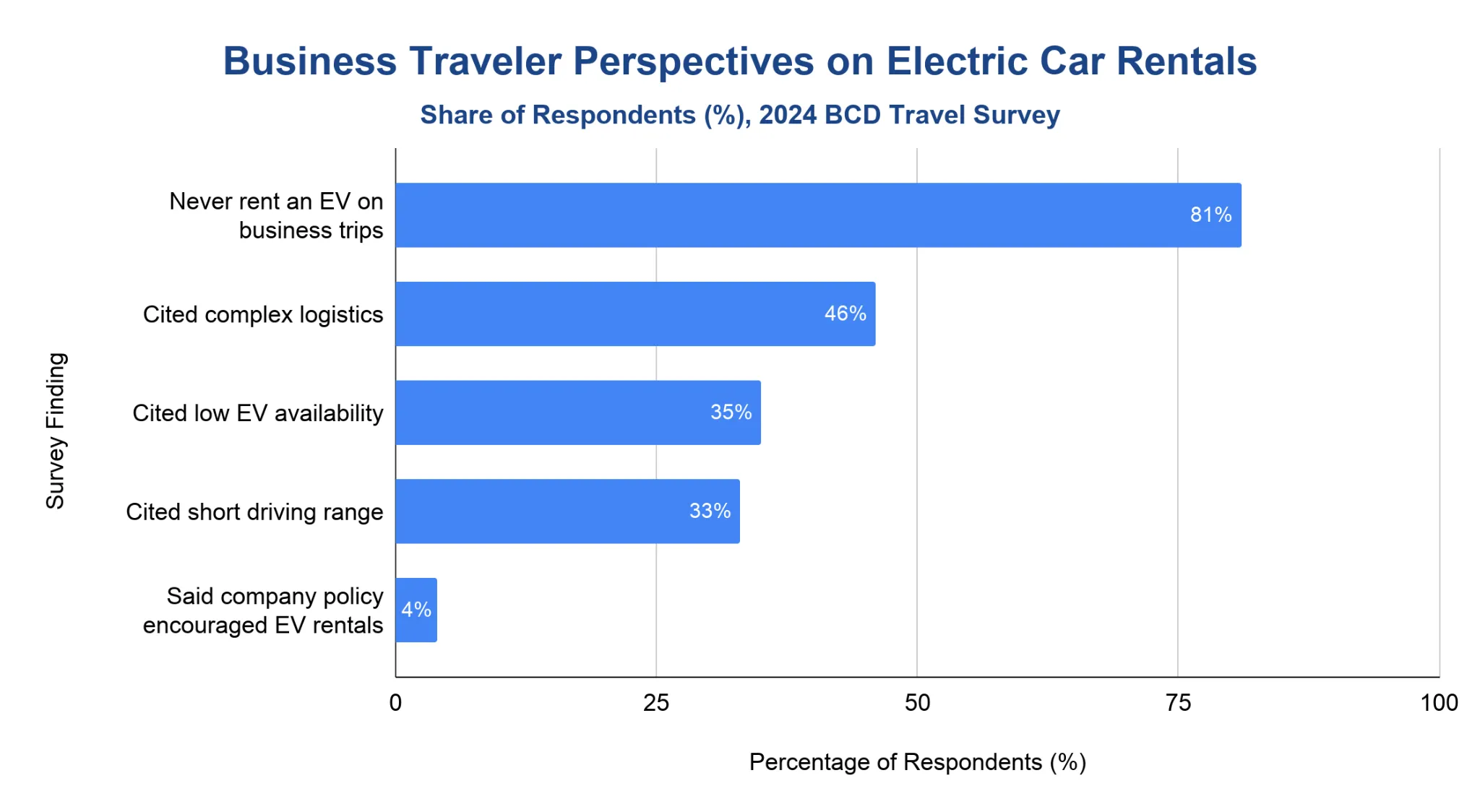
In BCD Travel’s 2024 survey of more than 900 North American and European business travelers, 81% said they never rent an EV on business trips.
- Complex logistics were the top barrier in 2024, cited by 46% of surveyed business travelers.
- Low EV availability at the rental location was cited by 35% of respondents.
- Short driving range was another barrier, cited by 33% of respondents.
- Company policy influenced rental choice for 69% of surveyed business travelers.
- Only 4% of respondents said their company policy encouraged EV rentals.
Note: These figures describe BCD Travel’s business-traveler survey group. They do not represent all U.S. rental customers.
Public EV Charging Ports in the United States
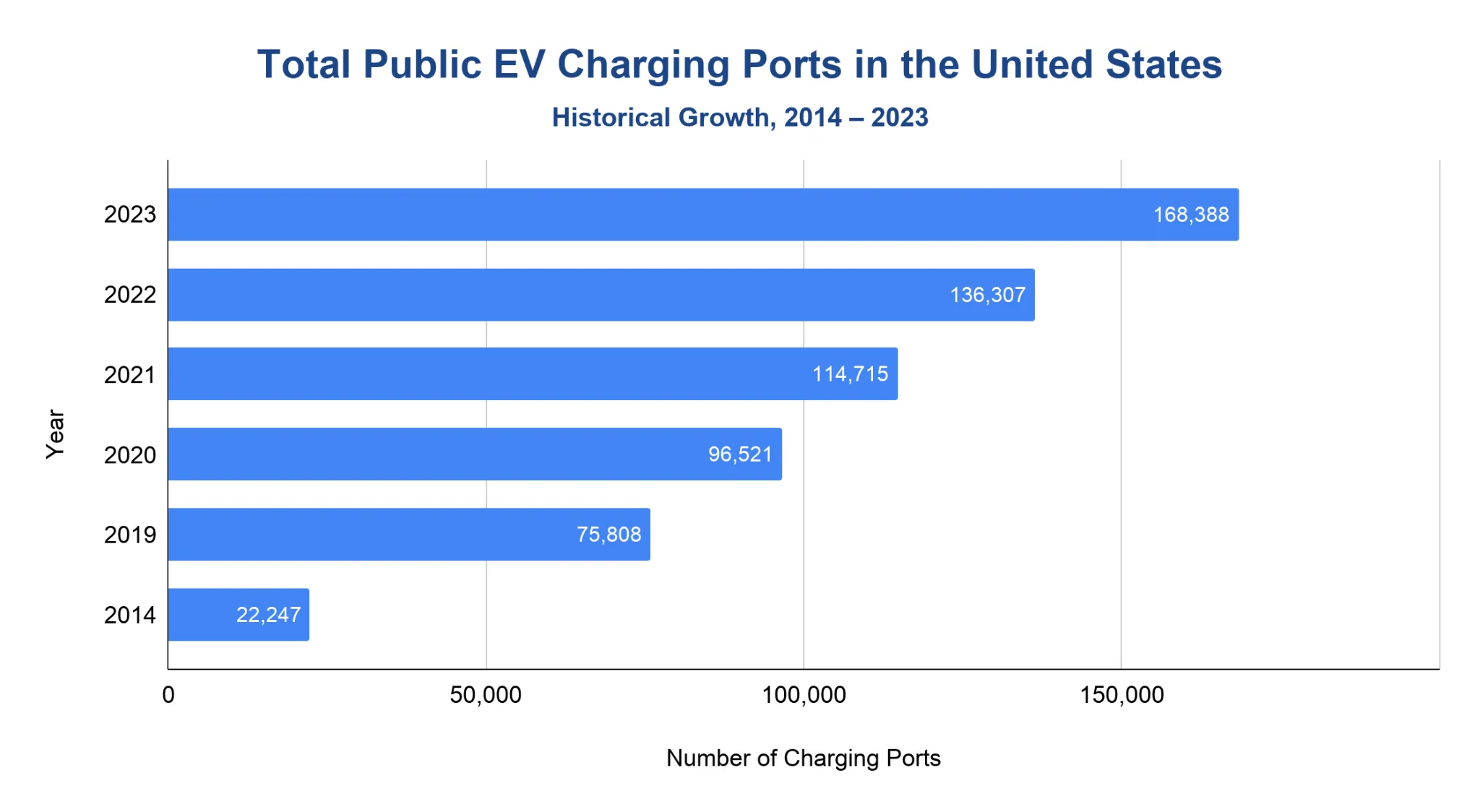
The United States had 168,388 public EV charging ports in 2023.
- The number of public ports increased from 22,247 in 2014 to 168,388 in 2023.
- By 2023, the port count was more than double the 75,808 recorded in 2019.
- After 2020, the network expanded from 96,521 ports to 168,388 ports in 2023.
- The Alternative Fuels Data Center (AFDC) reported a 6.5% quarterly increase in public ports in the second quarter (Q2) of 2024.
Note: A charging port is the plug a vehicle uses to charge.
Public EV Charging Station Locations in the United States
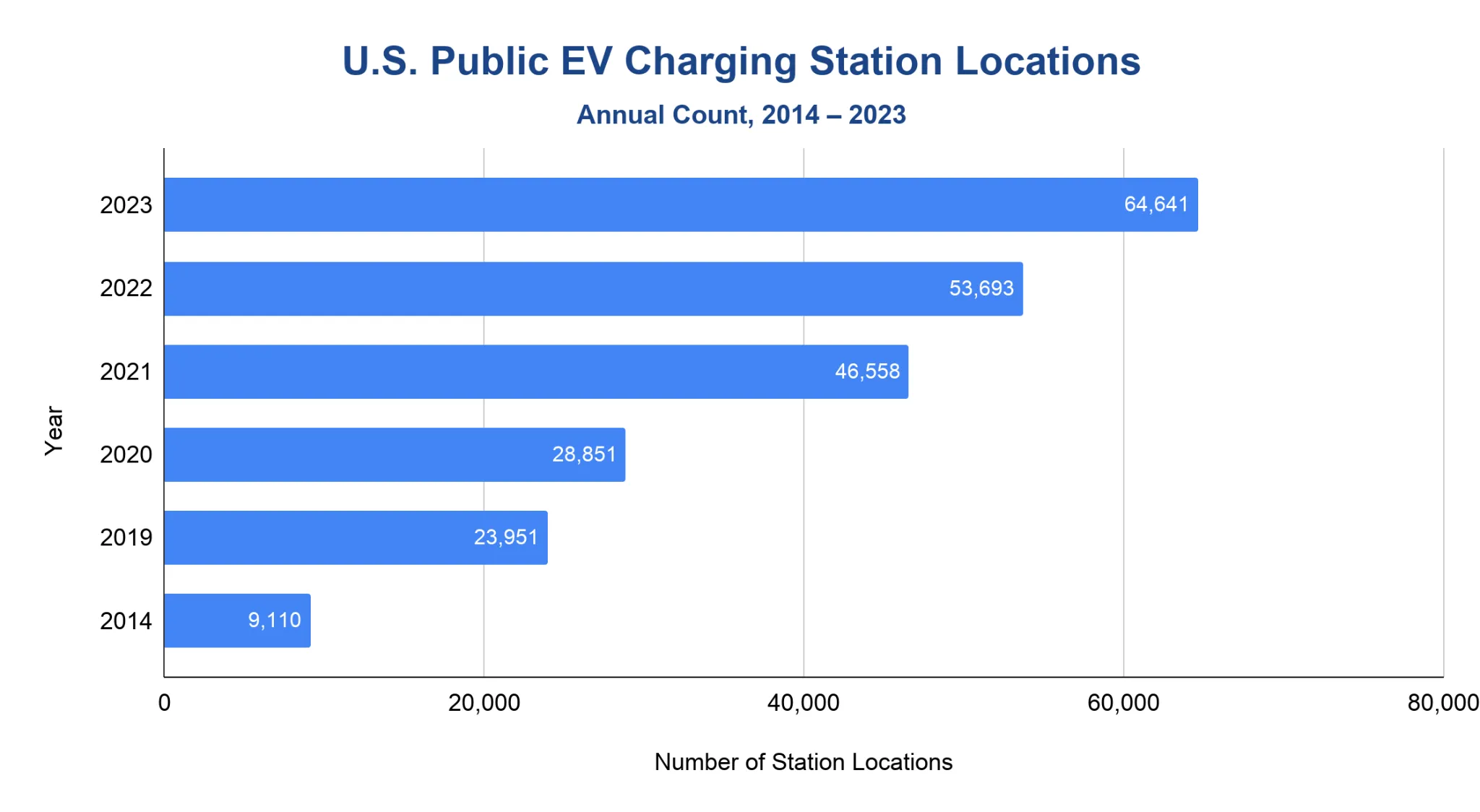
The United States had 64,641 public EV charging station locations in 2023.
- The number of public station locations increased from 9,110 in 2014 to 64,641 in 2023.
- By 2023, the location count was 169.9% higher than the 23,951 recorded in 2019.
- After 2020, the network expanded from 28,851 locations to 64,641 locations in 2023.
- The graph below shows steady growth from 2014 through 2023, with the largest jump occurring between 2020 and 2021.
Note: A station location is a public charging site with one or more charging ports.
More Statistics
- Electric Car Rental Statistics in China
- Car Rental Statistics in Canada
- Car Rental Statistics in France
- Car Rental Statistics in Germany
- Car Rental Statistics in Ireland
- Car Rental Statistics in Norway
- Electric Car Rental Statistics: New Zealand
- Car Rental Statistics in Portugal
- Electric Car Rental Statistics: UK
- Car Rental Statistics in the US
Outlook for Electric Car Rentals in the United States
The U.S. electric rental outlook is mixed. Charging infrastructure is growing, but rental companies are still adjusting EV fleet strategy.
- Hertz’s 2024 filing shows one major rental company reducing its EV exposure because of demand, margins, depreciation, and damage costs.
- The California Air Resources Board (CARB) requires 100% of new cars and light trucks sold in California to be zero-emission vehicles by 2035.
- California’s zero-emission vehicle target rises from 35% in model year 2026 to 68% in 2030.
- The Internal Revenue Service (IRS) says the federal Commercial Clean Vehicle Credit is not available for vehicles acquired after September 30, 2025.
- San Francisco International Airport (SFO) targets 5,728 Level 2 charging ports and 70 fast-charging stations by 2030.
| Model Year | California Zero-Emission Vehicle Sales Target (%) |
|---|---|
| 2026 | 35 |
| 2030 | 68 |
| 2035 | 100 |
Source · Note: EV rental growth depends on fleet costs, charging access, customer demand, and company strategy.
References
- FRED: Rental Revenue Trend (2014-2025) · fred.stlouisfed.org
- Hertz: EV Fleet Strategy and Rental Terms · hertz.com
- Enterprise: Premium Electric Sedan Class · enterprise.com
- Avis: EV Availability and Return Fees · avis.com
- Budget: Charging Rules and Rental Guidance · budget.com
- Revenue, Awards, Outlook, and Vehicle Categories (2024–2026) · sixt.com
- SEC: Hertz Fleet Reduction Filing · sec.gov
- AAA: Public Charging Price Benchmark · gasprices.aaa.com
- BCD Travel: Business Traveler EV Rental Survey (2024) · bcdtravel.com
- AFDC: Charging Network Data (2014-2024) · afdc.energy.gov
- CARB: ZEV Sales Mandates (2026-2035) · ww2.arb.ca.gov
- IRS: Commercial Vehicle Credit Rules (Through September 30, 2025) · irs.gov
- SFO: Airport Electrification Targets · flysfo.com

