

 Popular Countries
 24/7 Support
Updated
Electric car rentals in New Zealand are still a small part of the rental market, but they are becoming easier to find. As more charging stations appear and major rental companies add electric models, electric vehicle road trips are becoming a more practical option for visitors and locals.
How large is New Zealand’s rental market base for electric cars?
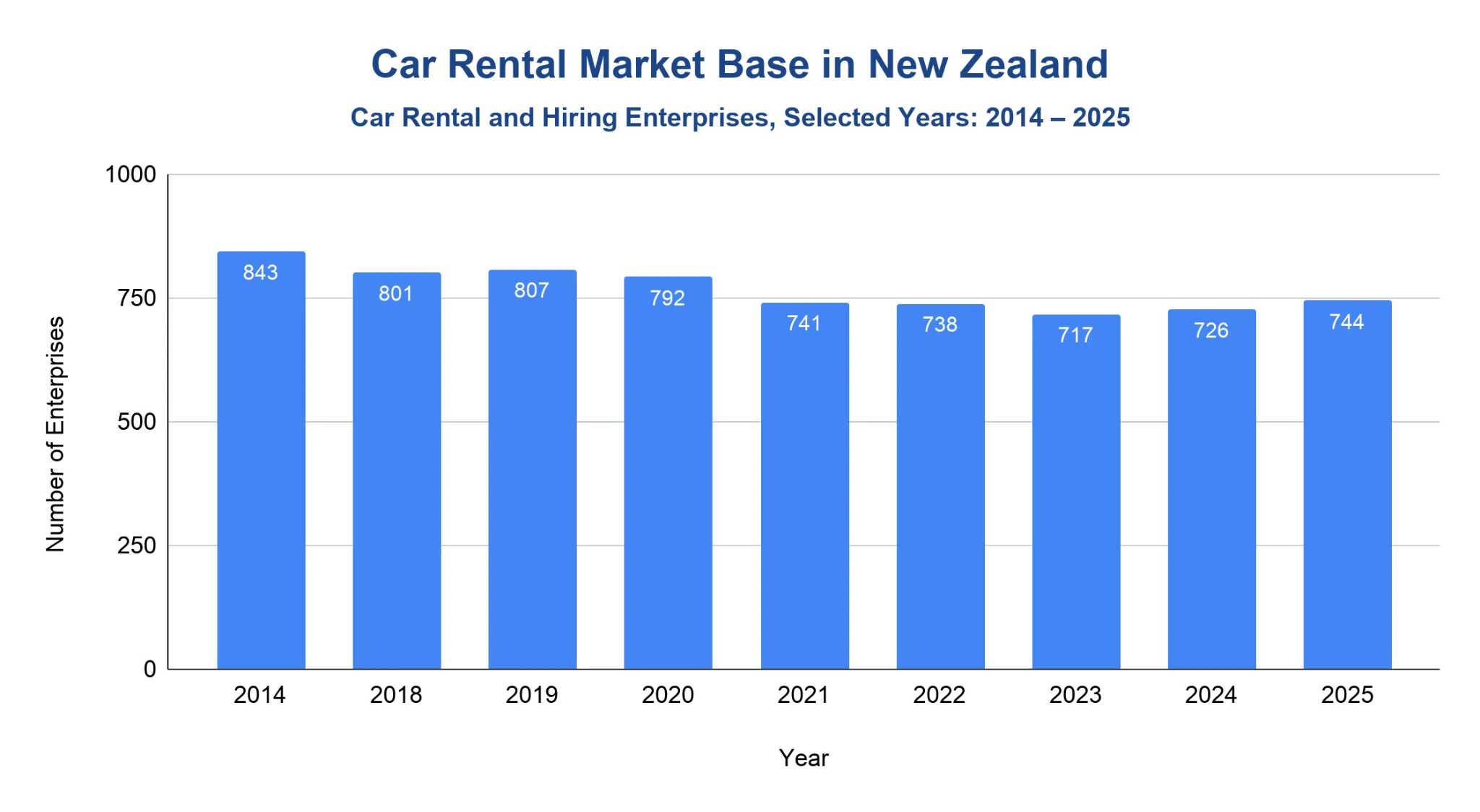
New Zealand’s wider passenger car rental and hiring industry provides the base for electric rental growth, with 744 enterprises in 2025, up from 726 in 2024 but still below the 843 recorded in 2014.
- Passenger car rental and hiring enterprises fell by 11.7% from 843 in 2014 to 744 in 2025.
- Before the pandemic, the industry had 807 enterprises in 2019, compared with 741 in 2021.
- Across the selected period, the lowest count was 717 enterprises in 2023.
- From 2023 to 2025, the industry added 27 enterprises, a 3.8% increase over two years.
Note: This section uses the wider passenger car rental and hiring industry as market context because electric rental vehicles are offered through the same rental-company base.
Which rental companies offer electric cars in New Zealand?
Battery electric vehicle rentals are publicly listed by major providers in New Zealand, including Avis, Budget, Hertz and GO Rentals.
- Avis New Zealand added close to 100 electric vehicles to its fleet in 2022, including Tesla Model 3, Hyundai Ioniq 5 and Hyundai Kona options.
- At launch, Avis listed electric rental options in Auckland, Wellington and Christchurch.
- Budget lists electric vehicle rental options including Tesla Model 3, Tesla Model Y, Hyundai Ioniq and Hyundai Kona.
- Hertz lists electric models including Polestar 2, Tesla Model 3 and Tesla Model Y.
- GO Rentals lists Tesla Model Y rentals and describes its Tesla offering as New Zealand’s largest Tesla rental fleet, with availability in Auckland, Christchurch and Queenstown.
Note: Battery electric vehicles run only on electricity. They are different from plug-in hybrid electric vehicles, which combine external charging with an internal combustion engine.
Where are car rentals concentrated in New Zealand?
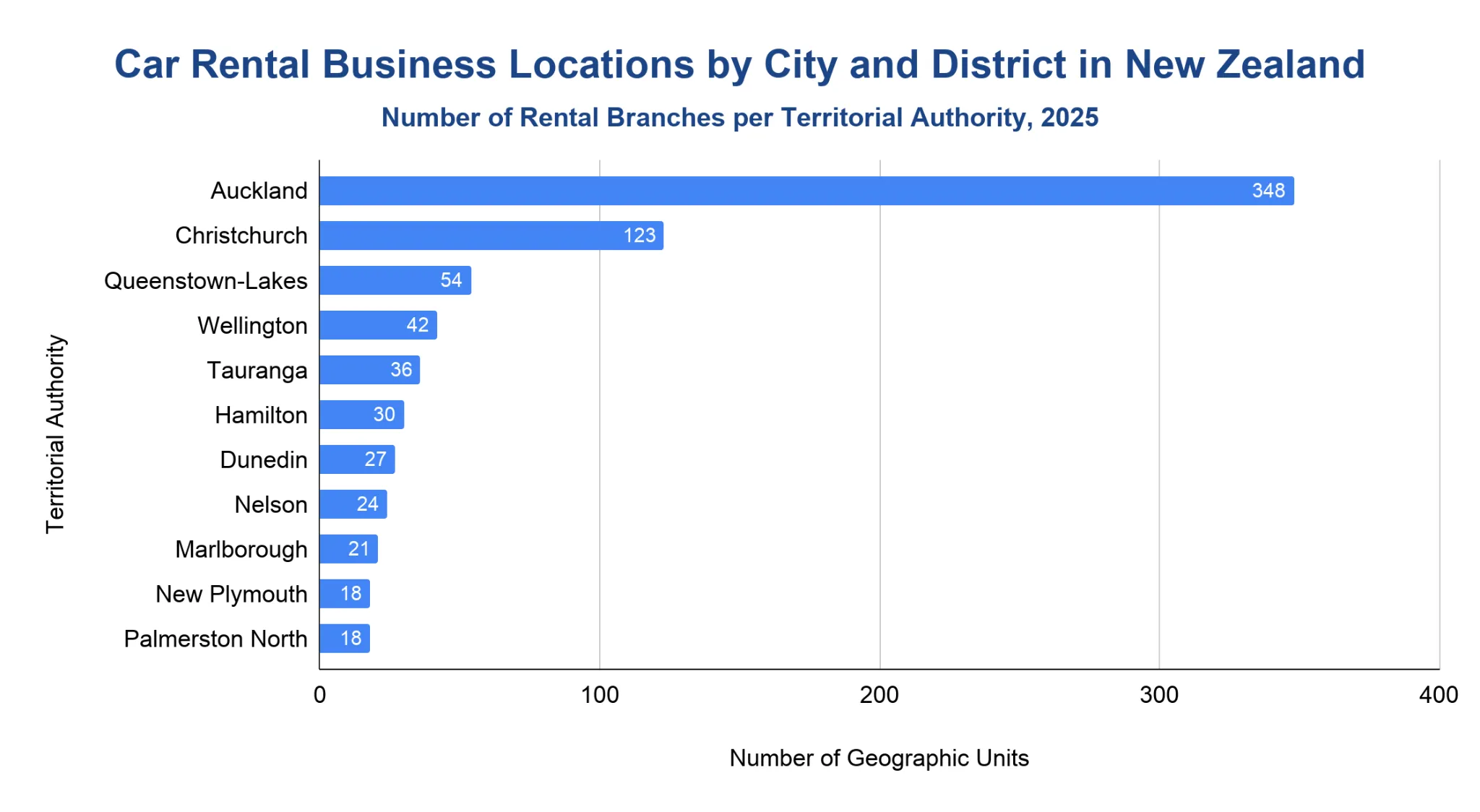
Auckland had 348 passenger car rental and hiring geographic units in 2025, far ahead of Christchurch with 123 and Queenstown-Lakes with 54.
- Auckland accounted for 35.9% of the 969 passenger car rental and hiring geographic units listed across territorial authorities in 2025.
- Christchurch ranked second with 123 geographic units, equal to 12.7% of the territorial-authority total.
- Queenstown-Lakes ranked third with 54 geographic units, reflecting its role as a major visitor destination.
- Together, Auckland, Christchurch, Queenstown-Lakes and Wellington accounted for 58.5% of the total.
- Wellington had 42 geographic units, followed by Tauranga with 36 and Hamilton with 30.
Note: Geographic units are business locations by territorial authority. The percentages in this section are calculated from the 969 territorial-authority geographic units shown in the source table.
What are the cost rules for electric vehicle rentals in New Zealand?
The main national electric vehicle-specific road-cost rule is Road User Charges. Light battery electric vehicles pay NZ$76 per 1,000 kilometres (km) from 1 April 2024, while plug-in hybrid electric vehicles pay NZ$38 per 1,000 km.
- At NZ$76 per 1,000 km, the battery electric vehicle Road User Charges rate equals NZ$0.076 per km.
- A 1,400 km road trip has a battery electric vehicle Road User Charges component of NZ$106.40 before any rental-company billing treatment.
- Budget says paid charging stations may charge by kilowatt-hour use, charging time or percentage of battery charged.
- GO Rentals says Tesla rentals are supplied with about 80% battery charge at pickup.
- During a Tesla rental, GO Rentals says charging costs are passed on to the card listed on the rental agreement.
Note: Road User Charges apply by distance travelled. Charging costs are separate from Road User Charges and can vary by charging provider, vehicle, charging speed and rental-company billing process.
Is New Zealand ready for electric car road trips?
Energy Efficiency and Conservation Authority (EECA) May 2026 dashboard data shows 1,466 public electric vehicle charge points across 582 charging sites and 1,371 charging units, alongside 84,773 registered battery electric vehicles.
- Canterbury had the most public charge points in May 2026, with 328.
- Auckland ranked second for public charge points with 319, while also having the largest battery electric vehicle count at 37,741.
- Nationally, the dashboard data works out to about 58 battery electric vehicles per public charge point.
- EECA says public chargers are located at least every 75 km on most of the state highway network.
- In EECA’s 2025 charging research, 48% of electric vehicle and plug-in hybrid electric vehicle drivers used public charging locations, while 47% agreed there were enough public chargers across New Zealand.
| Region | Charge Points | Sites | BEVs | BEVs Per Charge Point |
|---|---|---|---|---|
| Canterbury | 328 | 118 | 12,756 | 38.9 |
| Auckland | 319 | 135 | 37,741 | 118.3 |
| Wellington | 216 | 87 | 11,909 | 55.1 |
| Waikato | 179 | 73 | 5,556 | 31.0 |
| Bay of Plenty | 73 | 23 | 3,558 | 48.7 |
| Otago | 70 | 30 | 3,571 | 51.0 |
Source · EECA defines a charge point as an individual electrical supply point on a charging unit. The battery electric vehicle count in this table excludes plug-in hybrid electric vehicles.
- Electric Car Rental Statistics in China
- Electric Car Rental Statistics: United States
- Car Rental Statistics in Canada
- Car Rental Statistics in France
- Car Rental Statistics in Germany
- Car Rental Statistics in Ireland
- Car Rental Statistics in Norway
- Car Rental Statistics in Portugal
- Electric Car Rental Statistics: UK
- Car Rental Statistics in the US
What is the outlook for electric car rentals in New Zealand?
The clearest policy signal for electric rentals is charging infrastructure: the Government is targeting 10,000 public charge points by 2030.
- New Zealand’s public charging target is 10,000 public charge points by 2030, according to the Ministry of Transport.
- A March 2026 infrastructure announcement said 2,574 new charge points would be added through zero-interest loans and co-investment with ChargeNet and Meridian Energy.
- Eligible vehicles could receive the Clean Car Discount only if they were registered by 31 December 2023.
- The Clean Car Standard applies to light vehicle importers and is designed to encourage more low- and no-emission vehicle imports.
- New Zealand’s first Emissions Reduction Plan includes a goal for zero-emissions vehicles to reach 30% of the light fleet by 2035.
Note: Public charging policy affects the wider driving environment for electric vehicle renters because rental road trips depend on reliable charging access away from home or depot charging.
References
- Figure.NZ — Rental Enterprise and Location Data (2014–2025) · figure.nz
- Avis New Zealand — Fleet Launch and Model Availability · avis.co.nz
- Budget New Zealand — Model Listings and Charging Guidance · budget.co.nz
- Hertz New Zealand — Electric Vehicle Model Availability · hertz.co.nz
- GO Rentals — Rental Locations and Charging Guidance · gorentals.co.nz
- Ministry of Transport — Road User Charges and Charging Targets · transport.govt.nz
- EECA — Charger Dashboard and Charging Research · eeca.govt.nz
- National Infrastructure Funding and Financing — Charging Loan and Co-Investment Update · nationalinfrastructure.govt.nz
- Inland Revenue — Clean Car Discount and Standard Guidance · ird.govt.nz
- Ministry for the Environment — Emissions Plan and Fleet Goal · environment.govt.nz

