

 Popular Countries
 24/7 Support
Updated
Located in Tababela, 20.5 kilometers from Quito’s city center, Mariscal Sucre International Airport (UIO) operates at an elevation of 2,411 meters and is administered by Corporación Quiport. UIO handled more than 5 million passengers, connected Quito through 12 commercial airlines to 8 domestic and 14 international destinations, and remained Skytrax’s Best Regional Airport in South America for the 11th consecutive year in 2025.
How many passengers use Mariscal Sucre International Airport each year?
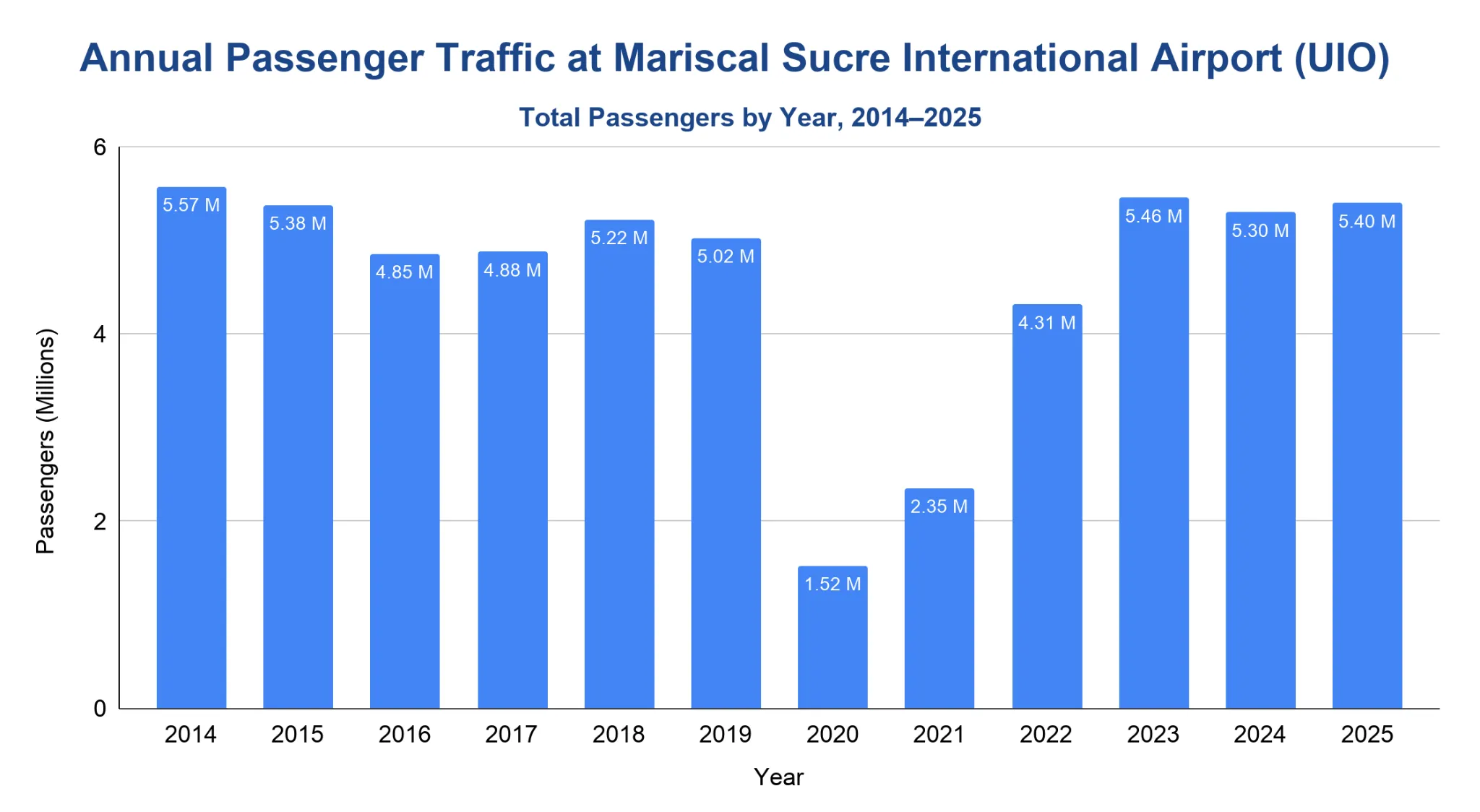
UIO handled 5.4 million passengers in 2025, slightly above the 5.3 million passengers reported for 2024.
- From 2014 to 2018, annual passenger traffic moved from 5.57 million to 5.22 million, with the strongest year in the series still being 2014.
- The pre-pandemic benchmark was 2019, when UIO handled 5.02 million total passengers.
- The pandemic reduced traffic to 1.52 million passengers in 2020, followed by 2.35 million in 2021.
- Post-pandemic traffic rose to 4.31 million in 2022 and 5.46 million in 2023, which was 9% above the 2019 level.
- Official operator summaries report 5.3 million passengers in 2024 and 5.4 million in 2025.
Note: The 2024 and 2025 passenger totals are rounded as published by Quiport.
How many passengers use Mariscal Sucre International Airport for domestic vs international travel?
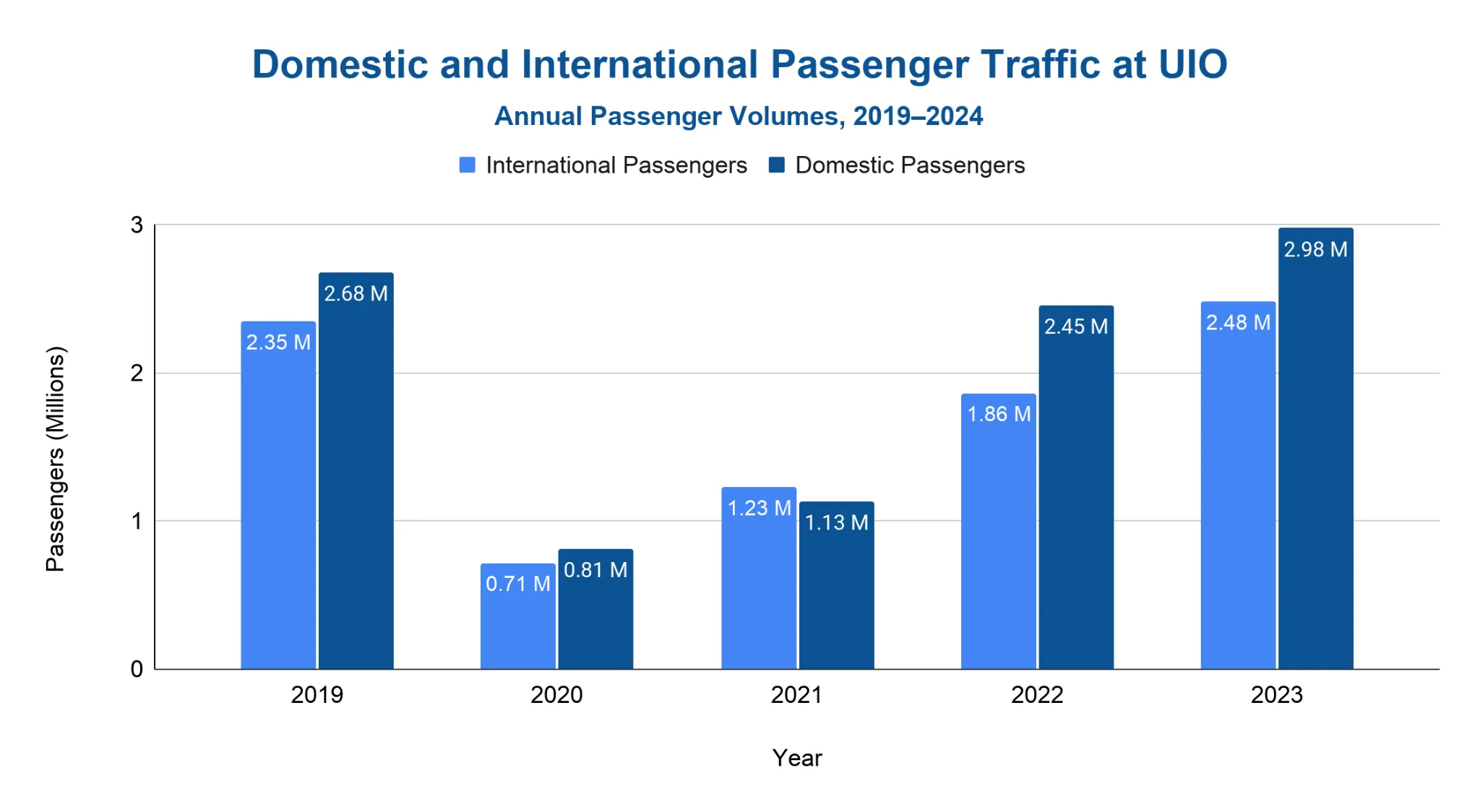
UIO recorded 2.98 million domestic passengers and 2.48 million international passengers in 2023.
- Domestic traffic represented a calculated 54.55% of the 2023 total, while international traffic represented 45.45%.
- In the pre-pandemic year 2019, domestic passengers totaled 2.68 million, while international passengers totaled 2.35 million.
- During the pandemic, traffic fell to 807,514 domestic passengers and 714,166 international passengers in 2020.
- Post-pandemic traffic rose through 2021 and 2022, then reached 5.46 million total passengers in 2023.
Note: Rounded domestic and international figures may not add exactly to the rounded total passenger figure.
How much revenue does Mariscal Sucre International Airport generate annually?
The Metropolitan Airport Services Public Company (EPMSA) reported US$12.26 million in accrued airport-services income in 2024.
- The public airport-services income budget was 100% self-managed in 2024.
- The approved annual budget was revised to US$11.58 million in July 2024.
- By December 2024, accrued income reached 105.87% of the revised annual budget.
- Executed income reached US$10.40 million in 2024.
When are the peak travel months at Mariscal Sucre International Airport?
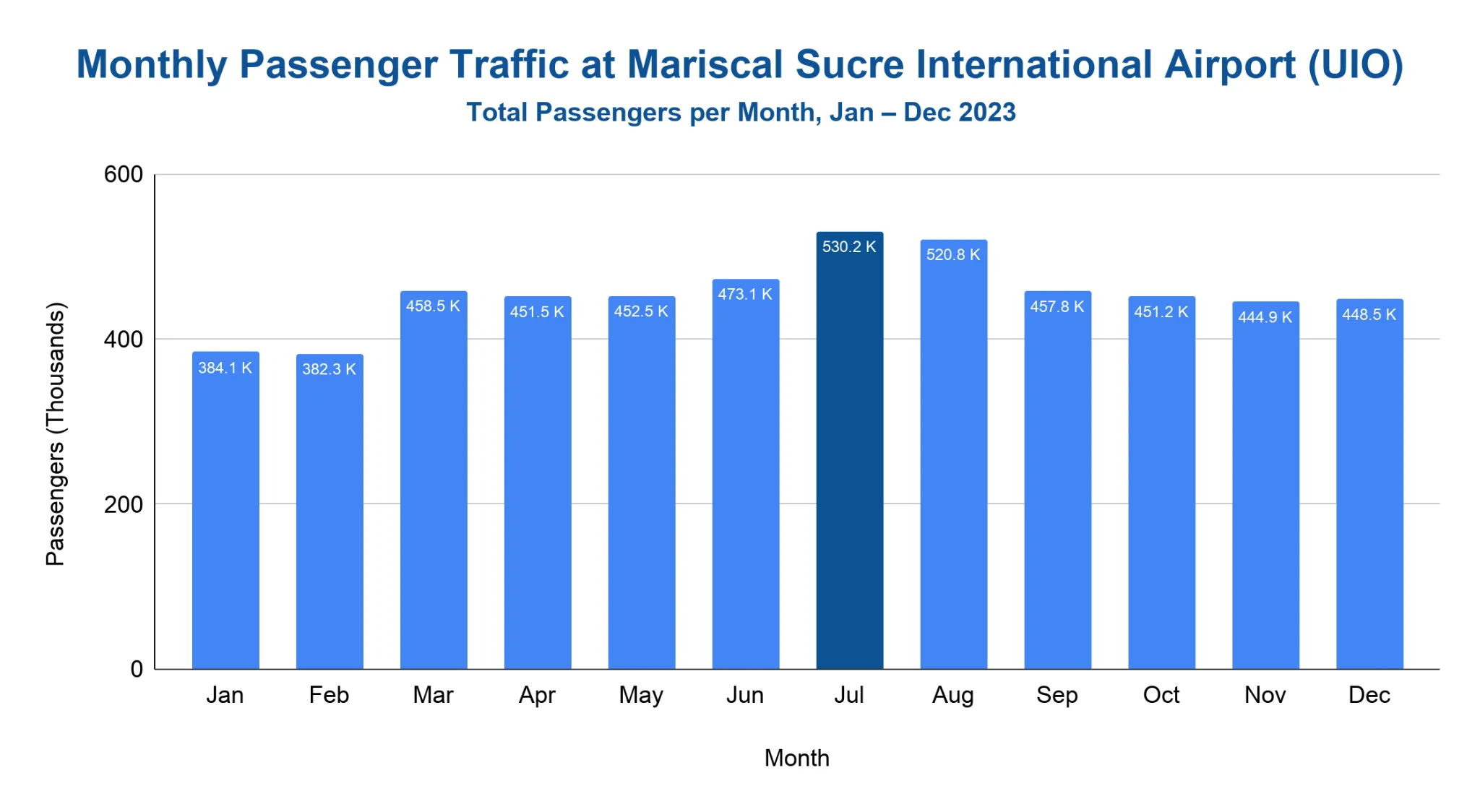
July was UIO’s busiest month in 2023, with 530,203 total passengers.
- August followed with 520,771 total passengers.
- January and February were the lowest months in the 2023 official monthly data, with 384,055 and 382,252 passengers.
- March, April and May each exceeded 451,000 passengers in 2023.
- October recorded 451,228 passengers, while November recorded 444,888.
How much cargo moves through Mariscal Sucre International Airport annually?
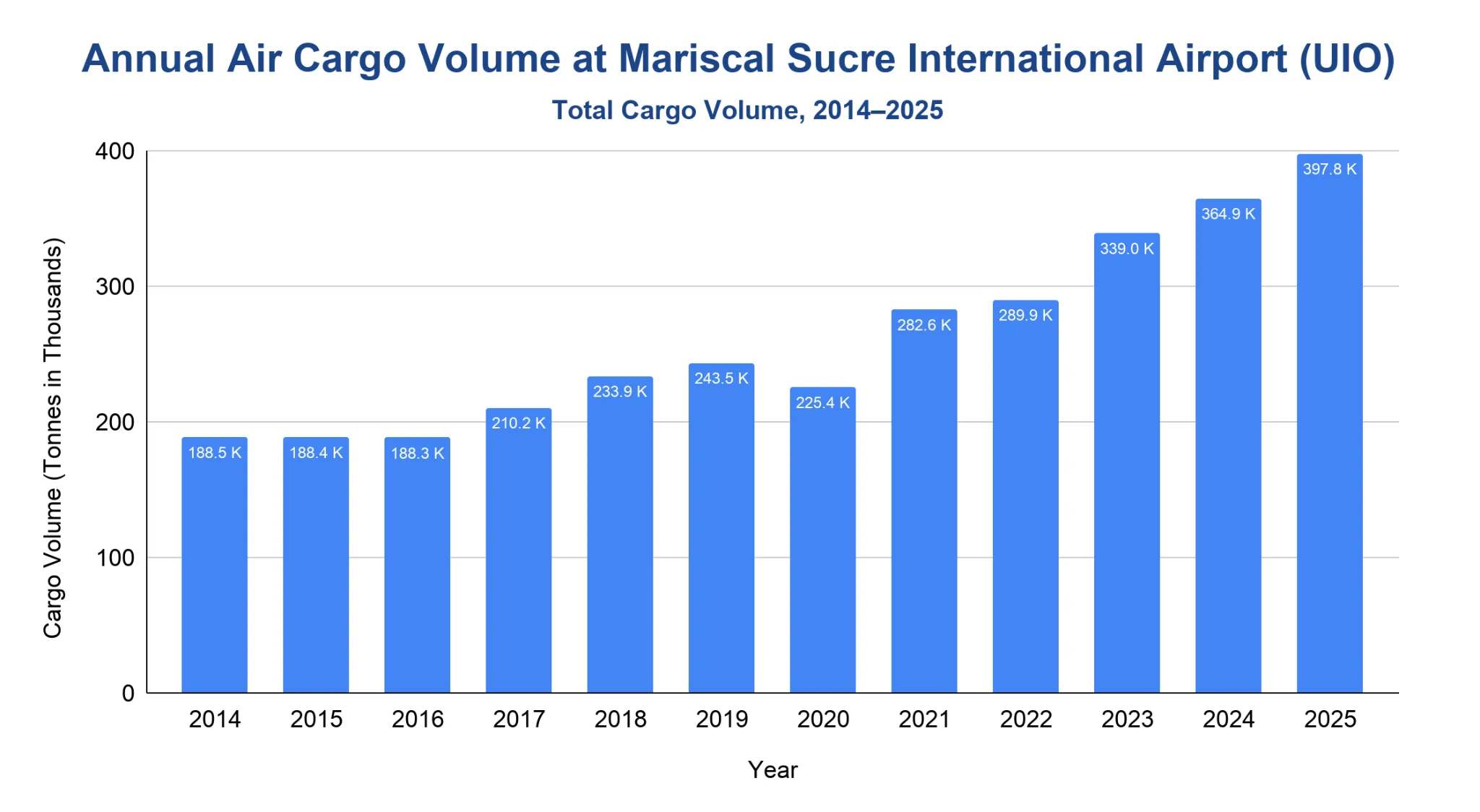
UIO handled 397,799 tonnes of cargo in 2025, according to DGAC’s airport-level cargo release.
- From 2014 to 2018, cargo rose from 188,535 to 233,898 tonnes.
- The pre-pandemic benchmark was 2019, when UIO handled 243,492 tonnes.
- Cargo declined to 225,372 tonnes in 2020, then rebounded to 282,587 tonnes in 2021.
- Post-pandemic volumes increased to 289,862 tonnes in 2022, 338,961 tonnes in 2023, and 364,905 tonnes in 2024.
- In 2025, UIO led Ecuador’s air-cargo system with 397,799 tonnes out of 424,790 tonnes moved nationwide.
- Quiport reported 16 cargo airlines in operation in 2025, with flowers representing 93% of exported cargo from the airport.
How reliable is Mariscal Sucre International Airport in terms of on-time performance?
UIO posted 90.29% on-time departures in Cirium’s 2023 On-Time Performance Review, as reported by Quiport.
- Quito won the “Most On-Time Airport” title in the small-airport category for 2023.
- The on-time definition used in the cited Quiport report is a flight departure within 15 minutes of the scheduled time.
- The airport’s 2025 year-end summary also listed Quito among the world’s most punctual airports, according to Cirium.
- Operational improvements in 2025 included biometric gates for international departures.
Major Expansion Projects at Mariscal Sucre International Airport
The US$74.2 million terminal expansion entered operation in 2025, raising UIO’s processing capacity from 5 million to more than 7 million passengers per year.
- The expansion added 17,647 m² to the passenger terminal and 35,000 m² to the apron.
- New passenger-processing areas include 20 airline check-in counters, 12 self-check-in units and a preboarding room for 350 passengers.
- Apron works added 1 code E aircraft stand, 2 remote code C stands, 1 new boarding bridge and an expanded taxiway.
- The project began in 2019, paused in 2020 because of the pandemic, resumed in 2024, and was inaugurated in 2025.
- The ZEDE-Quito economic zone covers 205.01 hectares beside the airport and is authorized for industrial and logistics activities.
Other Airport Statistics
- Amsterdam Airport Schiphol (AMS) Statistics
- Baku Airport (GYD) Statistics
- Brussels Airport Statistics
- Oslo Airport Statistics
- Salalah International Airport (SLL) Statistics
- Lisbon Airport Statistics
- Hamad International Airport (DOH) Statistics
- Singapore Changi Airport (SIN) Statistics
- Johannesburg OR Tambo Airport Statistics
- Seoul Gimpo Airport Statistics
- Seoul Incheon Airport (ICN) Statistics
- Dubai International Airport (DXB) Statistics
Sustainability Initiatives at Mariscal Sucre International Airport
Quito Airport’s UIO Natural Laboratory covered 150 hectares and earned Green Airport Recognition for biodiversity and air-operations coexistence in 2025.
- Quito Airport reached Airport Carbon Accreditation Level 4+ Transition after previously obtaining Level 3+ Neutrality in 2019 and renewing that neutrality certification in 2021 and 2022.
- The airport’s 2018 carbon footprint was calculated at 3,273 tonnes of CO₂, a 41% reduction from the 2014 baseline of 5,534 tonnes.
- The waste decarbonization program uses 5 biodigesters and 12 composters.
- The waste program had avoided 75 tonnes of landfill waste by the 2024 award release.
- By 2035, the waste program is expected to prevent 1,246 tonnes of CO₂e.
- The UIO Natural Laboratory has restored more than 72 hectares, planted 12,000 native trees, captures around 400 tonnes of CO₂ per year and has released more than 160 wild animals.

