

 Popular Countries
 24/7 Support
Published
Lisbon’s Humberto Delgado Airport (LIS), or Lisbon Airport, is Portugal’s main international airport and one of the fastest-growing major aviation hubs in Europe. It connects the capital to more than 145 destinations worldwide and handles over half of Portugal’s total air traffic.
How many passengers pass through Lisbon Airport each year?
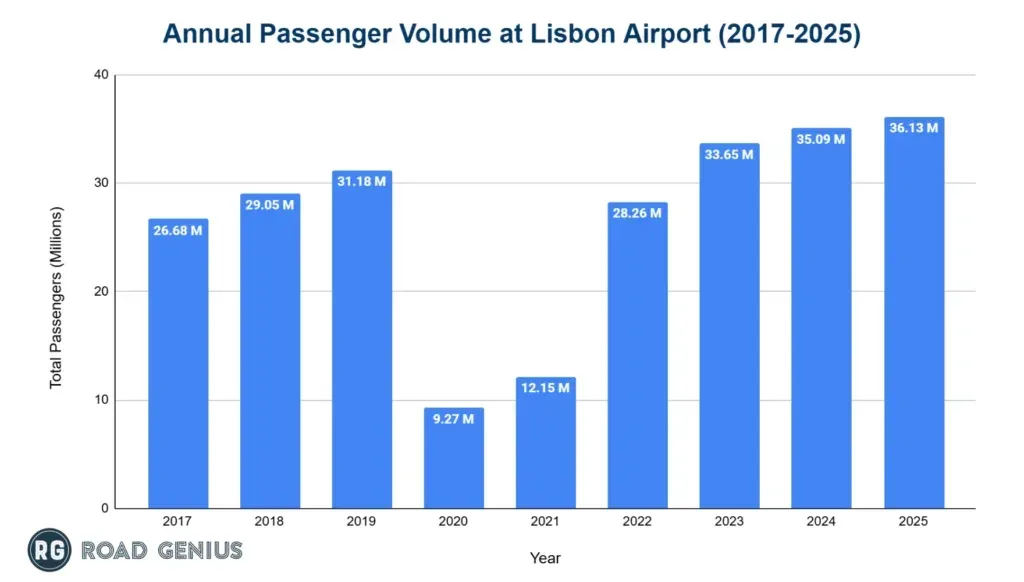
Lisbon Airport handles over 30 million passengers annually, making it the 12th busiest airport in Europe and an important intercontinental hub.
- The airport served 36.13 million passengers in 2025, a 3.0% increase from 35.09 million in 2024 and the highest figure on record.
- Before the COVID-19 pandemic, traffic peaked at 31.18 million in 2019 but dropped sharply by 70% to 9.27 million in 2020.
- Recovery followed with 12.15 million in 2021 and 28.26 million in 2022, a 132.6% year-over-year increase as travel restrictions eased.
- In 2023, the airport handled 33.65 million passengers, a 19.1% rise from the year before.
Arrival vs Departure
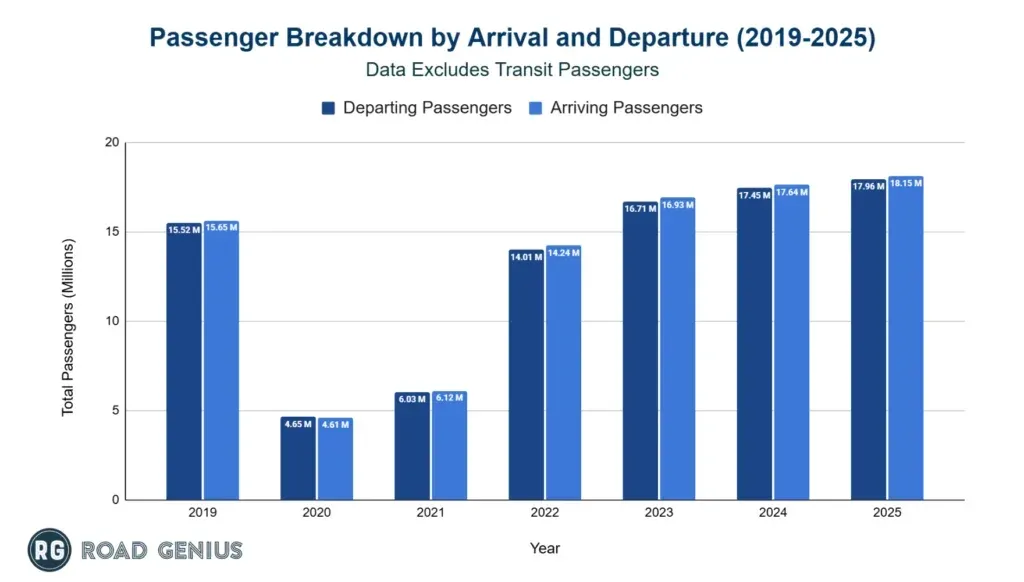
Lisbon Airport maintains a balanced flow of arriving and departing passengers, reflecting its role as both a destination and a departure hub.
- In 2025, 17.96 million passengers departed the airport.
- The number of arriving passengers was 18.15 million, maintaining a close balance between departing and arriving passengers.
What is the total number of aircraft operations at Lisbon Airport each year?
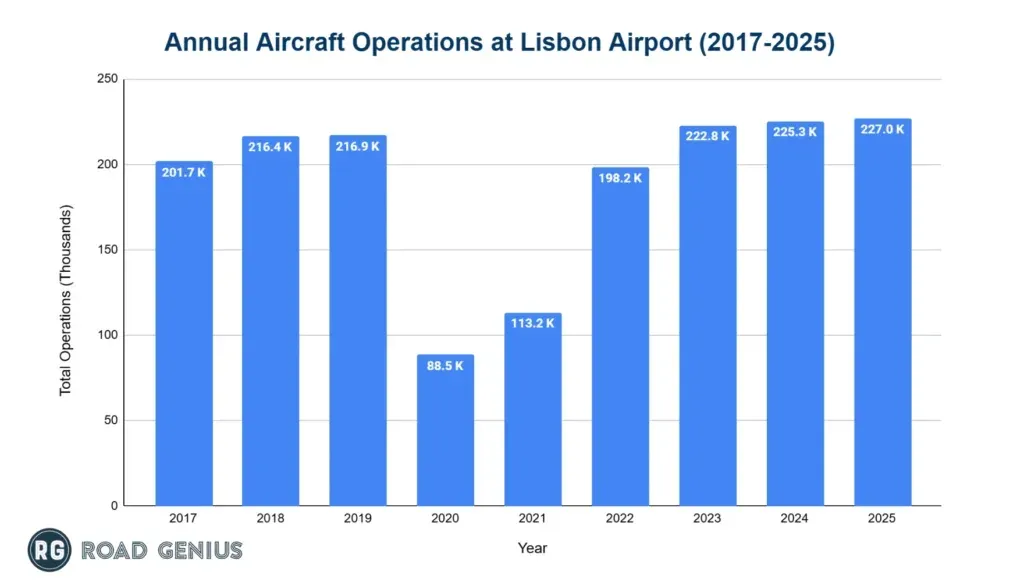
Lisbon Airport records over 200,000 aircraft movements annually. However, growth in flight operations has lagged behind passenger growth due to capacity constraints.
- The airport logged 226,998 aircraft movements in 2025, a modest 0.8% increase from 225,268 aircraft movements in 2024.
- Aircraft movements peaked at 216,917 in 2019, then dropped to 88,518 in 2020 amid travel restrictions.
- Recovery continued with 113,236 movements in 2021 and 198,200 in 2022.
- By 2023, movements reached 222,752, showing a steady post-pandemic recovery.
Which airlines operate the most flights out of Lisbon Airport?
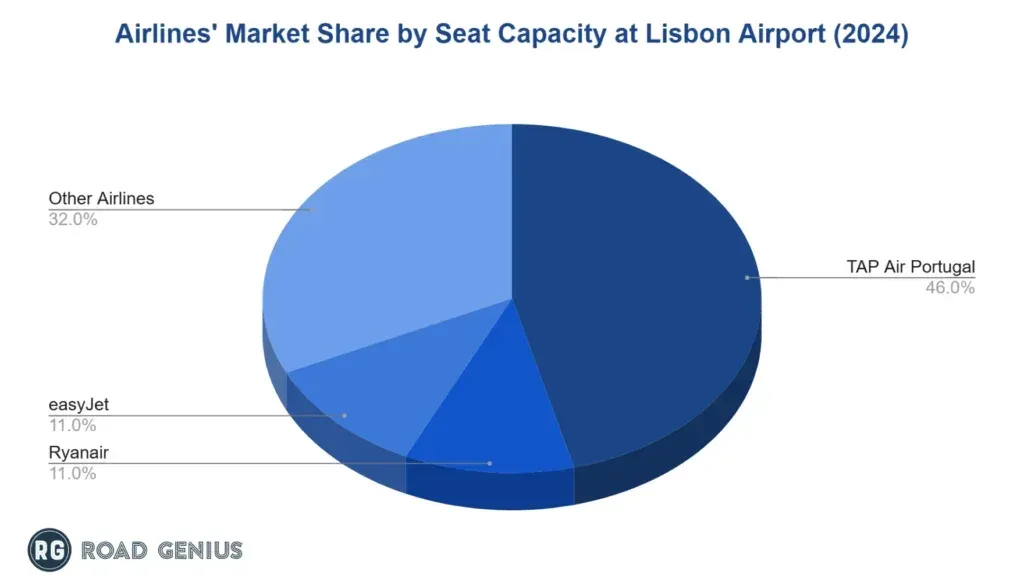
TAP Air Portugal leads flight operations at LIS, supported by several low-cost carriers that expand route options.
- In 2024, TAP held 46% of total seat capacity, operating a hub-and-spoke network with a focus on transatlantic routes.
- Ryanair accounted for about 11% of capacity, offering low-cost options on major European routes.
- easyJet also held an 11% share, contributing to strong budget airline coverage and leisure travel access.
What are the monthly trends in passenger traffic at Lisbon Airport?
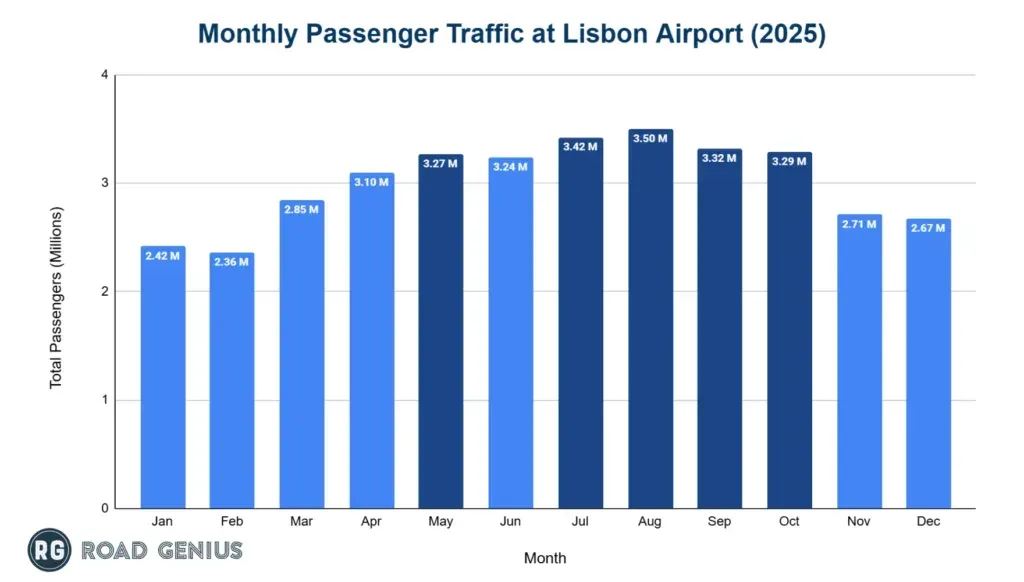
Passenger volumes at LIS follow a seasonal trend, with peak traffic in summer and lower volumes in winter.
- August 2025 had the highest amount of traffic, with 3.5 million passengers.
- July followed with 3.42 million.
- September and October saw 3.32 million and 3.29 million passengers respectively.
- January and February were the slowest months, with 2.42 million and 2.36 million passengers.
How many routes are there at Lisbon Airport?
- Lisbon Airport serves around 145 to 147 destinations through a mix of full-service and low-cost airlines.
- Approximately 60 airlines operate at LIS, offering a range of pricing and service levels.
- Across Portugal, the total number of airport routes expanded from 722 in 2019 to 827 in 2024, showing steady growth after pandemic disruption.
- Lisbon plays a strategic role as a gateway to Brazil and Latin America, with expanding links to North America and Africa.
Which destinations are the most popular from Lisbon Airport?
European Destinations
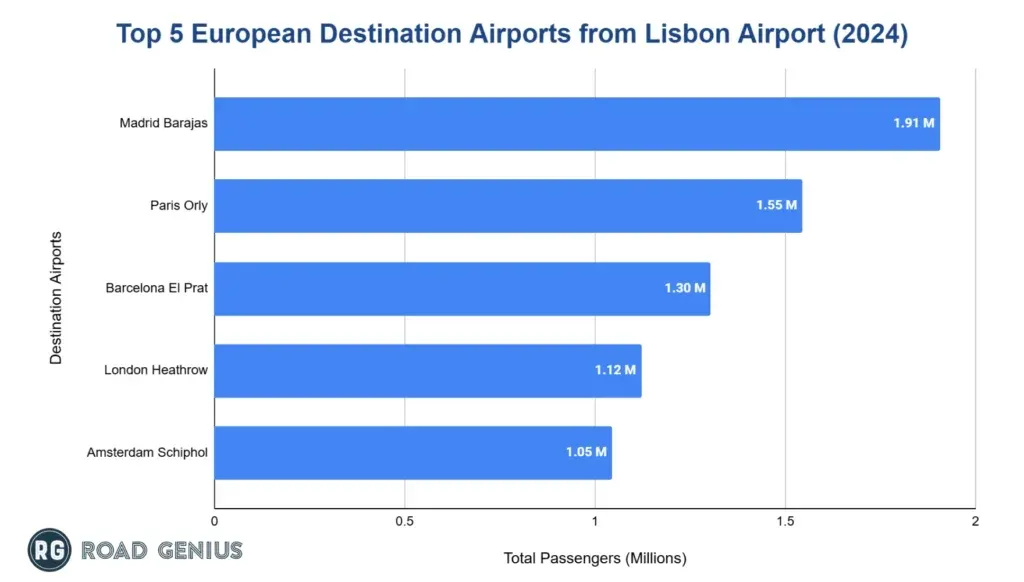
- Madrid (MAD) carried 1.91 million passengers in 2024, making it the busiest European route from Lisbon.
- Paris (ORY) handled 1.55 million passengers, serving as a major connection point to France.
- Barcelona (BCN) transported 1.3 million passengers, maintaining strong Spain-Portugal connectivity.
- London-Heathrow (LHR) served 1.12 million passengers, providing critical UK business and leisure links.
- Amsterdam (AMS) carried 1.05 million passengers, offering extensive European hub connections.
Intercontinental Destinations
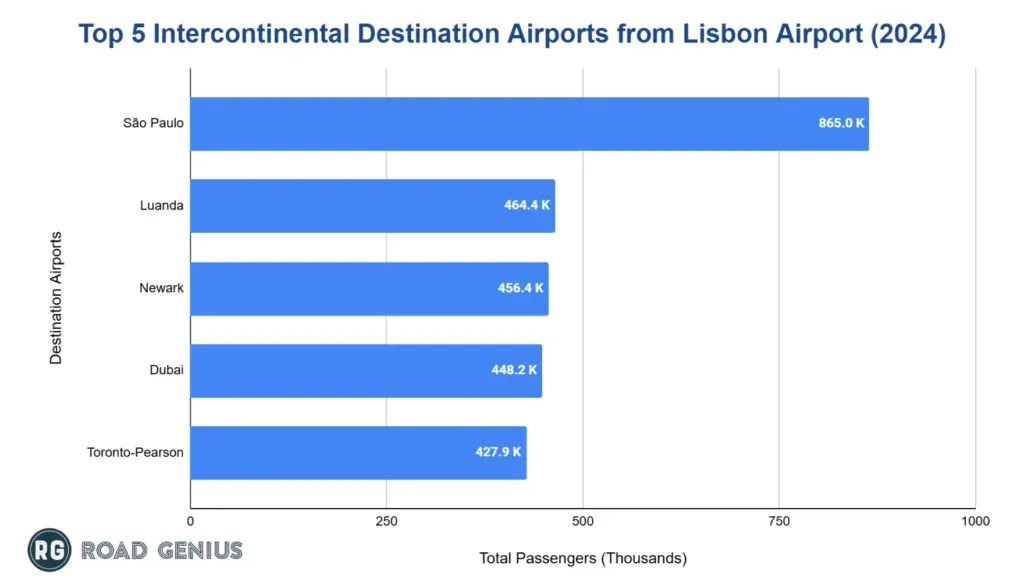
- São Paulo (GRU) handled 864,997 passengers in 2024, serving as the primary gateway to Brazil and South America.
- Luanda (LAD) carried 464,375 passengers, maintaining important historical ties with Angola.
- Newark (EWR) served 456,445 passengers, representing key North American business connections.
- Dubai (DXB) transported 448,150 passengers, providing Middle East and Asia connectivity.
- Toronto-Pearson (YYZ) handled 427,884 passengers, offering additional North American market access.
Domestic Destinations
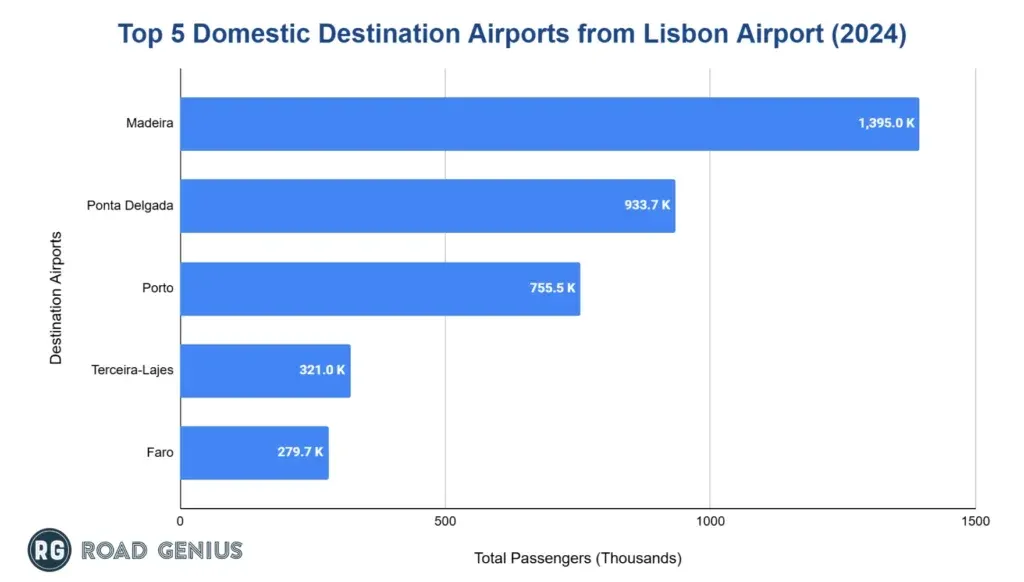
- Madeira (FNC) carried 1.4 million passengers in 2024, providing essential connectivity to Madeira.
- Ponta Delgada (PDL) handled 933,707 passengers, serving the Azores’ main island.
- Porto (OPO) transported 755,476 passengers, connecting Portugal’s two major cities.
- Terceira-Lajes (TER) served 320,984 passengers, linking to another key Azores destination.
- Faro (FAO) carried 279,682 passengers, connecting the capital to the Algarve region.
How much cargo does Lisbon Airport handle annually?
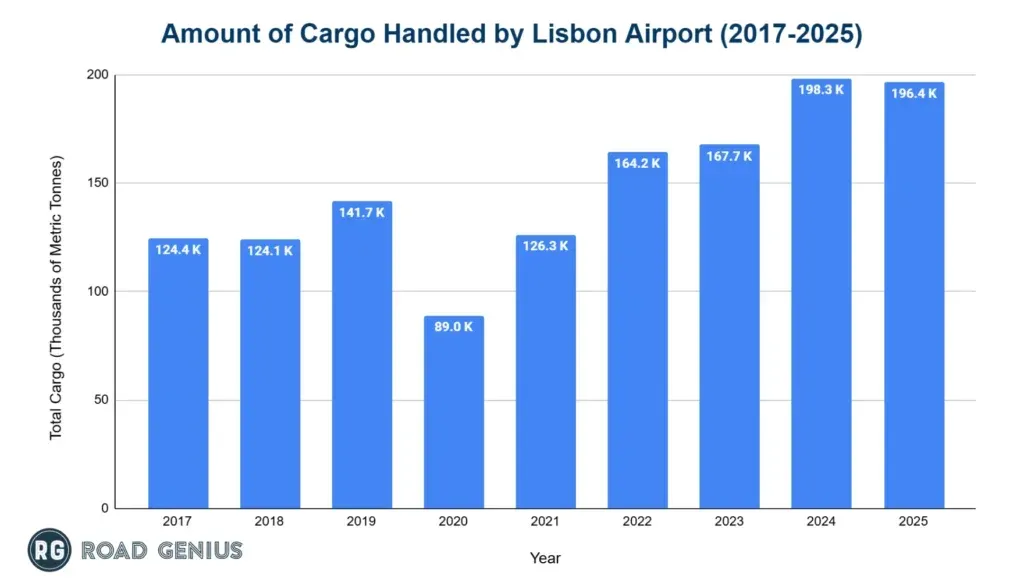
Lisbon Airport is also a major European cargo hub, with freight volumes rising faster than passenger numbers.
- The airport handled 196,405 metric tonnes of cargo in 2025, a 0.9% decrease from 198,288 metric tonnes in 2024.
- Pre-pandemic volumes were 141,656 metric tonnes in 2019, dropping to 88,960 metric tonnes in 2020.
- Recovery continued through 126,305 metric tonnes in 2021 and 164,216 metric tonnes in 2022.
- Cargo volumes reached 167,653 metric tonnes in 2023, highlighting consistent growth in freight operations.
How much revenue has Lisbon Airport generated each year?
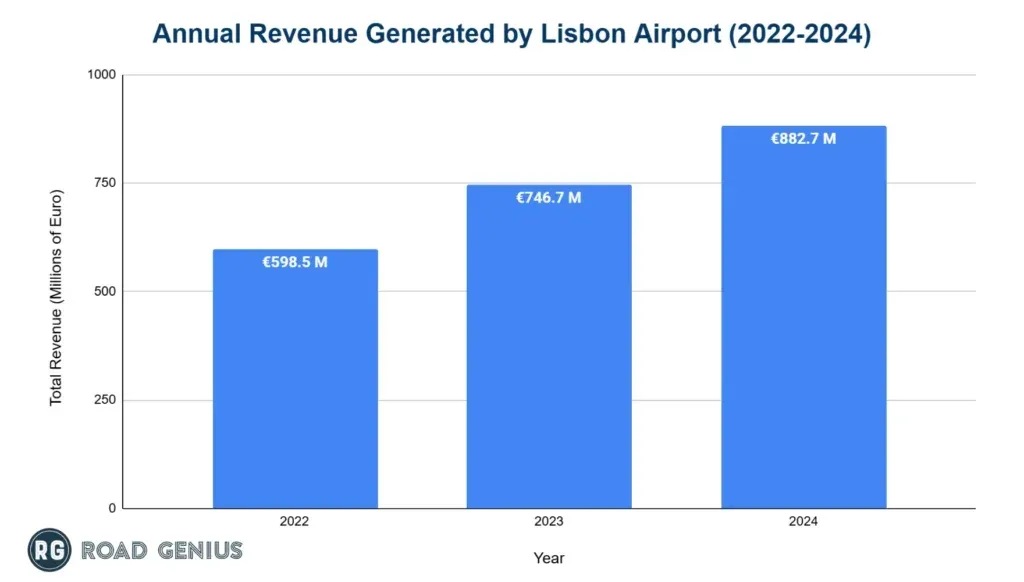
- Lisbon Airport generated €882.7 million in revenue in 2024, an 18.2% increase over 2023 and the highest figure to date.
- Revenue totaled €746.7 million in 2023, reflecting ongoing recovery and expansion.
- Revenue stood at €598.5 million in 2022, showing early signs of financial rebound after the pandemic.
More Statistics
- Amsterdam Airport Schiphol (AMS) Statistics
- Dubrovnik Airport Statistics
- Hong Kong International Airport (HKG) Statistics
- Bergen Airport Statistics
- Porto Airport Statistics
- Hamad International Airport (DOH) Statistics
- Seoul Incheon Airport (ICN) Statistics
- Geneva Airport Statistics
- Ankara Esenboğa Airport (ESB) Statistics
- Istanbul Airport (IST) Statistics
- Dubai International Airport (DXB) Statistics
- Da Nang Airport Statistics
What are the main causes of flight disruptions at Lisbon Airport?
- Single runway operations limit capacity and cause bottlenecks.
- Labor actions, including ground handling strikes, disrupt check-in, baggage and aircraft services.
- Power infrastructure failures, like the May 2025 Iberian Peninsula outage, caused widespread cancellations.
- Air Traffic Control issues, including staffing shortages, lead to network-wide delays.
- Aerodrome capacity limitations are a key factor, especially during peak hours.
- A high-pressure operational environment reduces margin for error and limits the airport’s ability to absorb disruptions.
What are some notable incidents at Lisbon Airport?
- March 3, 2021: A KLM Boeing 737-800 overran the runway due to incorrect takeoff performance calculations. The aircraft became airborne just 284 meters from the runway end. Investigators linked the incident to similar events involving other airlines.
- December 4, 1980: A Cessna 421 carrying Portuguese Prime Minister Francisco de Sá Carneiro crashed into buildings in Camarate shortly after takeoff, killing all seven people on board.
References
- Porto Airport Traffic Statistics — INE · ine.pt
- Airlines' Market Share by Seat Capacity at Lisbon Airport — Air Service One · airserviceone.com
- Top Destinations from Lisbon Airport — Eurostat air passenger transport (avia_par_pt) · ec.europa.eu
- Portuguese Airport Annual Passenger, Flight, Cargo and Financial Data · ana.pt

