

 Popular Countries
 24/7 Support
Updated
Since opening on July 6, 1998, Hong Kong International Airport (HKIA) has become one of Asia's key aviation hubs. The airport connects Hong Kong to more than 200 destinations worldwide through about 140 airlines and is a critical bridge between Mainland China and the wider Asia-Pacific region.
How many passengers use Hong Kong International Airport each year?
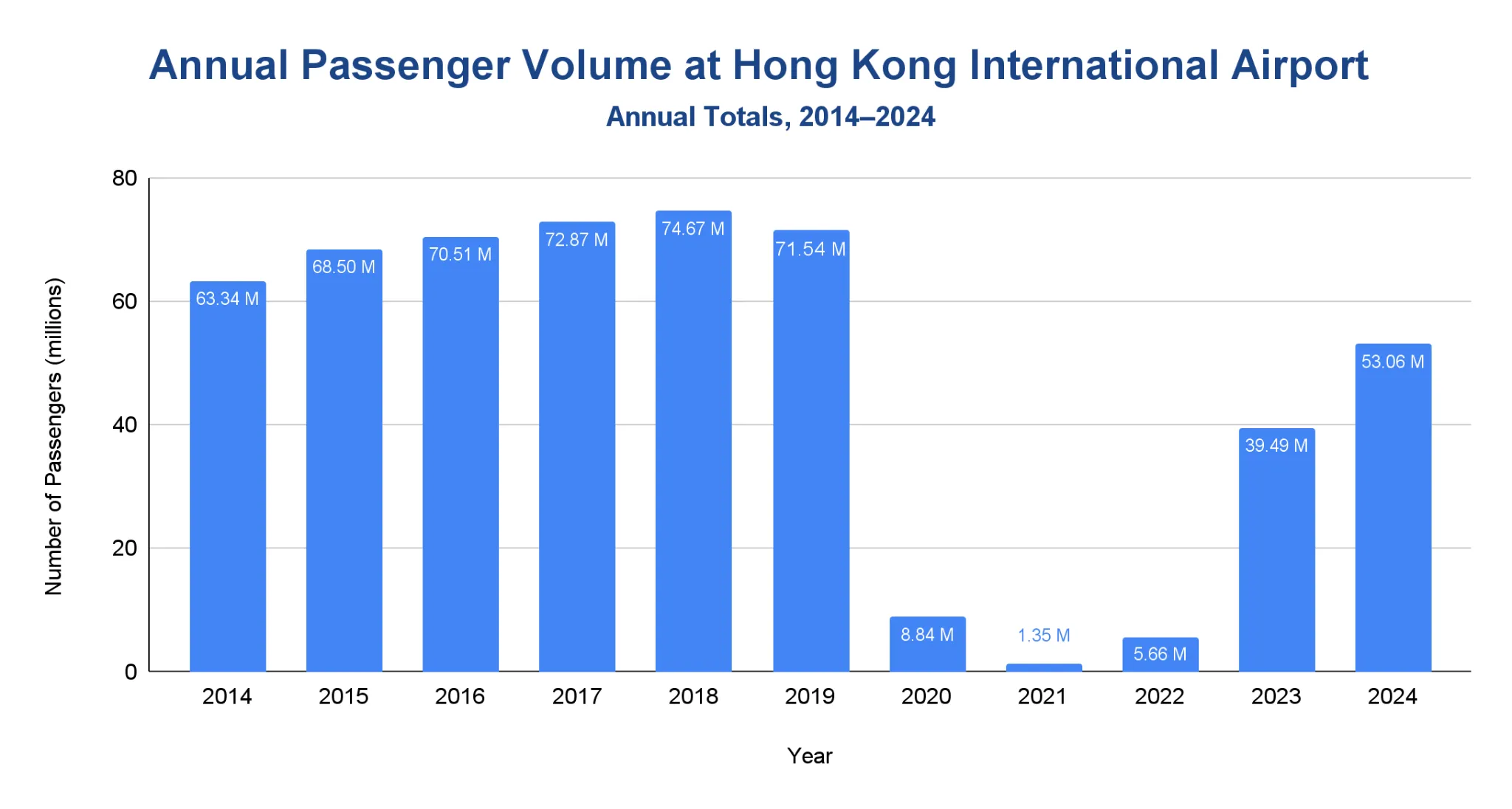
Hong Kong International Airport handled 53.06 million passengers in 2024, at 71% of its 2018 peak before the COVID-19 pandemic.
- HKIA reached its record of 74.67 million passengers in 2018.
- Traffic dipped to 71.54 million in 2019 amid late-year social unrest in Hong Kong.
- The pandemic caused an unprecedented collapse, and the airport served only 8.84 million passengers in 2020, then 1.35 million in 2021.
Does HKIA Operate Any Domestic Flights?
No. Hong Kong International Airport does not operate scheduled domestic passenger flights. HKIA’s air traffic statistics are published as Finalized Civil International figures, with military and local flights excluded.
How many aircraft movements take place at Hong Kong International Airport each year?
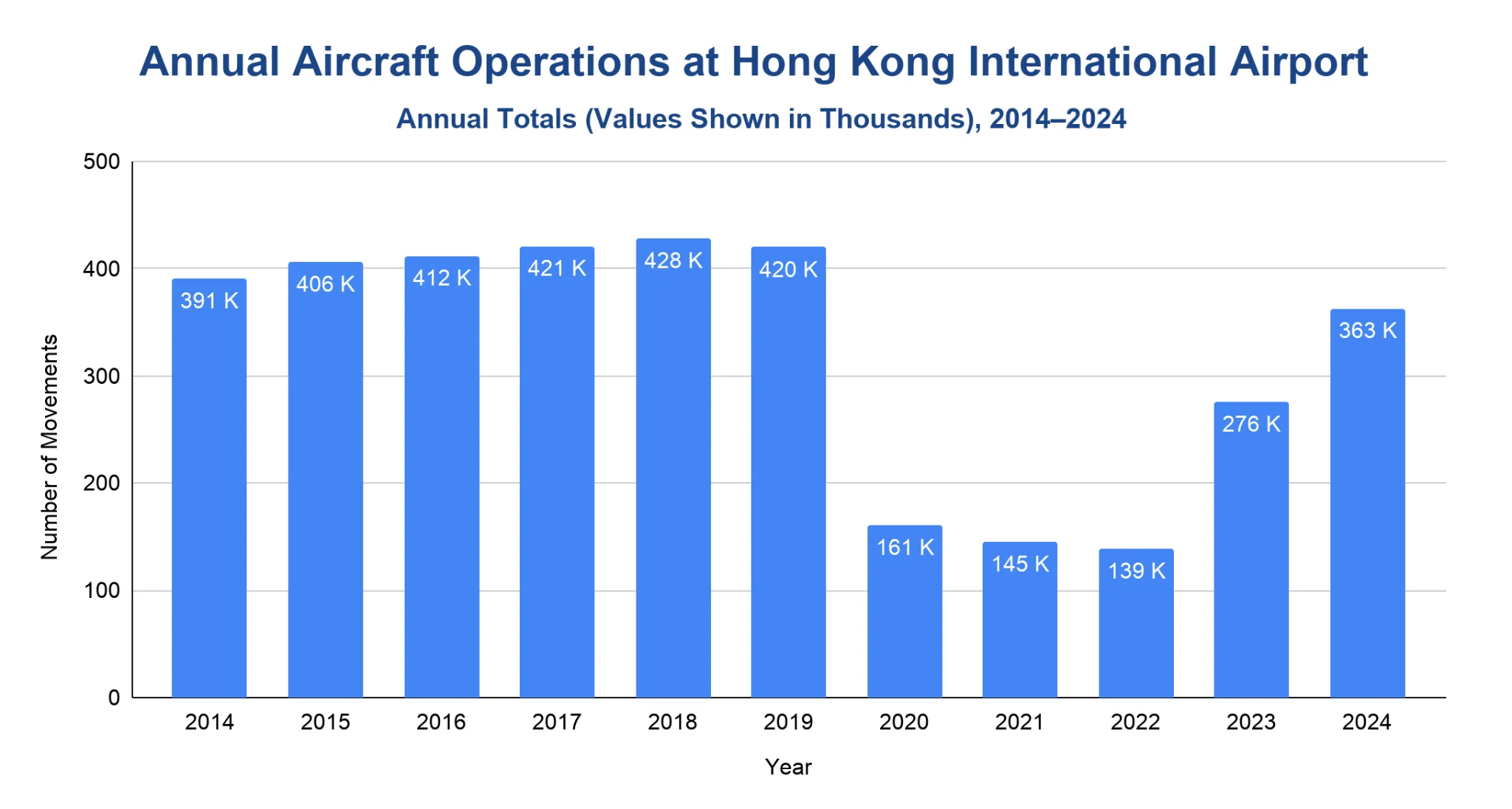
HKIA recorded 363,000 aircraft movements in 2024, around 86.4% of 2019 levels.
- Passenger movements comprised 76%, cargo movements 21.5% and non-revenue movements the remainder.
- The airport peaked at 428,000 movements in 2018 and 420,000 in 2019.
- Operations dropped to 161,000 in 2020, and reached a low of 139,000 in 2022.
What are the busiest international routes from Hong Kong International Airport by scheduled seats?
Hong Kong International Airport’s busiest international routes shift with travel demand and airline schedules, especially across nearby Asia-Pacific markets.
- Hong Kong (HKG)–Taipei (TPE) was the world’s busiest international route in 2024 by scheduled seats with around 6.8 million seats.
- This route, often called the 'Golden Route,' maintains its top ranking due to high-frequency 'shuttle' demand for business travelers.
- It also serves a role as a primary transit link for passengers connecting between Taiwan and Mainland China or North America.
- In 2023, HKG–TPE ranked 3rd globally among international routes with 4.6 million seats.
Note: These rankings are from OAG and are based on scheduled airline seats (capacity) across both directions for the full year, not passenger counts.
How much revenue does Hong Kong Airport generate?
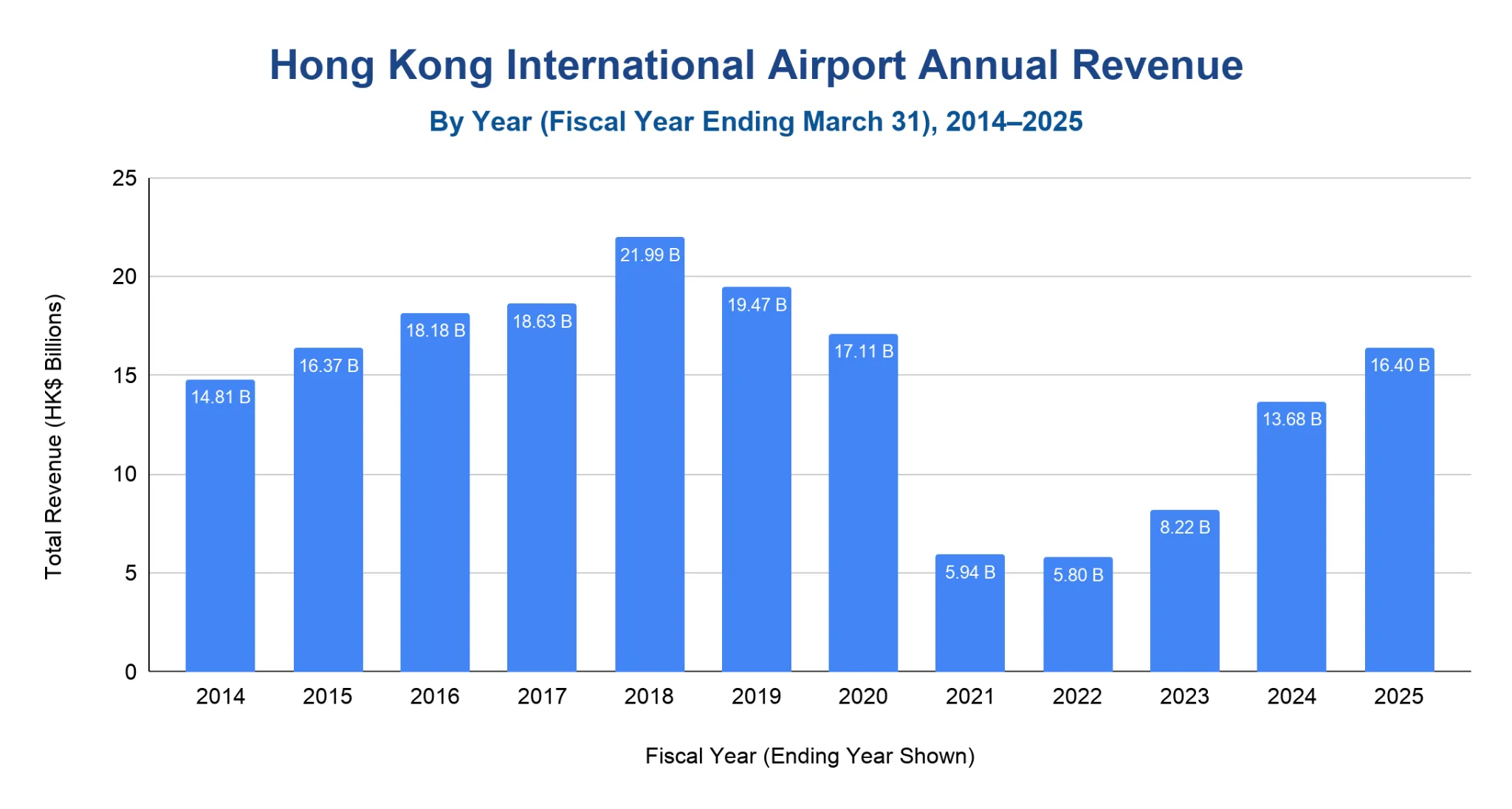
Revenue peaked at HK$21.99 billion in 2018 before falling to a low of HK$5.8 billion in 2022.
- 2019 generated HK$19.47 billion with a balanced mix of aeronautical and non-aeronautical income.
- Revenue rebounded to HK$8.22 billion in 2023 as passenger traffic returned.
- Revenue rose to HK$13.68 billion in 2024 and HK$16.40 billion in 2025.
Note: Revenue figures are reported on a fiscal-year basis, with the ending year shown for readability.
How much cargo moves through Hong Kong International Airport each year?
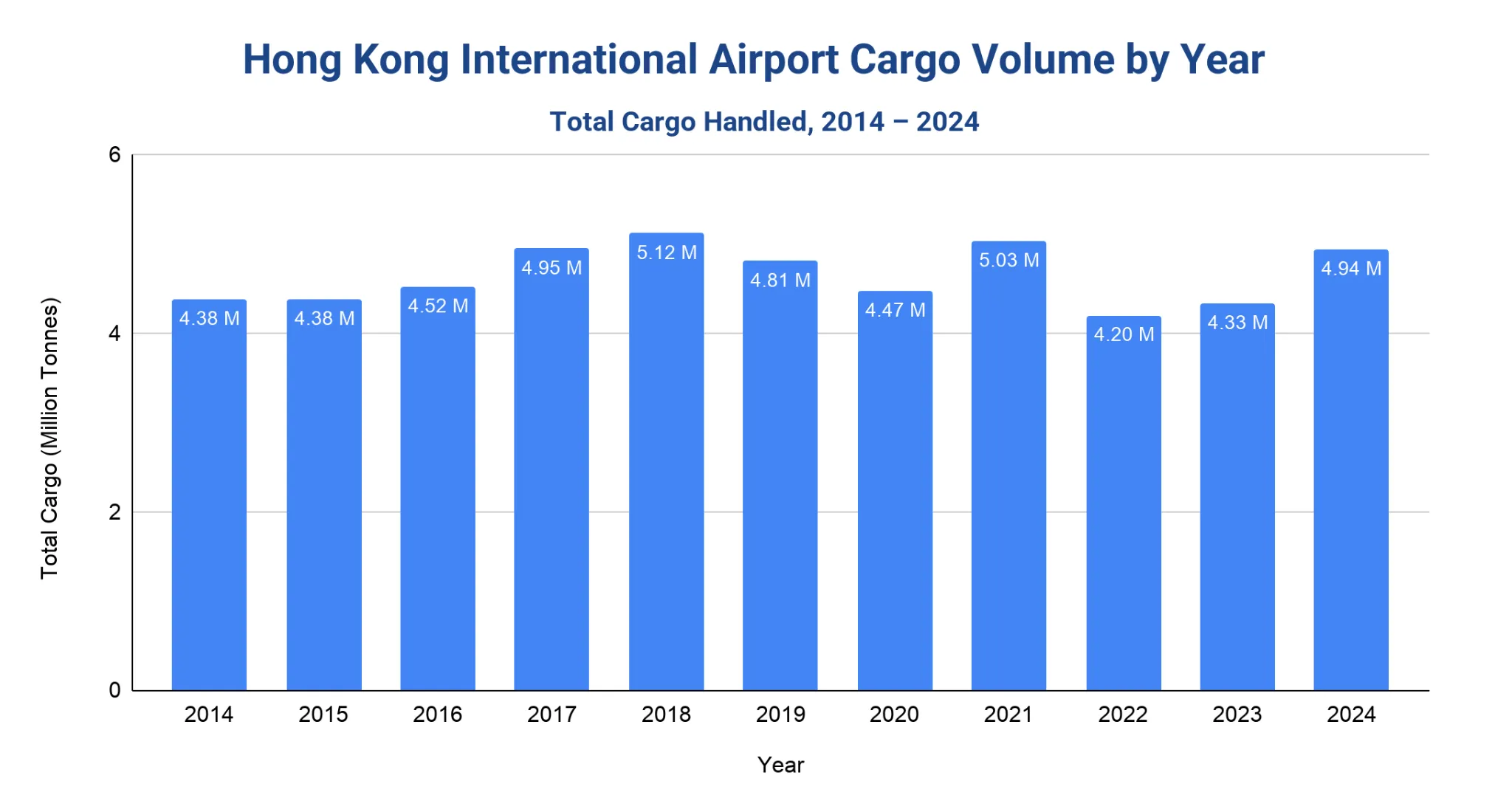
HKIA processed 4.94 million tonnes of cargo in 2024, keeping its place among the world's leading air-freight hubs.
- Record volumes reached 5.12 million tonnes in 2018 and 5.03 million tonnes in 2021.
- Cargo showed resilience during the pandemic, contrasting with passenger trends, with a 7.1% decline in 2020 vs 2019.
- Cargo loaded exceeded cargo unloaded (3.65 million tonnes loaded vs 1.29 million tonnes unloaded).
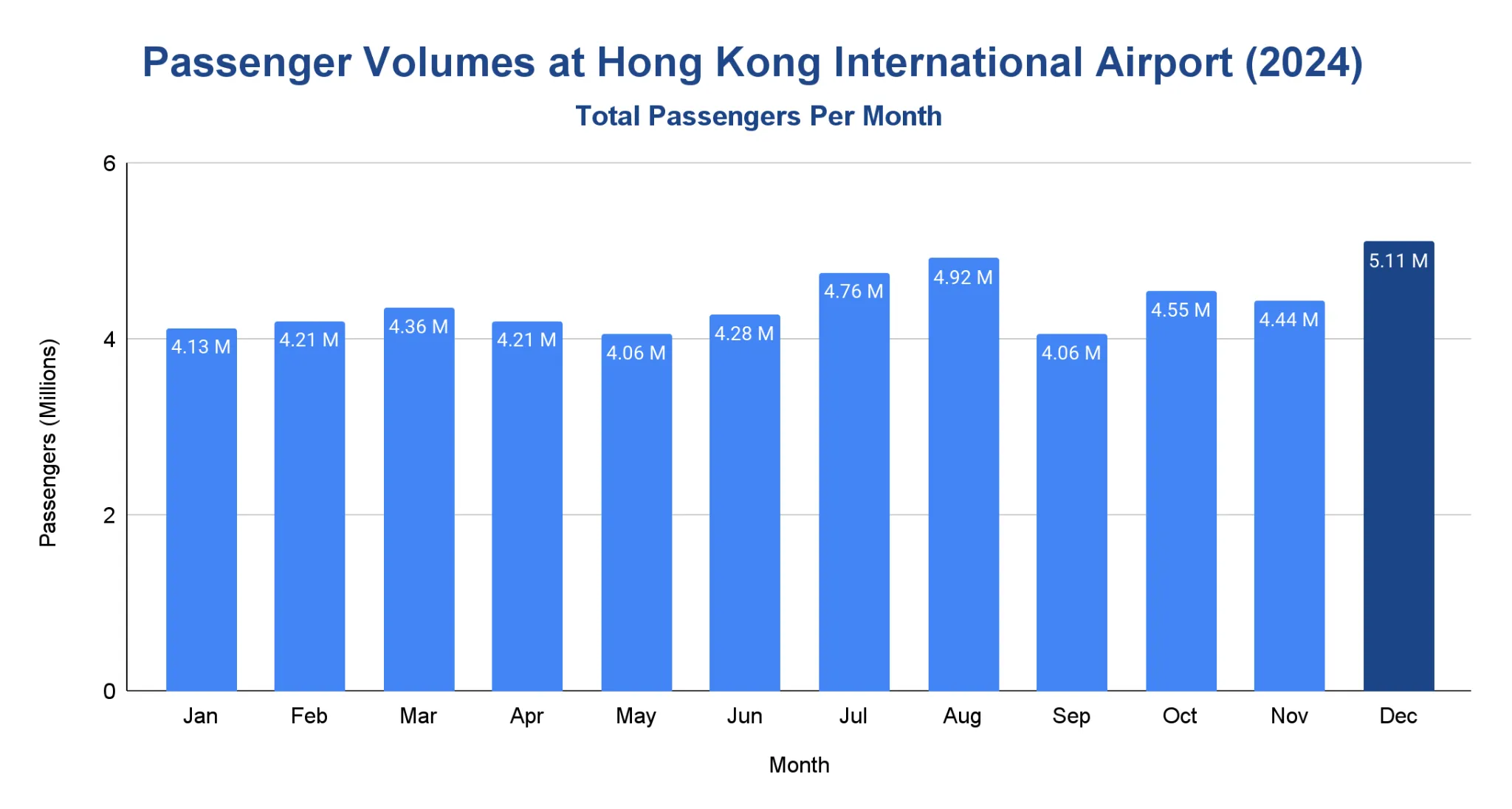
Peak Travel Months at Hong Kong International Airport
December recorded the highest monthly volume at Hong Kong International Airport in 2024, at 5.11 million passengers.
- Summer months traditionally generate peak traffic with historical highs of 5.99 million in August 2019.
- Chinese New Year creates significant spikes in January and February.
- Golden Week (October) and Christmas (December) also drive high volumes.
Major Expansion Projects at Hong Kong International Airport
The Three-Runway System (3RS) represents HKIA's largest investment at HK$141.5 billion.
- All three runways became operational on November 28, 2024.
- Capacity increases from 68 to 102 aircraft movements per hour.
- Terminal 2 expansion and a new concourse are planned to support an additional 30 million passengers per annum.
- HKIA’s target is to serve 120 million passengers and handle 10 million tonnes of cargo annually in about 10 years from the 3RS commissioning.
What are Hong Kong International Airport’s Sustainability Initiatives?
HKIA pledges Net Zero Carbon by 2050 with 55% emissions reduction by 2035 against its 2018 baseline.
- Sustainable Aviation Fuel adoption began with Cathay Pacific and EcoCeres partnerships.
- A 2,400-hectare Marine Park protects Chinese white dolphins around expansion areas.
More Statistics
- Baku Airport (GYD) Statistics
- Bahrain International Airport (BAH) Statistics
- Split Airport Statistics
- Helsinki Airport Statistics
- Salalah International Airport (SLL) Statistics
- Lisbon Airport Statistics
- King Fahd Airport (DMM) Statistics
- Durban King Shaka Airport Statistics
- Seoul Gimpo Airport Statistics
- Seoul Incheon Airport (ICN) Statistics
- Istanbul Airport (IST) Statistics
- Da Nang Airport Statistics
What is Hong Kong International Airport’s Safety Record like?
HKIA maintains a strong safety record with few major incidents since 1998.
- August 22, 1999: China Airlines Flight 642 typhoon landing accident resulted in three fatalities.
- April 13, 2010: Cathay Pacific Flight 780 emergency landing due to fuel contamination caused 57 injuries but no fatalities.
- Advanced windshear detection systems and comprehensive emergency services support safety operations.
How does Hong Kong International Airport rank globally?
HKIA holds its position among the world's premier airports across several key performance measures, though its standing shifted during the pandemic recovery.
- Throughout its operational history HKIA has collected over 90 "World's Best Airport" awards, a testament to its service quality and operational excellence.
- Airport Authority Hong Kong said HKIA was crowned the world’s busiest cargo airport for the 13th time since 2010.
- Around 68,000 staff work at Hong Kong International Airport.
References
- HKIA Passenger Traffic, Aircraft Movements and Cargo Data (2014–2024) · hongkongairport.com
- Airport Authority Hong Kong Annual Reports, Finance and Revenue Data (2014–2025) · hongkongairport.com
- OAG — Busiest International Routes by Scheduled Seats (2023–2024) · oag.com
- Airport Authority Hong Kong — Busiest Cargo Airport in 2023 · hongkongairport.com
- HKIA Three-Runway System Commissioning Press Release · hongkongairport.com
- Three-Runway System Financial Arrangements Report · threerunwaysystem.hongkongairport.com
- China Airlines Flight 642 — Final Investigation Report (1999) · cad.gov.hk
- Cathay Pacific Flight 780 — Final Investigation Report (2010) · cad.gov.hk
- HKIA Environmental & Net-Zero Initiatives (2024–2025) · hongkongairport.com
- HKIA Bio-diversity and 2,400-hectare Marine Park (2024) · hongkongairport.com
- HKIA Sustainable Aviation Fuel Study (2024) · hongkongairport.com

