

 Popular Countries
 24/7 Support
Published
Seoul Incheon International Airport (ICN) handles millions of international travelers each year and stands as one of the world's most important aviation hubs. The airport opened in 2001 and has since become a major connecting point for passengers and cargo moving across Asia and the globe.
How many passengers does Seoul Incheon International Airport handle each year?
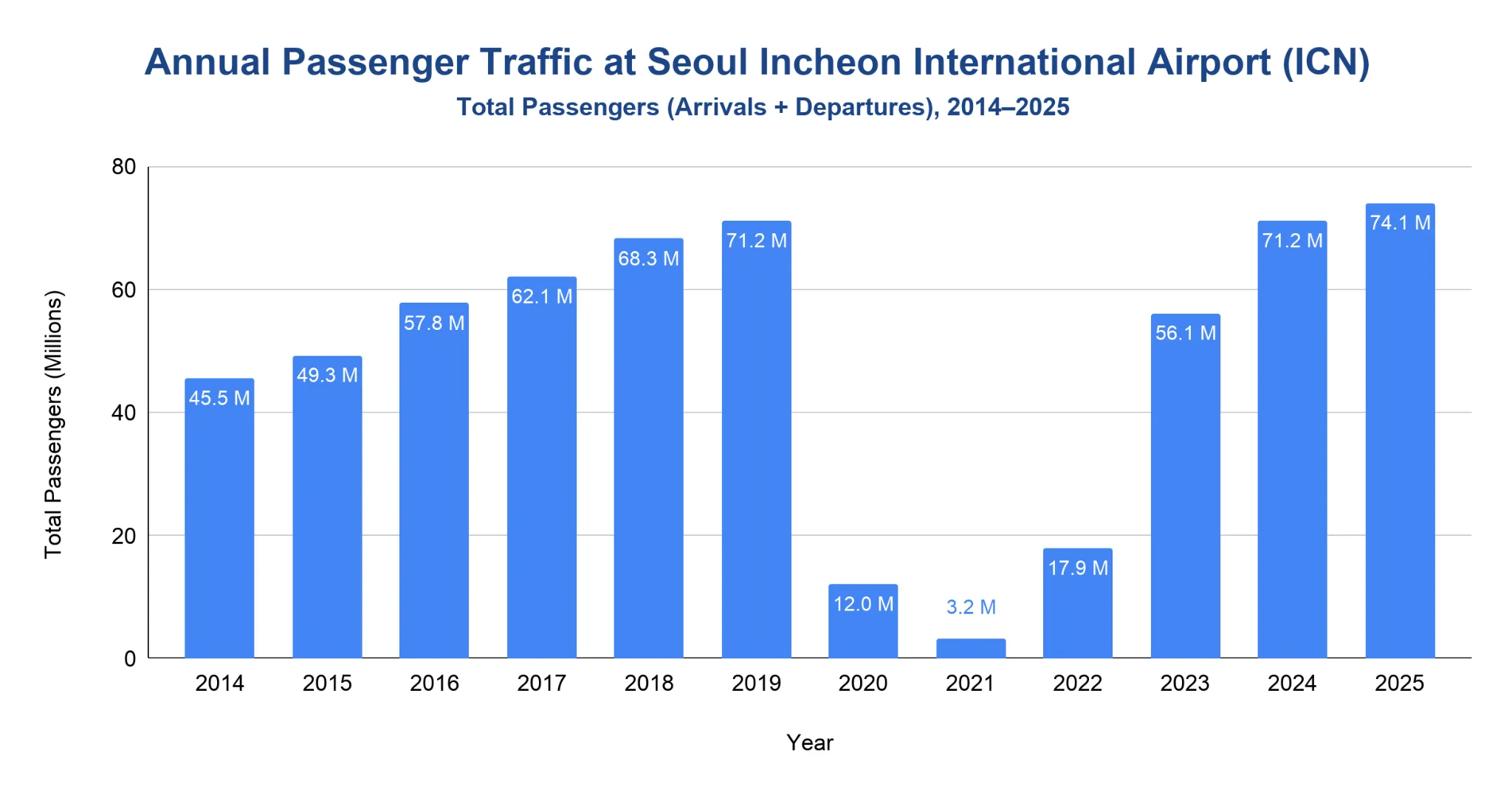
Seoul Incheon handled 74.07 million total passengers in 2025, the highest full-year total in the airport’s history.
- Total passengers rose from 45.51 million in 2014 to 71.17 million in 2019 before the pandemic disruption.
- Traffic fell to 12.05 million in 2020 and 3.2 million in 2021.
- Recovery then brought totals to 17.87 million in 2022, 56.13 million in 2023, 71.16 million in 2024, and 74.07 million in 2025.
How many passengers used Seoul Incheon International Airport in 2025?
Seoul Incheon processed 74.07 million total passengers in 2025, the highest full-year total in the airport’s history.
- Total passengers in 2025 were up 4.1% from 71.16 million in 2024.
- The 2025 total was 2,901,753 passengers above the airport’s previous high in 2019.
- Passenger traffic averaged about 6.17 million passengers per month across 2025.
Note: This section uses IIAC’s official full-year total-passenger series. The growth rate and monthly average are calculated directly from the official annual totals.
How many passengers used Seoul Incheon International Airport in 2024?
Seoul Incheon processed 71.16 million total passengers in 2024, including 70.67 million international passengers.
- Total passengers in 2024 were up 26.8% from 56.13 million in 2023.
- International passengers reached 70.67 million, leaving 487,701 domestic passengers for the year.
- Monthly traffic averaged 5.93 million passengers, with December the busiest month at 6.45 million and August close behind at 6.37 million.
- IIAC said Incheon ranked 3rd globally for international passenger traffic in 2024.
Note: Domestic passengers and average monthly passengers are calculated directly from official IIAC totals; the ranking applies to international passenger traffic, not total passengers.
Peak Travel Months at Seoul Incheon Airport
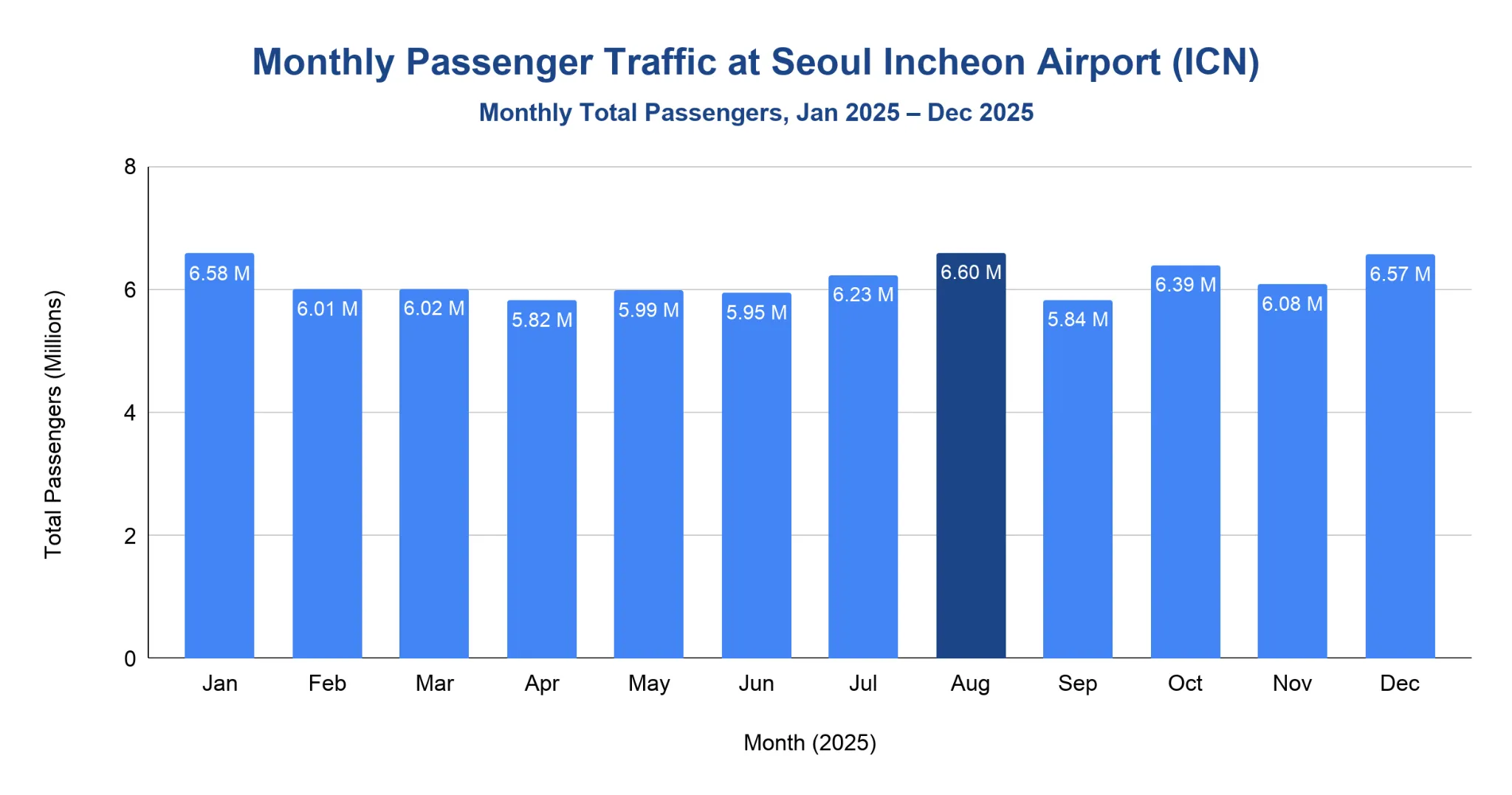
August was Seoul Incheon’s busiest month of 2025, with 6.6 million passengers.
- January 2025 followed closely at 6.582 million passengers, and December 2025 reached 6.57 million.
- April 2025 was the quietest month of the year at 5.82 million passengers.
- Eight months in 2025 recorded more than 6 million passengers.
- As of March 2026, the latest official monthly figure available was 6.578 million passengers.
How many aircraft operations happen at Seoul Incheon International Airport annually?
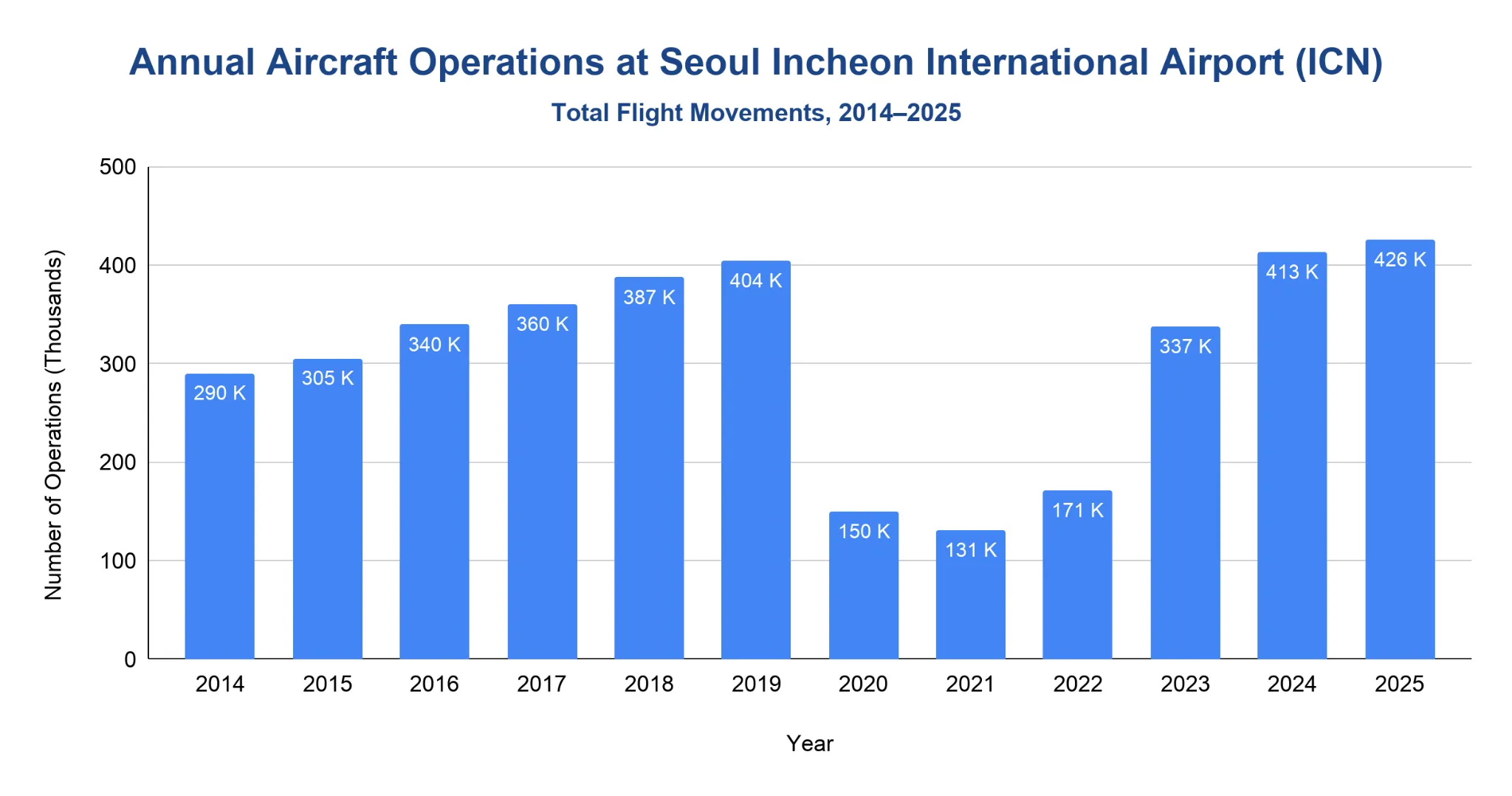
Seoul Incheon recorded 425,760 aircraft operations in 2025, setting a new annual high.
- The previous record was 413,200 operations in 2024, after 404,104 in 2019.
- Aircraft operations fell to 149,982 in 2020 and 131,027 in 2021 before recovering.
- Recovery reached 171,253 operations in 2022, 337,299 in 2023, 413,200 in 2024, and 425,760 in 2025.
- As of March 2026, the latest official monthly figure available was 36,079 aircraft operations.
How much cargo does Seoul Incheon International Airport move each year?
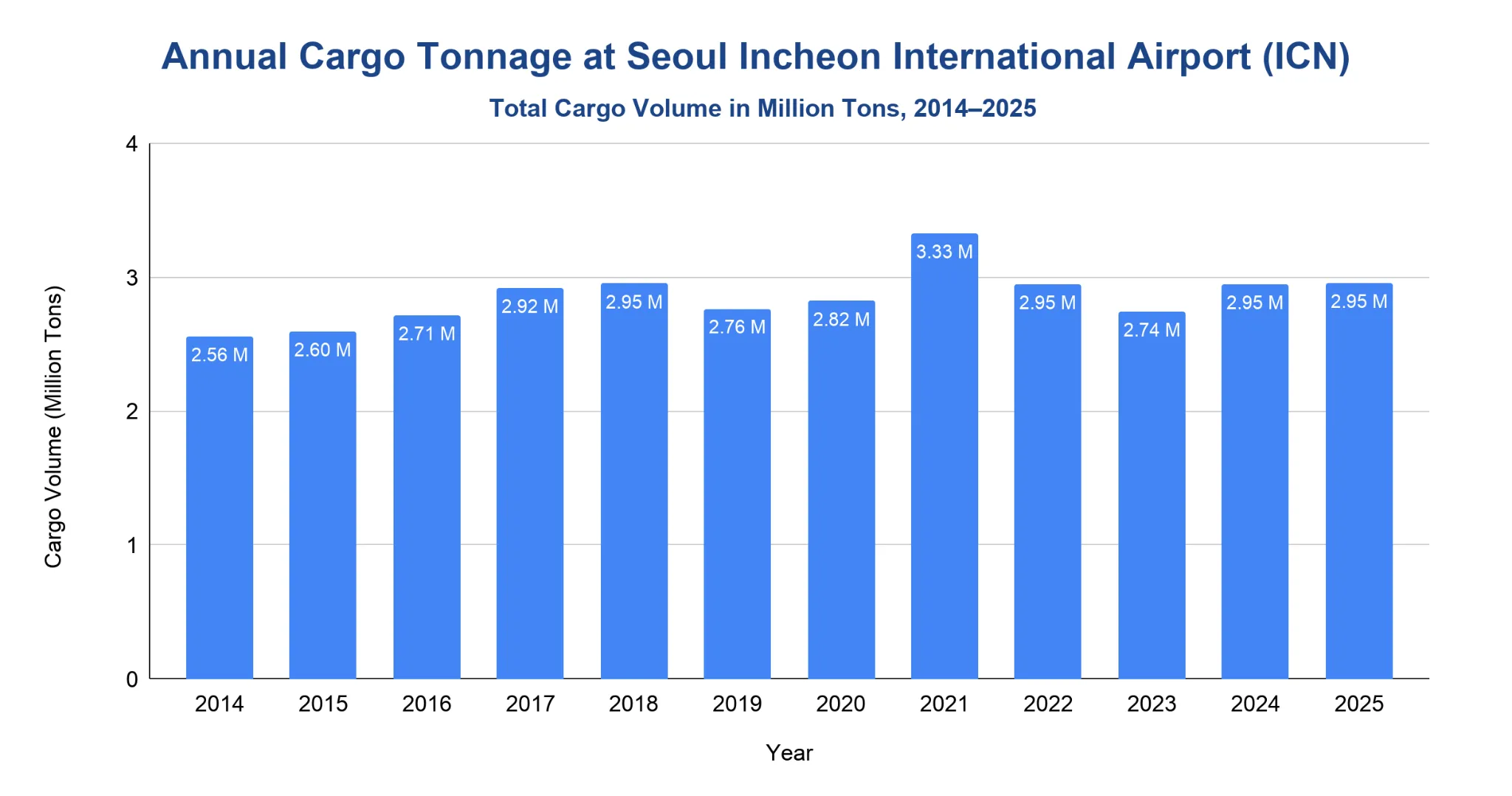
Seoul Incheon moved 2.95 million tons of cargo in 2025.
- Cargo reached a pandemic-era peak of 3.33 million tons in 2021.
- Annual cargo then measured 2.95 million tons in 2022, 2.74 million tons in 2023, 2.95 million tons in 2024, and 2.95 million tons again in 2025.
- As of March 2026, the latest official monthly cargo figure available was 260,213 tons.
Major Expansion Projects at Seoul Incheon International Airport
Phase 4, completed in October 2024, raised Incheon’s annual capacity to 106 million passengers, 6.3 million tons of cargo, and 600,000 flights.
- The project ran for 84 months from November 2017 to October 2024.
- The official project cost was KRW 4.84 trillion.
- Major additions included Runway 4, a 347,000 m² Terminal 2 expansion, 62 passenger aprons, and 13 cargo aprons.
- Phase 4 itself added capacity for 29 million passengers, 1.3 million tons of cargo, and 100,000 flights annually.
Seoul Incheon Environmental and Sustainability Goals
Incheon Airport’s published roadmap targets 100% renewable electricity by 2040 and net-zero greenhouse-gas emissions by 2045.
- IIAC says Incheon was the first airport in Asia to join RE100 and is pursuing full renewable-energy conversion by 2040.
- The airport’s greenhouse-gas reduction roadmap goes to 0 by 2045.
- All company vehicles have already been fully converted to eco-friendly vehicles.
- IIAC is also building out green mobility and biofuel-related infrastructure as part of its broader low-carbon program.
Other Statistics
- Amsterdam Airport Schiphol (AMS) Statistics
- Brussels Airport Statistics
- Copenhagen Airport Statistics
- Hong Kong International Airport (HKG) Statistics
- Bergen Airport Statistics
- Salalah International Airport (SLL) Statistics
- King Fahd Airport (DMM) Statistics
- Durban King Shaka Airport Statistics
- Johannesburg OR Tambo Airport Statistics
- Stockholm Arlanda Airport Statistics
- Istanbul Airport (IST) Statistics
- Da Nang Airport Statistics
Seoul Incheon International Airport Safety Record
IIAC says Incheon’s air-navigation safety systems have provided 190,000 hours of uninterrupted service without a safety-related incident since the airport opened.
- The airport says it operates 50 types of air-navigation safety systems.
- All 4 runways operate at CAT-III grade with runway visibility range down to 75 m.
- IIAC also says the airport runs an integrated Safety Management System with proactive and systematic safety-management procedures.
- Incheon’s Airport Collaborative Decision Making (A-CDM) system is designed to improve flight predictability, enhance on-time performance, and reduce unnecessary aircraft movements and ground waiting times.
References
- Incheon Airport Statistics: Passenger, Peak-Month, Aircraft-Operations, and Cargo Data (2014–2025) · airport.kr
- Incheon International Airport Ranking (2024) · airport.kr
- Phase 4 Construction Projects · airport.kr
- ESG — Implementing a Low-Carbon Eco-Friendly Airport · airport.kr
- Safety & Security · airport.kr
- Logistics Services · airport.kr
- Overview of the Safety Management System · airport.kr
- Airport Collaborative Decision Making Overview · airport.kr

