

 Popular Countries
 24/7 Support
Published
Seoul Gimpo International Airport (GMP) serves as South Korea’s main domestic aviation hub and a key gateway for regional business travel. Located about 15 km west of central Seoul, the airport has focused on high-frequency domestic routes and short-haul regional connections since Incheon International Airport opened in 2001.
How many passengers pass through Seoul Gimpo Airport each year?
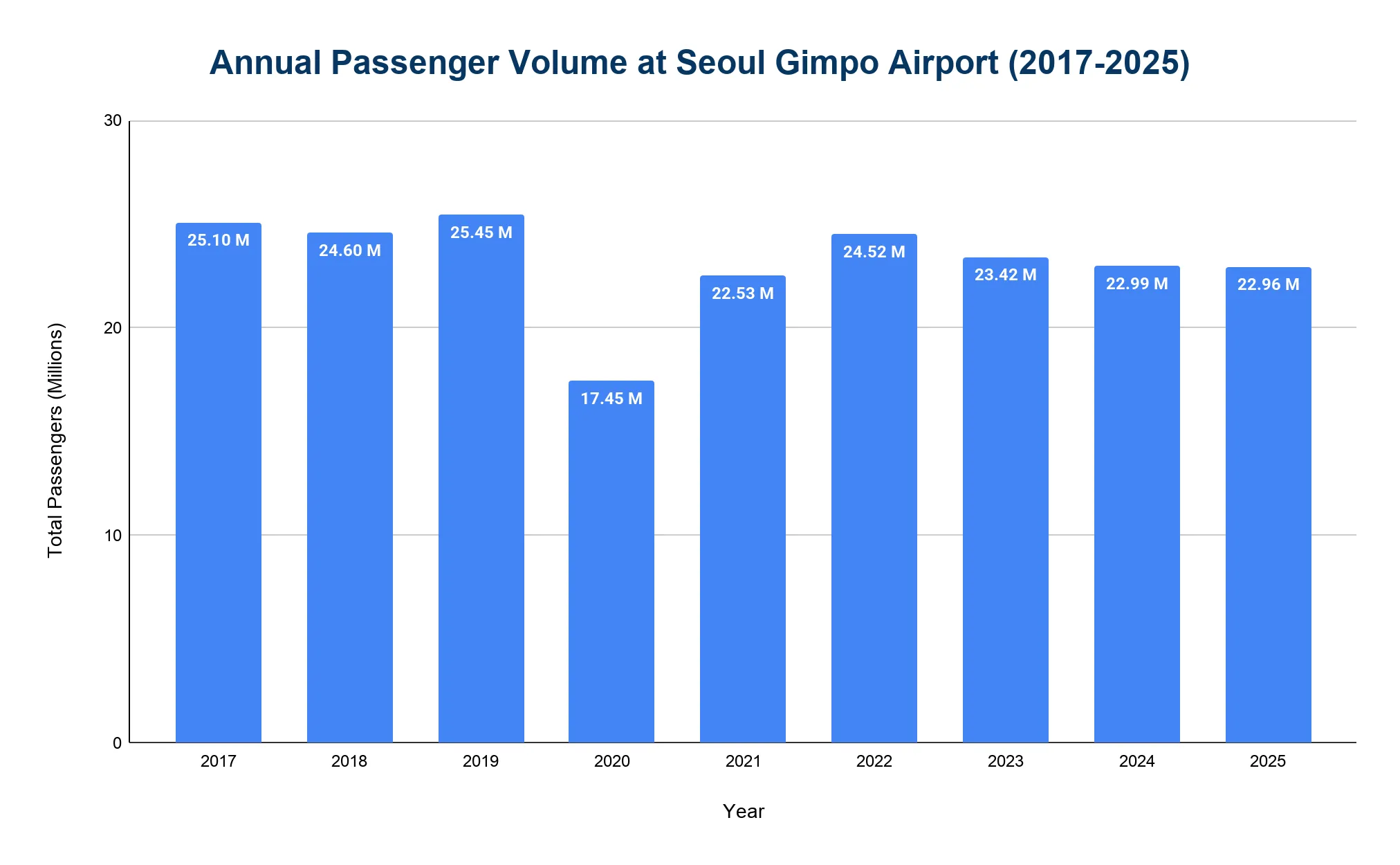
Seoul Gimpo Airport handles more than 22 million passengers each year, making it South Korea’s second-busiest airport after Incheon.
- 22.96 million passengers were processed in 2025, a slight decrease from 22.99 million in 2024.
- The airport saw its peak in 2019 with 25.45 million passengers before the pandemic.
- Passenger traffic dropped to 17.45 million in 2020, a 31.4% decline due to COVID-19.
- Recovery was swift, with 22.53 million in 2021, 24.52 million in 2022 and 23.42 million in 2023.
Domestic vs International Passengers
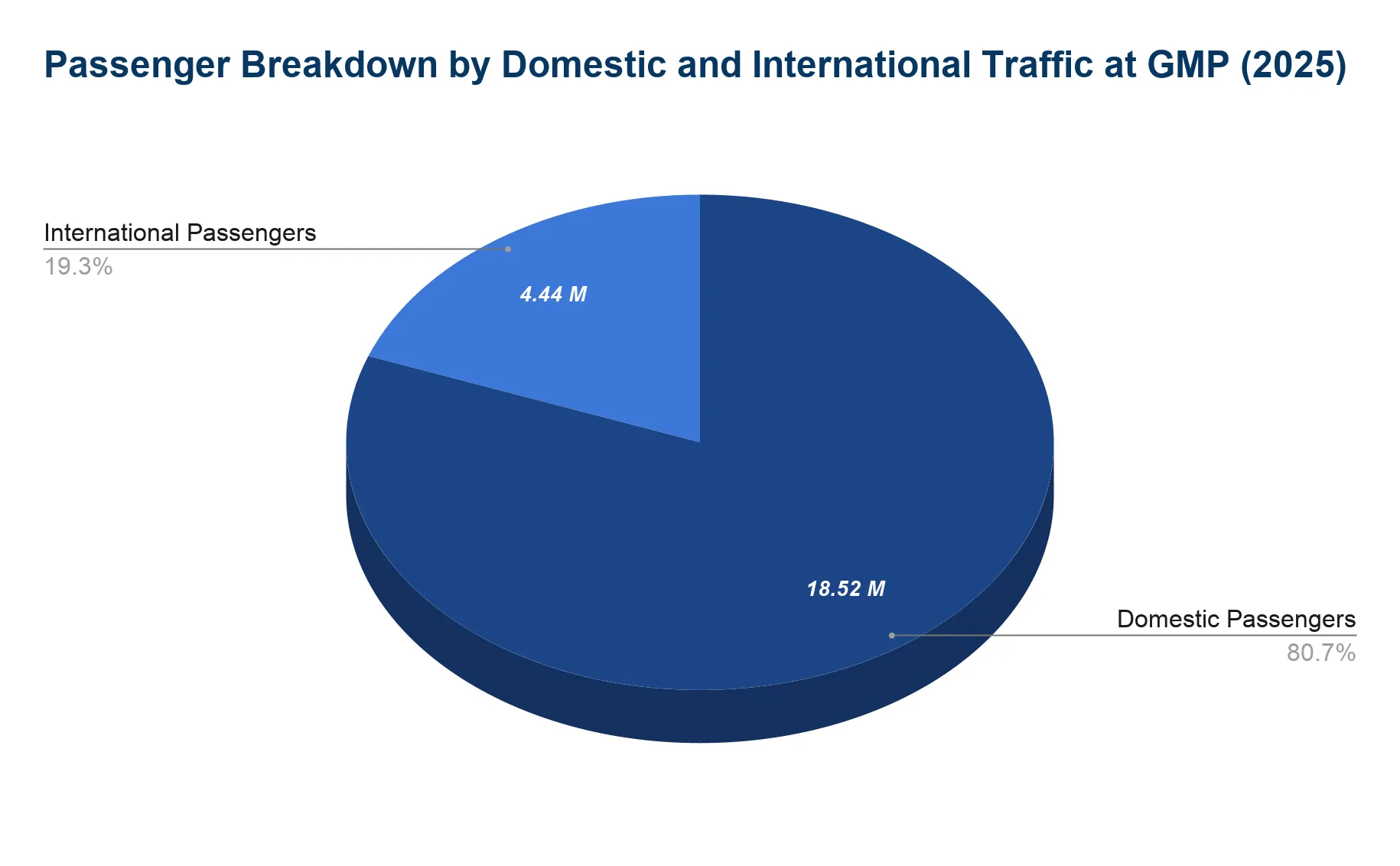
Gimpo’s passenger profile is heavily domestic, with around 80% of all traffic on domestic routes.
- 18.52 million domestic passengers in 2025 (80.7% of total).
- 4.44 million international passengers (19.3% of total).
- This split reflects Gimpo’s specialized role as South Korea’s main domestic airport.
What is the total number of aircraft operations at Seoul Gimpo Airport each year?
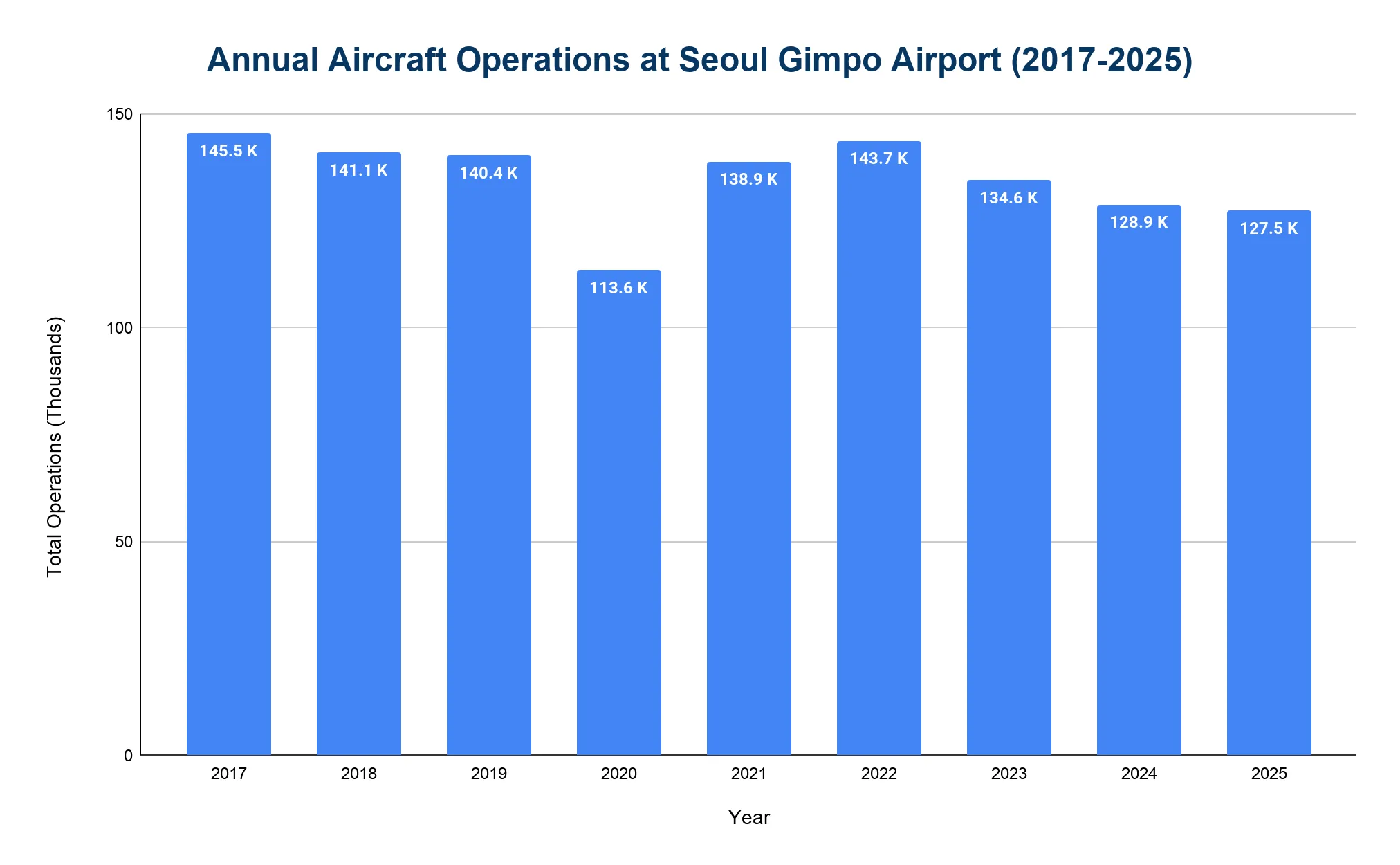
Gimpo sees over 125,000 aircraft operations annually, ranking it among the busiest airports globally by flight frequency.
- 127,464 movements in 2025, a 1.2% drop from 128,948 in 2024.
- The airport peaked at 140,422 movements in 2019.
- Activity dropped to 113,580 in 2020.
- Recovered to 138,855 in 2021, 143,713 in 2022 and 134,560 in 2023.
Which airlines operate the most flights out of Seoul Gimpo Airport?
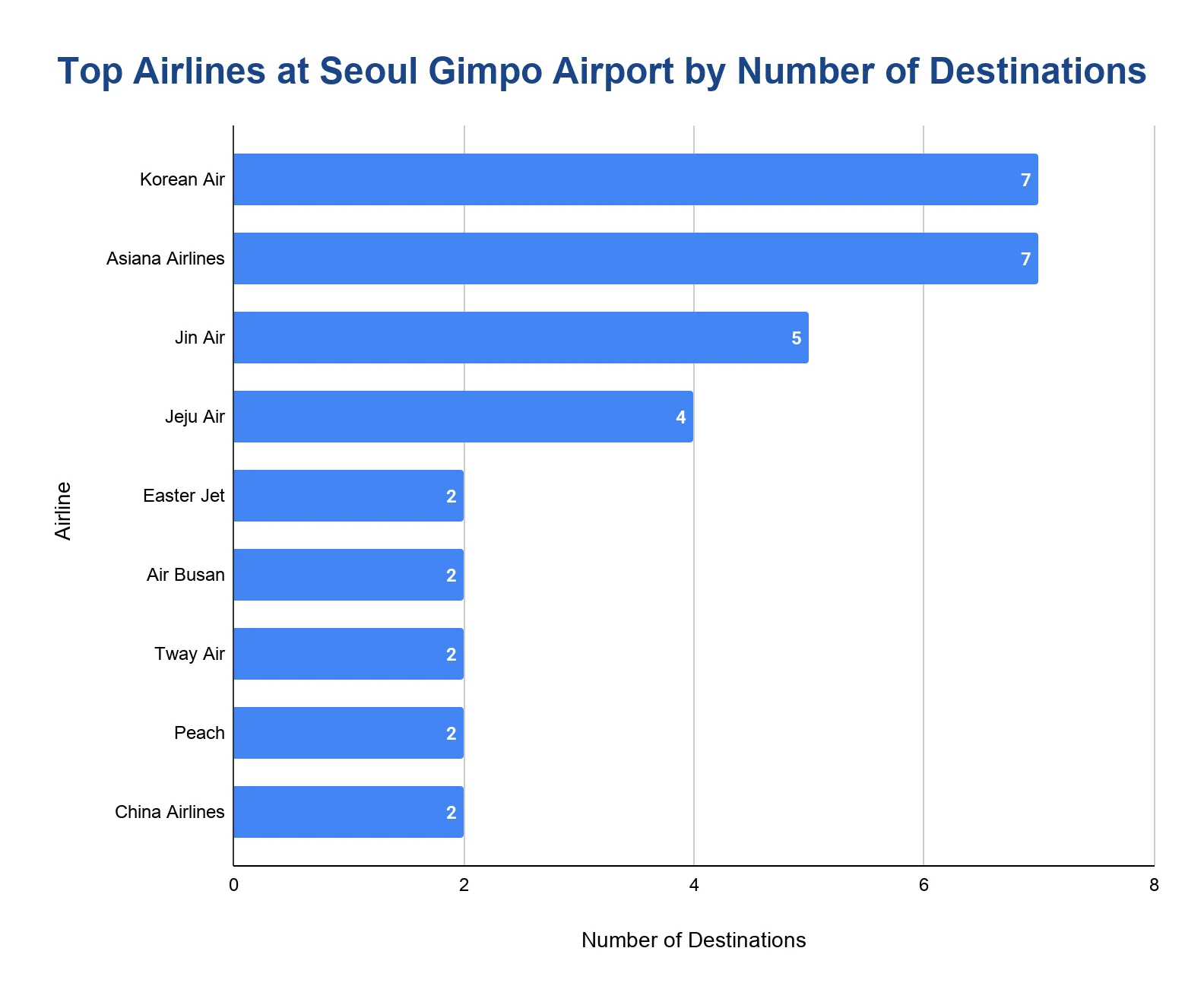
Korean Air and Asiana Airlines dominate operations at Gimpo, followed by a mix of full-service and low-cost carriers on high-demand domestic routes.
- Korean Air and Asiana Airlines both serve 7 destinations from the airport.
- Jin Air follows with 5 destinations.
- Jeju air operates to 4 destinations.
- Other airlines connect to 2 destinations each.
What are the monthly trends in passenger traffic at Seoul Gimpo Airport?
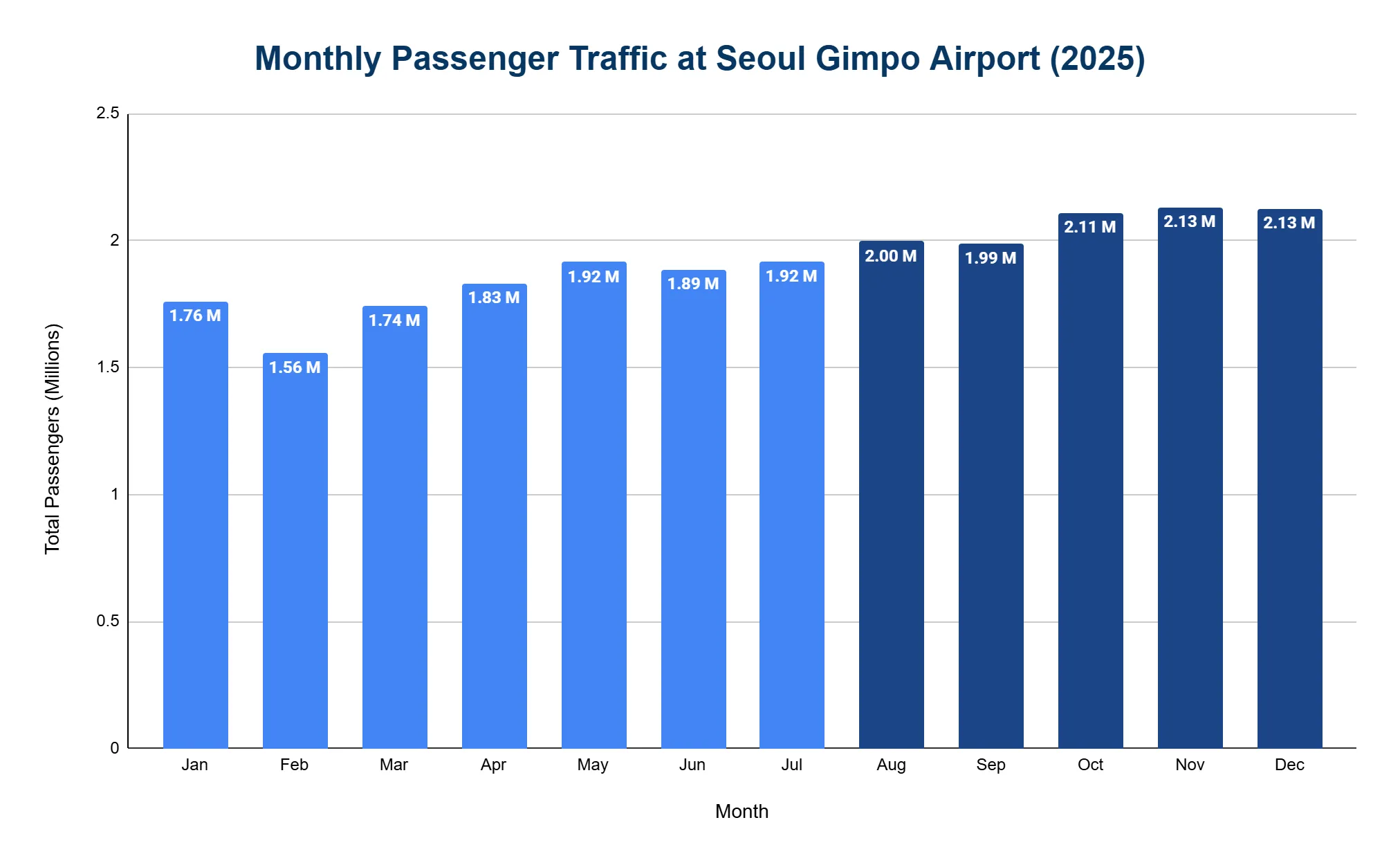
Gimpo shows clear seasonal patterns, driven by vacation travel and business cycles.
- November and December were the busiest months in 2025, each with 2.13 million passengers.
- October followed with 2.11 million passengers.
- August received 2 million passengers, while September recorded 1.99 million passengers.
- February had the lowest traffic at 1.55 million passengers, consistent with post-holiday slowdowns.
How many routes are there at Seoul Gimpo Airport?
Gimpo offers scheduled passenger service to 15 destinations in 3 countries.
- 7 domestic destinations in South Korea.
- 8 international destinations in Japan, China and Taiwan.
- 18 airlines operate these routes.
- The core year-round network supports key business and leisure markets.
Which destinations are the most popular from Seoul Gimpo Airport?
Domestic Destinations
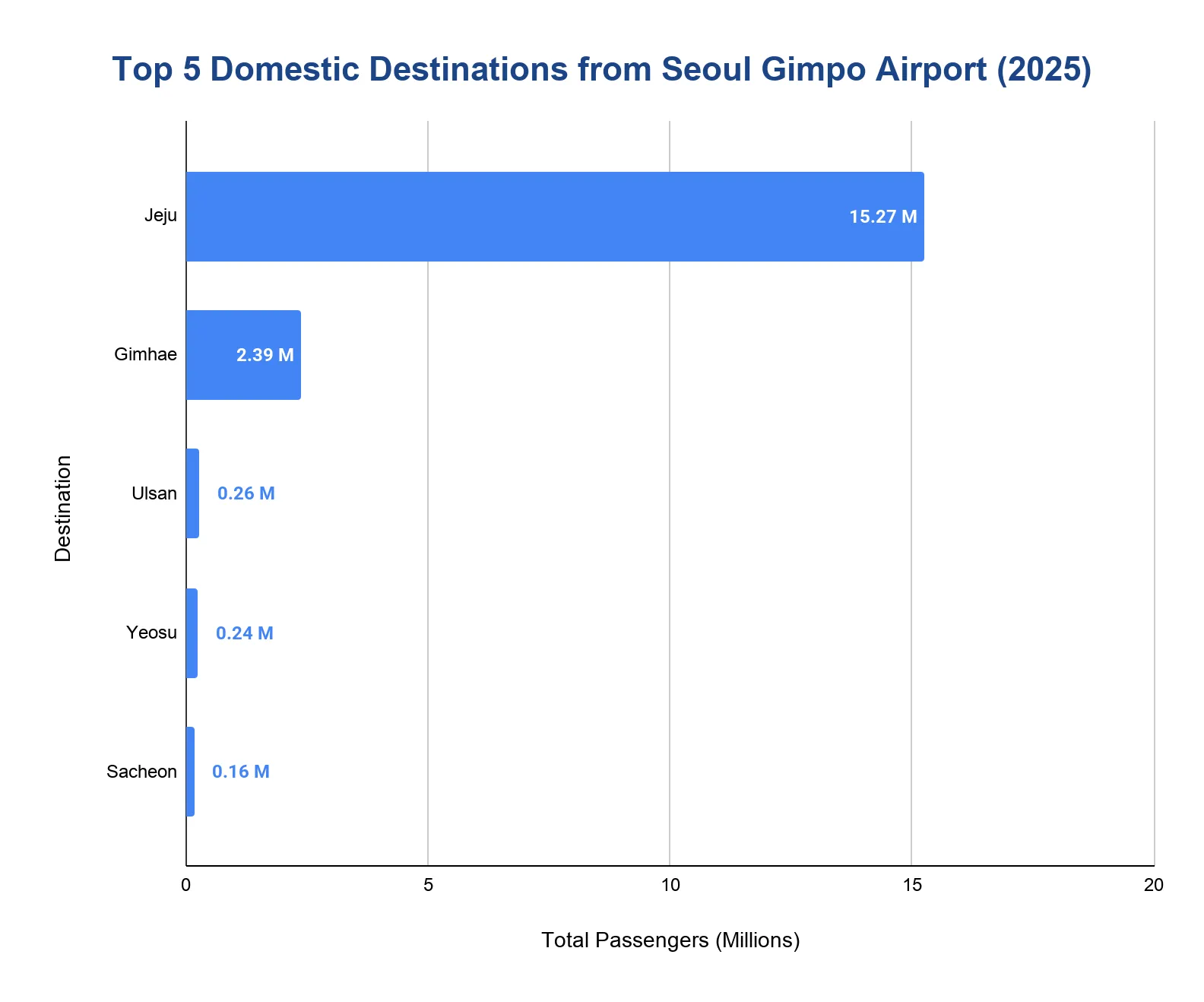
- Jeju (CJU) carried 15.27 million passengers in 2025, making it the world's busiest air route and served by Air Busan, Jeju Air, Korean Air, and T'way Air.
- Gimhae (PUS) handled 2.39 million passengers, and acted as the primary gateway to South Korea's second-largest city, with service from Air Busan, Eastar Air, Jeju Air, Jin Air, Korean Air, and T'way Air.
- Ulsan (USN) served 262,033 passengers, connecting to the major industrial hub and operated by Korean Air and Jin Air.
- Yeosu (RSU) carried 238,636 passengers, providing access to the coastal tourism destination with flights by Asiana Airlines and Jin Air.
- Sacheon (HIN) completed the top 5 with 164,653 passengers, serving the regional center exclusively through Jin Air.
International Destinations
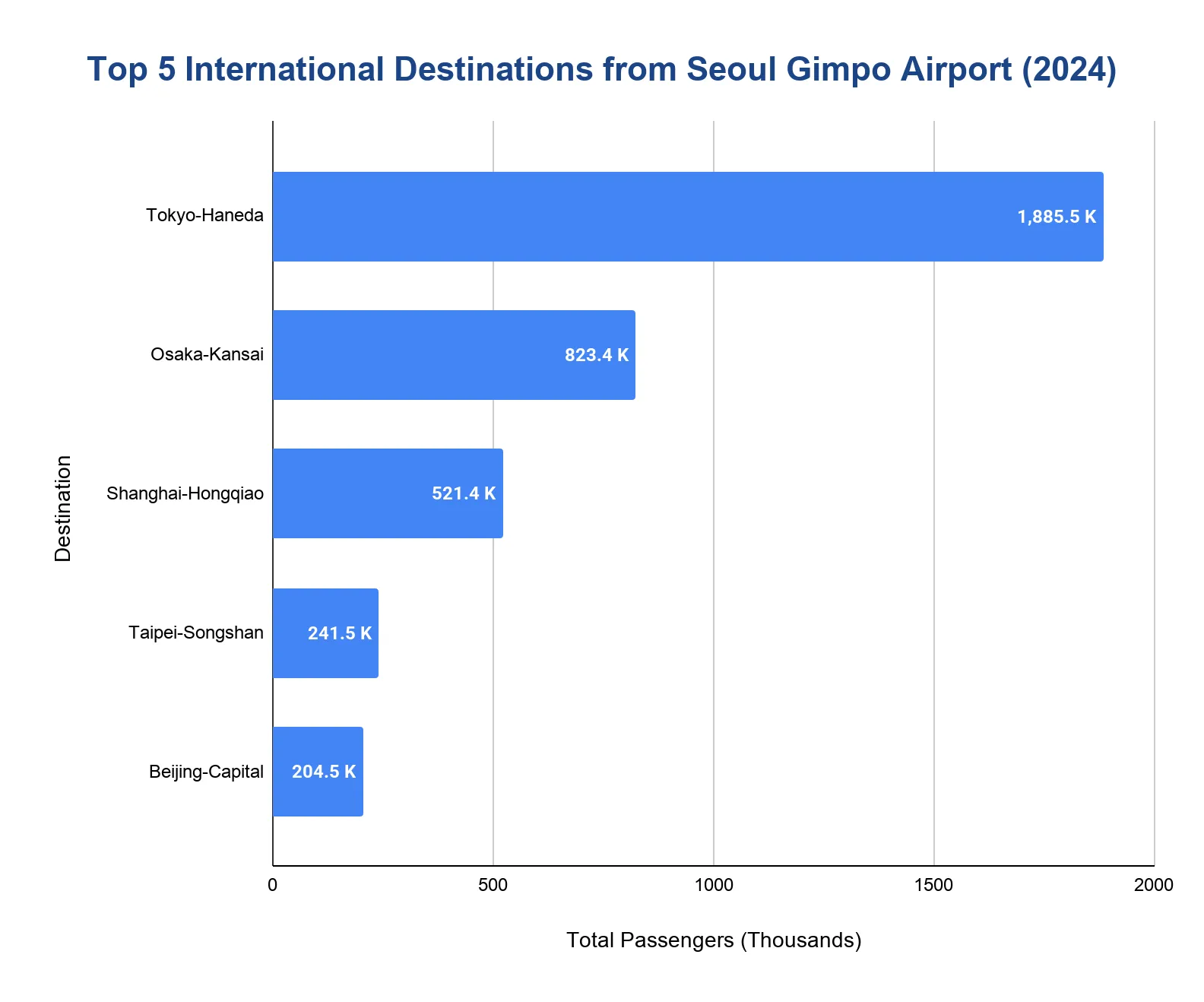
- Tokyo-Haneda (HND) processed 1.89 million passengers, dominating international traffic as the most popular overseas destination, with flights operated by ANA, Asiana, JAL, and Korean Air.
- Osaka-Kansai (KIX) recorded 823,428 passengers, establishing strong connectivity to western Japan through Asiana, Jeju Air, and Korean Air services.
- Shanghai-Hongqiao (SHA) attracted 521,383 passengers, facilitating business travel to China's economic powerhouse via Asiana, China Eastern, and Korean Air.
- Taipei-Songshan (TSA) welcomed 241,453 passengers, offering direct access to Taiwan's vibrant capital through China Airlines, EVA Air, and T'way Air operations.
- Beijing-Capital (PEK) generated 204,489 passengers, maintaining diplomatic and business links to China's seat of government with Air China, Asiana, and Korean Air.
How much cargo does Seoul Gimpo Airport handle annually?
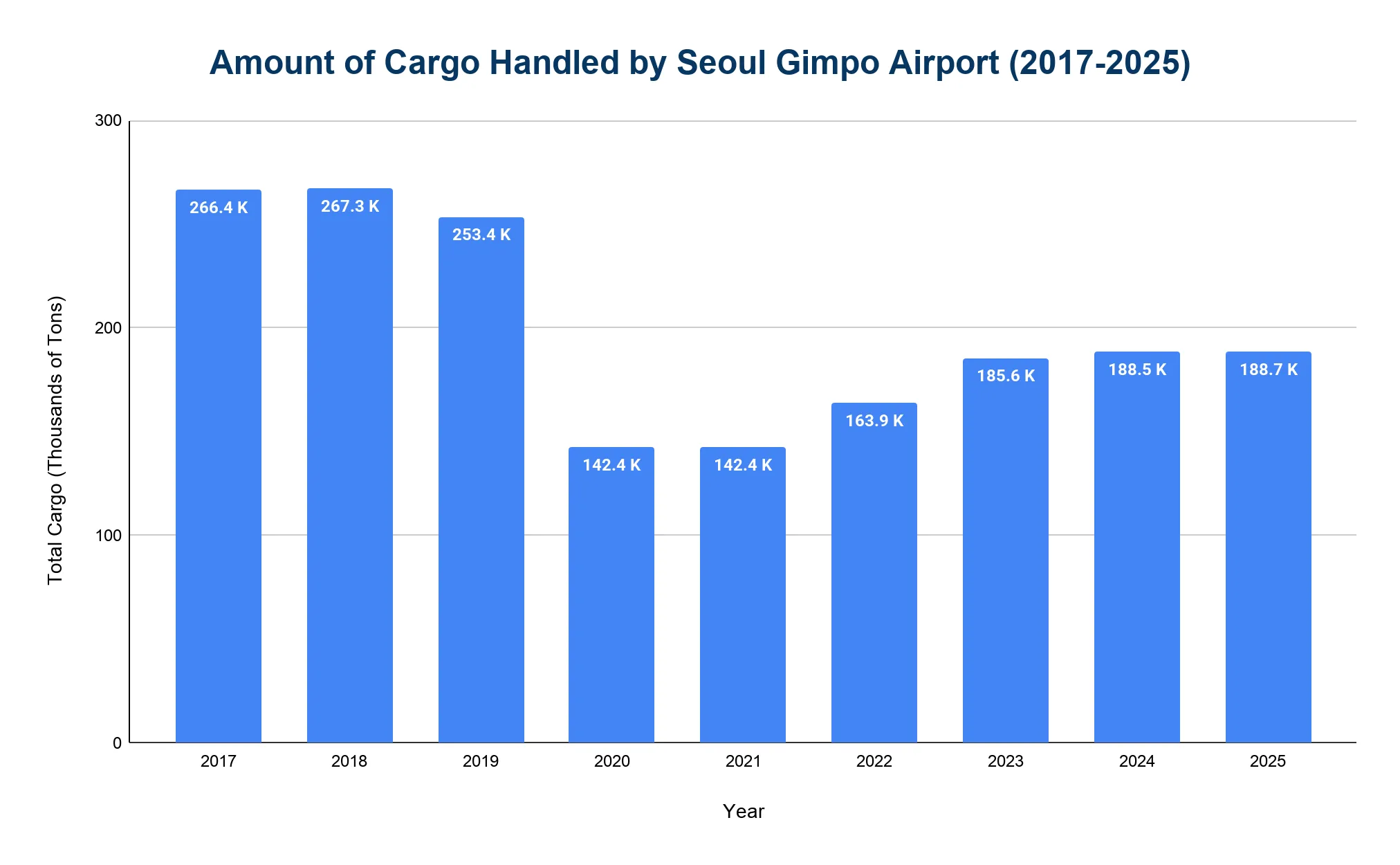
Gimpo handles over 185,000 metric tons of cargo per year, reflecting steady recovery from pandemic lows.
- 188,651 tons in 2025, a 0.07% increase from 188,515 tons in 2024.
- Pre-pandemic peak at 253,395 tons in 2019.
- Dropped to 142,380 tons in 2020, down 43.8%.
- Recovery has been gradual but consistent, with 142,439 tons in 2021, 163,918 tons in 2022, and reaching 185,570 tons in 2023.
Related Travel Statistics
- Baku Airport (GYD) Statistics
- Quito Airport (UIO) Statistics
- Malta Airport Statistics
- Oslo Airport Statistics
- Salalah International Airport (SLL) Statistics
- Lisbon Airport Statistics
- Hamad International Airport (DOH) Statistics
- King Fahd Airport (DMM) Statistics
- Singapore Changi Airport (SIN) Statistics
- Johannesburg OR Tambo Airport Statistics
- Stockholm Arlanda Airport Statistics
- Zurich Airport Statistics
What are the main causes of flight disruptions at Seoul Gimpo Airport?
- Severe weather, including heavy rain (over 30mm/hour), strong winds (over 25 knots) and typhoons.
- Cascading delays from tight scheduling and high flight frequency.
- Congestion during peak periods, including gate shortages and ramp delays.
- Air Traffic Control delays due to crowded airspace.
- Crew and staffing shortages post-pandemic, affecting operations across the industry.
What are the notable incidents at Seoul Gimpo Airport?
- Nov 19, 1980: Korean Air Lines Flight 015 (Boeing 747-200) landed short of the runway, killing 15 of 226 including the captain and first officer.
- Nov 25, 1989: Korean Air Flight 175 (Fokker F28-4000) crashed after takeoff at Ulsan; all survived, 40 injured.
- Aug 5, 1998: Korean Air Flight 8702 (Boeing 747-400) overran the runway; all 395 survived, aircraft destroyed.
References
- Seoul Gimpo Airport Traffic Data · airport.co.kr
- Airlines and Top Destinations from Seoul Gimpo Airport · flightconnections.com
- Aviation Safety Network — Notable Incidents at Calgary Airport · asn.flightsafety.org

