

 Popular Countries
 24/7 Support
Updated
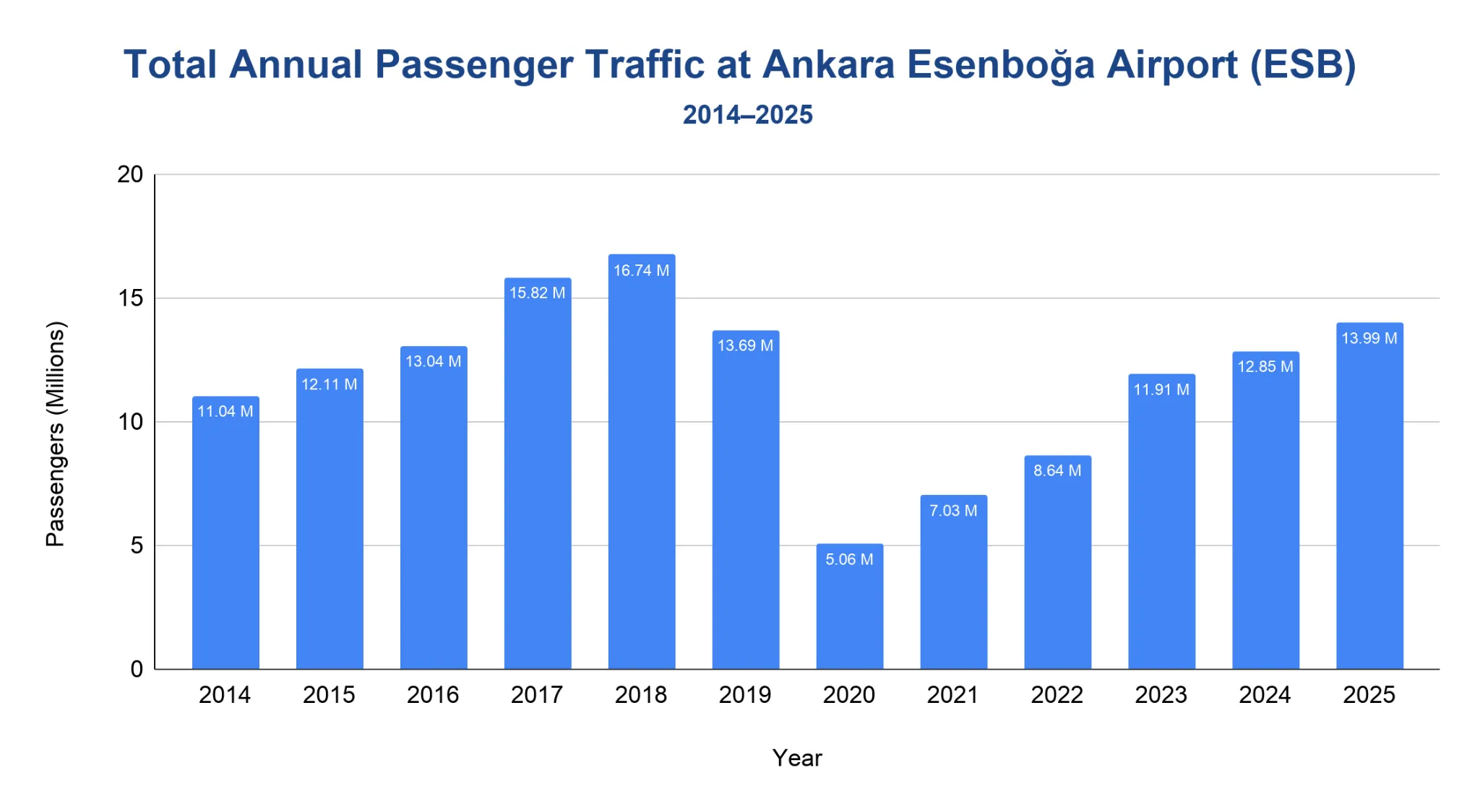
Situated in Ankara, Türkiye, Ankara Esenboğa Airport (ESB) handled almost 14 million passengers in 2025 and serves as the capital city’s main air gateway. Located 28 km northeast of Ankara, ESB is owned by the State Airports Authority (Devlet Hava Meydanları İşletmesi, DHMİ) and operated by TAV Airports.
How many passengers use Ankara Esenboğa Airport each year?
Ankara Esenboğa Airport handled 13.99 million total passengers in 2025, up 8.8% from 12.85 million in 2024.
- From 2014 to 2018, passenger traffic rose from 11.04 million to 16.74 million, a 51.7% increase during the airport’s strongest pre-pandemic growth period.
- The pre-pandemic reset came in 2019, when traffic fell to 13.69 million, down 18.2% from the 2018 peak.
- The pandemic low was 2020, when ESB handled 5.06 million passengers, a 63.1% drop from 2019.
- Post-pandemic recovery moved from 7.03 million passengers in 2021 to 8.64 million in 2022, 11.91 million in 2023, 12.85 million in 2024, and 13.99 million in 2025.
- The 2025 passenger total reached 83.6% of the airport’s 2018 peak.
Note: Total passengers means domestic plus international passenger traffic.
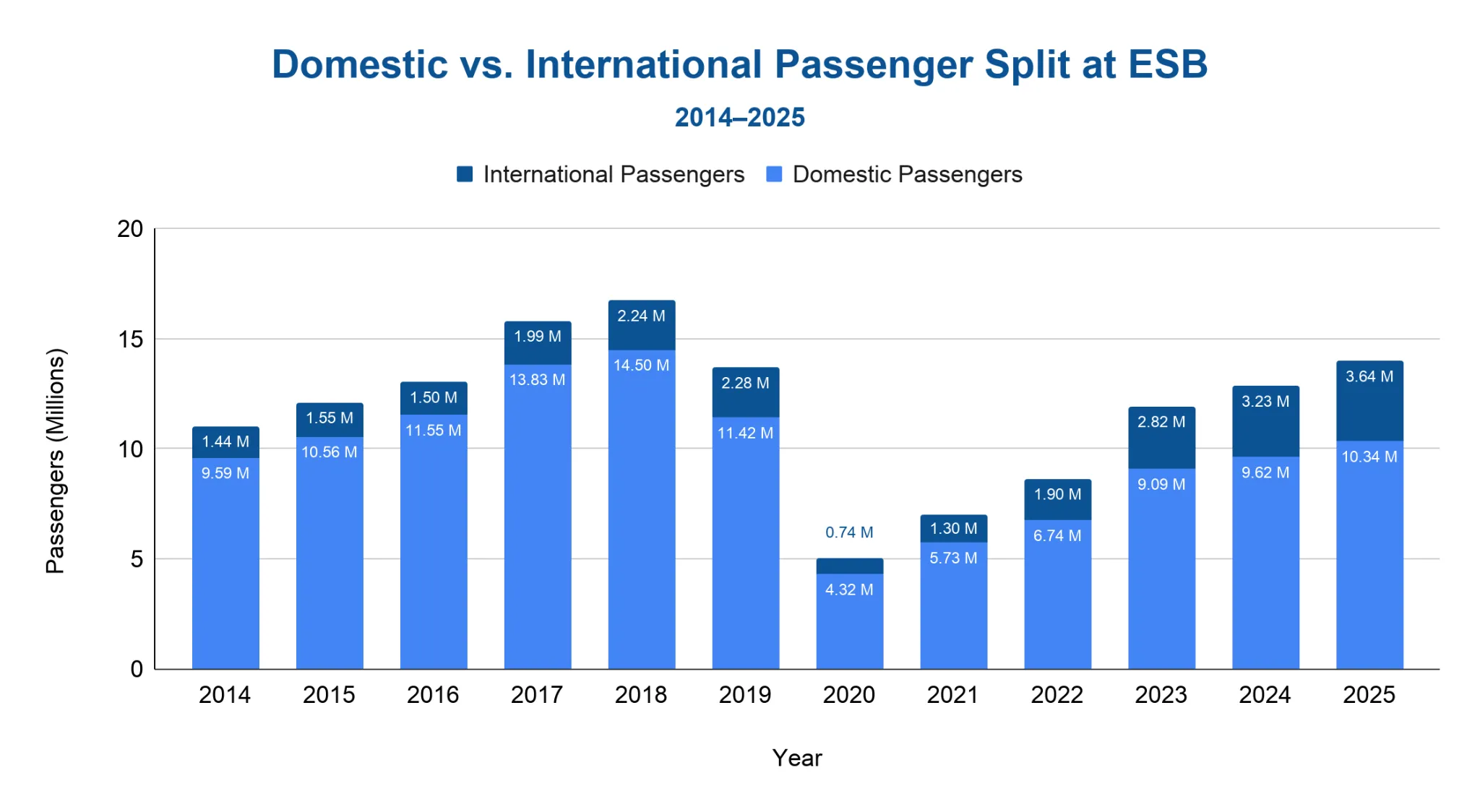
How many passengers use Ankara Esenboğa Airport for domestic vs international travel?
Domestic passengers made up 10.34 million of ESB’s 13.99 million passengers in 2025, while international passengers accounted for 3.64 million.
- Domestic traffic remained the larger segment throughout 2014-2025, but the international share increased over the period.
- From 2014 to 2018, international traffic moved from 1.44 million to 2.24 million, while domestic traffic rose from 9.59 million to 14.5 million.
- In the final pre-pandemic year, 2019, international passengers reached 2.28 million, or 16.6% of total traffic.
- During the pandemic low in 2020, domestic traffic fell to 4.32 million and international traffic dropped to 740,419.
- By 2025, international traffic reached 26% of total passenger traffic, compared with 13.1% in 2014.
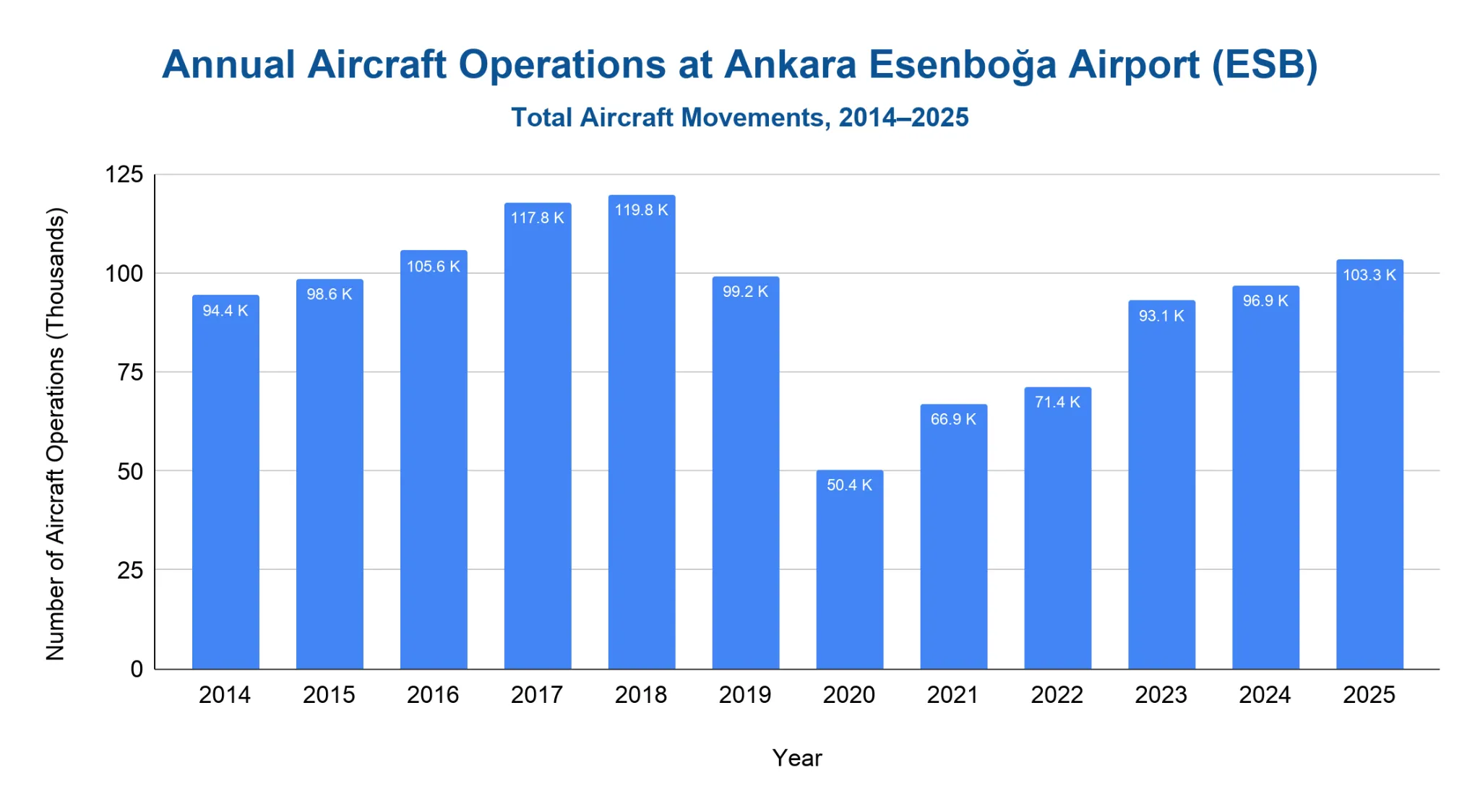
What is the total number of aircraft operations at Ankara Esenboğa Airport?
Ankara Esenboğa Airport recorded 103,318 total aircraft operations in 2025, up 6.6% from 96,910 in 2024.
- Aircraft operations increased from 94,418 in 2014 to 119,771 in 2018, a 26.9% rise during the pre-pandemic growth period.
- Operations fell to 99,242 in 2019, down 17.1% from the 2018 peak.
- The pandemic low came in 2020, when ESB recorded 50,394 aircraft operations.
- Post-pandemic operations recovered to 66,913 in 2021, 71,355 in 2022, 93,074 in 2023, 96,910 in 2024, and 103,318 in 2025.
- The 2025 total reached 86.3% of the airport’s 2018 aircraft-operation peak.
Major Expansion Projects completed at Ankara Esenboğa Airport
TAV Airports completed a €230 million first-phase investment at Ankara Esenboğa Airport in 2026.
- The completed investment includes the airport’s third runway, a new air traffic control tower, rescue and firefighting facilities, and expanded airside infrastructure.
- The project also added an 85,000 m² cargo apron.
- The investment supports Ankara Esenboğa’s long-term role as the capital city’s main air gateway.
Other Statistics
- Brussels Airport Statistics
- Dubrovnik Airport Statistics
- Lisbon Airport Statistics
- Madeira Airport Statistics
- Porto Airport Statistics
- Hamad International Airport (DOH) Statistics
- Johannesburg OR Tambo Airport Statistics
- Seoul Gimpo Airport Statistics
- Geneva Airport Statistics
- Zurich Airport Statistics
- Dubai International Airport (DXB) Statistics
- Da Nang Airport Statistics
Sustainability Initiatives at Ankara Esenboğa Airport
Ankara Esenboğa Airport holds Airport Carbon Accreditation (ACA) Level 4+ status and is included in TAV Airports’ solar power investment program.
- ESB became Türkiye’s first carbon-neutral airport in 2012.
- The airport is listed at ACA Level 4+, reflecting advanced carbon-management accreditation.
- Ankara’s first-phase solar investment includes 3.6 MW of solar capacity.
- The Ankara solar investment is part of a 16.1 MW combined solar program across Ankara, Bodrum, and İzmir.
- The combined program is expected to offset about 30% of electricity consumption across those three airports.
References
- DHMİ — İstatistikler (Statistics Portal) · dhmi.gov.tr
- TAV Airports · tavairports.com
- Airport Carbon Accreditation · airportcarbonaccreditation.org

