

 Popular Countries
 24/7 Support
Published
Fukuoka Airport (FUK) is Kyushu's main aviation gateway and a vital link between Japan and East Asia. Located just 5 minutes by subway from downtown Hakata Station, this compact yet efficient airport has consistently ranked as one of Japan's busiest, operating with a single 2,800m runway until a second 2,500m parallel runway opened in March 2025.
How many passengers use Fukuoka Airport each year?
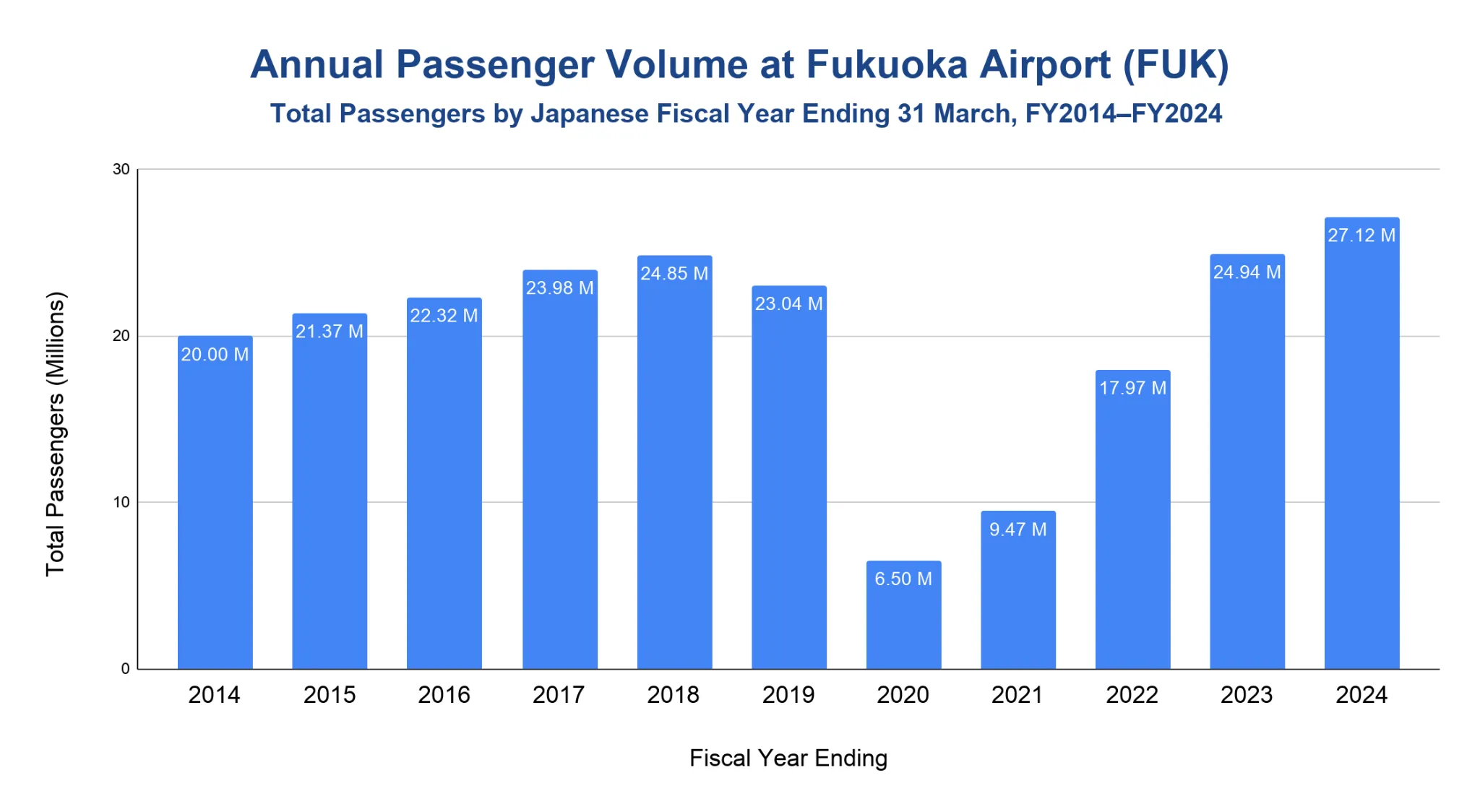
Fukuoka Airport handled 27.12 million total passengers in FY2024, the highest official annual total in the available series.
- From FY2014 to FY2018, passenger traffic rose from 20 million to 24.85 million, building a strong pre-pandemic base.
- FY2019 eased to 23.04 million passengers, below the FY2018 high but still above the earlier levels.
- The pandemic cut traffic to 6.5 million passengers in FY2020, followed by a partial rebound to 9.47 million in FY2021.
- Recovery accelerated from 17.97 million passengers in FY2022 to 24.94 million in FY2023.
- FY2024 completed the recovery with 27.12 million passengers, exceeding the FY2018 pre-pandemic peak.
What is the breakdown between domestic and international passengers at Fukuoka Airport?
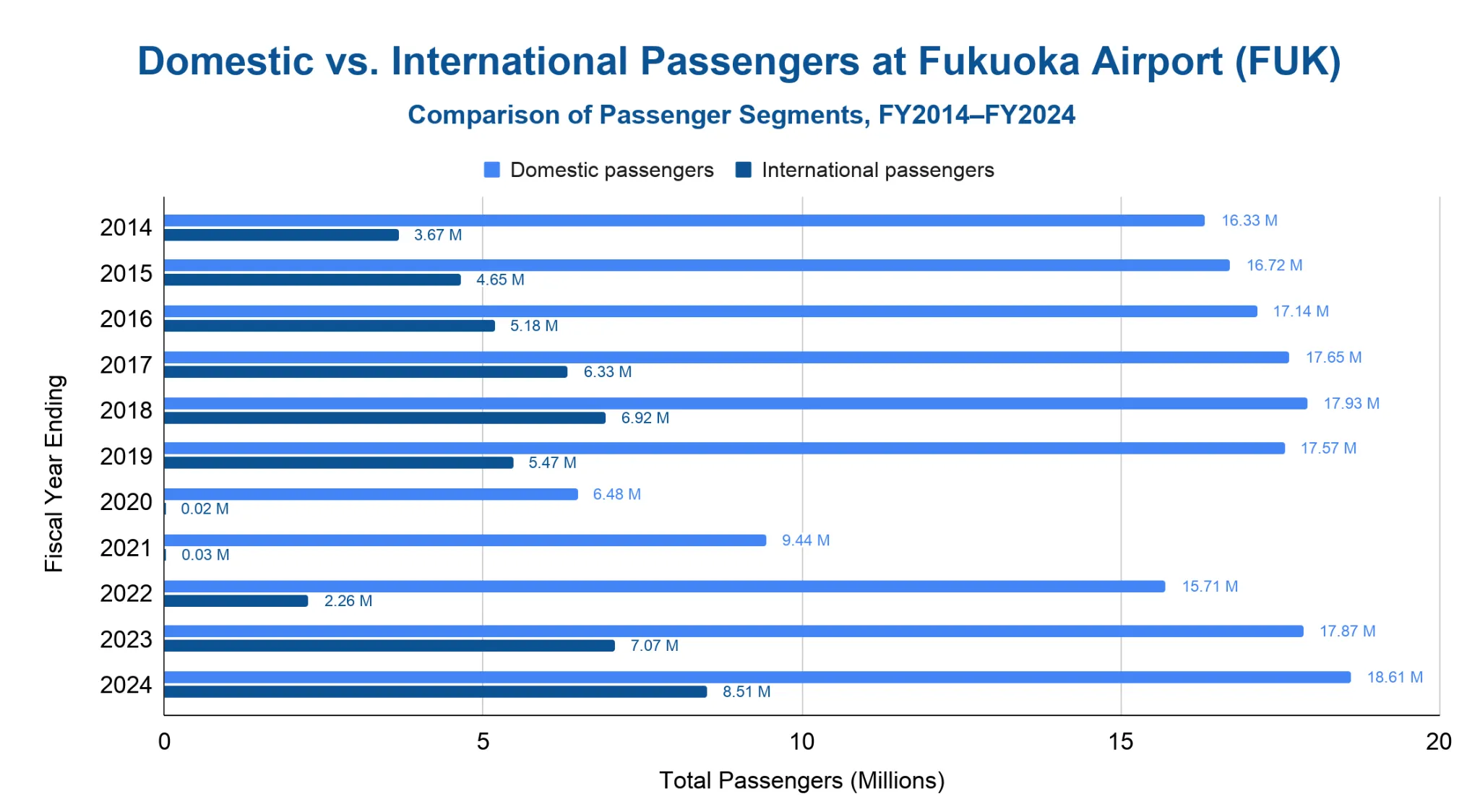
Domestic traffic remained the larger segment in FY2024, with 18.61 million domestic passengers and 8.51 million international passengers.
- From FY2014 to FY2018, domestic passengers increased from 16.33 million to 17.93 million, while international passengers rose faster from 3.67 million to 6.92 million.
- FY2019 kept domestic traffic high at 17.57 million, while international traffic slipped to 5.47 million.
- International traffic nearly disappeared during the pandemic, falling to 16,831 passengers in FY2020 and 26,229 in FY2021.
- Recovery began in FY2022, when international traffic returned to 2.26 million passengers and domestic traffic reached 15.71 million.
- By FY2024, international passengers reached 8.51 million, raising the international share to 31.4% of total traffic.
How many aircraft operations take place at Fukuoka Airport each year?
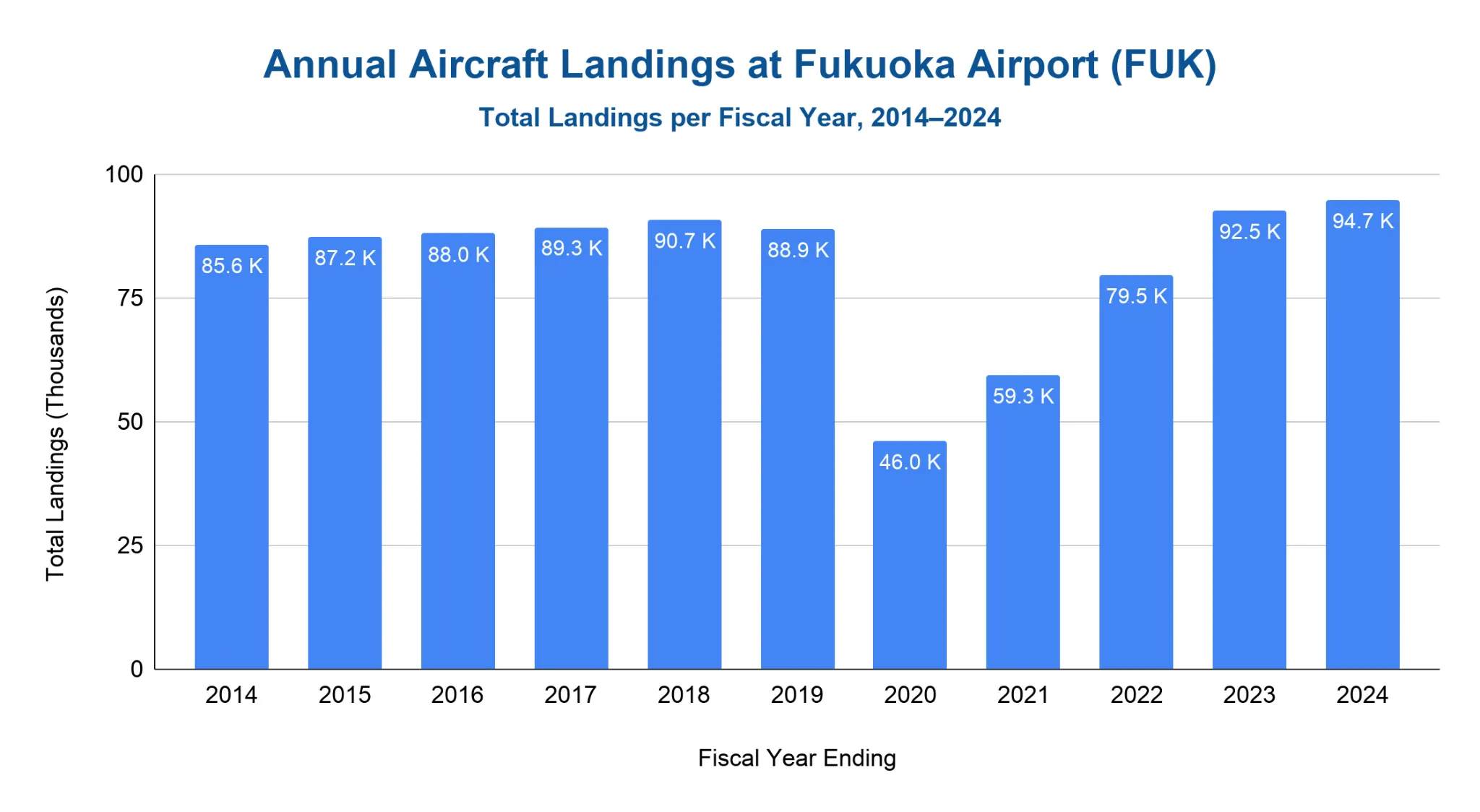
Fukuoka Airport recorded 94,706 landings in FY2024, the highest official annual total in the available series.
- From FY2014 to FY2018, landings increased from 85,608 to 90,723, led by growth in international activity.
- FY2019 remained close to the pre-pandemic high with 88,855 total landings.
- Pandemic disruption reduced activity to 46,016 landings in FY2020, before FY2021 recovered to 59,277.
- Post-pandemic activity climbed to 79,487 landings in FY2022 and 92,543 in FY2023.
- FY2024 reached 94,706 landings, a total recorded as the second runway entered service in March 2025.
How much revenue does Fukuoka Airport generate each year?
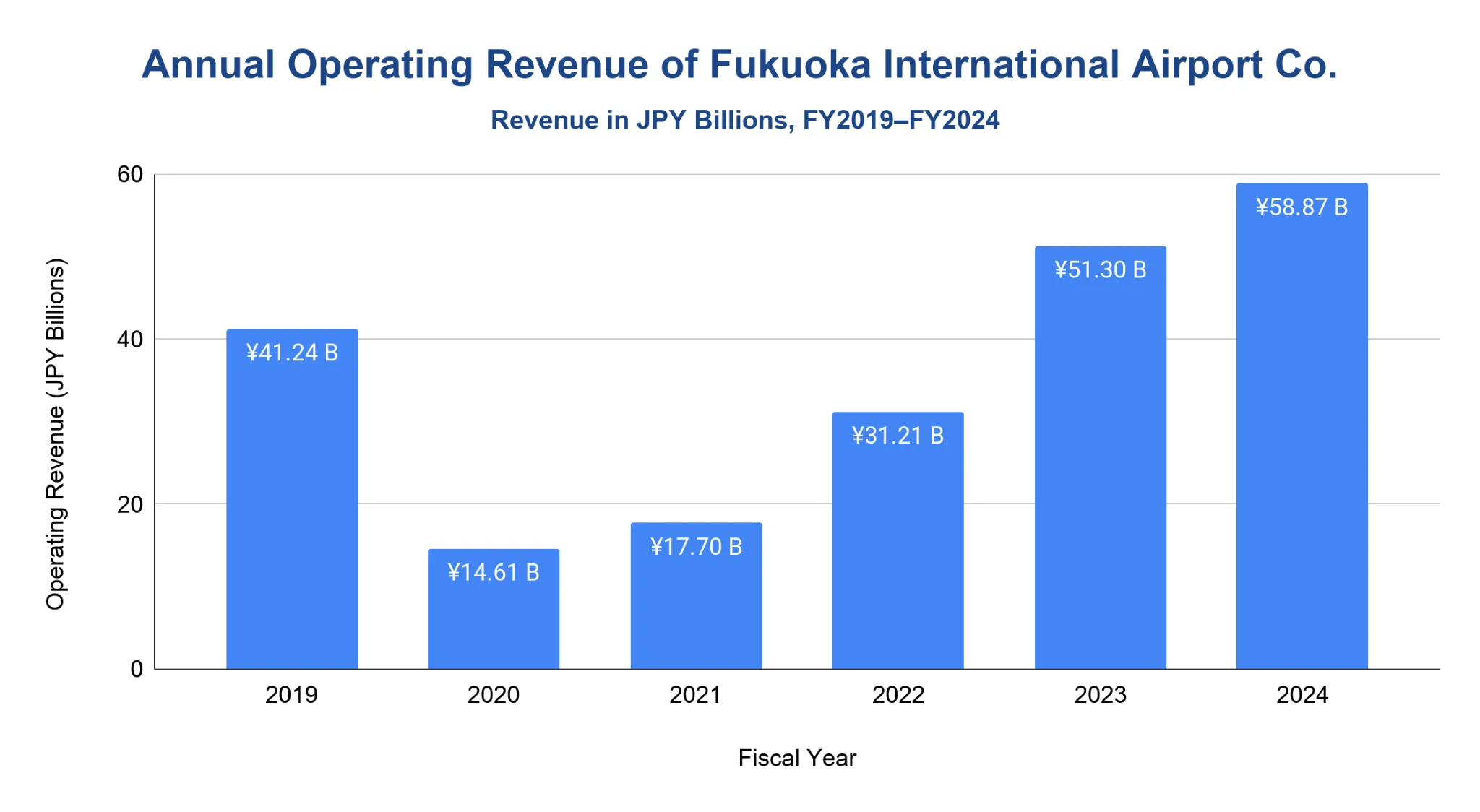
Fukuoka International Airport Co. reported ¥58.87 billion in sales for FY2024, its highest value in the official operator-period series.
- FY2019 sales stood at ¥41.24 billion, before the full impact of the pandemic.
- Sales fell sharply to ¥14.61 billion in FY2020, when passenger traffic collapsed.
- The early recovery was gradual, with sales rising to ¥17.70 billion in FY2021 and ¥31.21 billion in FY2022.
- By FY2023, sales had recovered to ¥51.30 billion as passenger traffic returned above pre-pandemic levels.
- FY2024 sales increased again to ¥58.87 billion, while the net loss narrowed to ¥1.01 billion.
Peak Travel Months at Fukuoka Airport
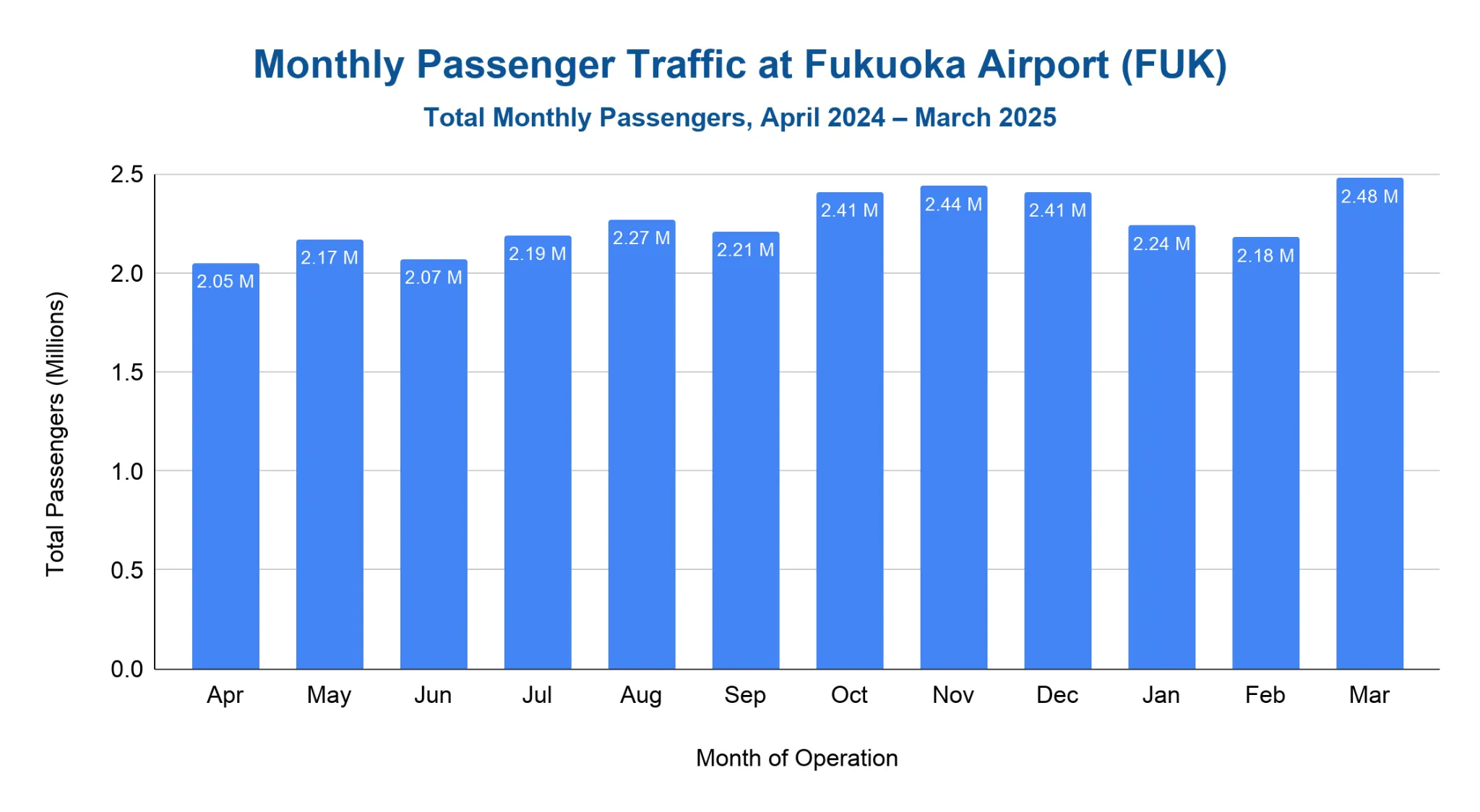
March was Fukuoka Airport's busiest month in FY2024, with 2.48 million total passengers.
- The first part of FY2024 was steady, with monthly traffic ranging from 2.05 million in April 2024 to 2.27 million in August 2024.
- Autumn and year-end travel were stronger, with October, November, and December each above 2.40 million passengers.
- November 2024 was the busiest calendar-month period of 2024, with 2.44 million passengers.
- The fiscal-year peak came in March 2025, when total passenger traffic reached 2.48 million.
- April 2024 was the lowest month of FY2024, with 2.05 million passengers.
How much cargo moves through Fukuoka Airport each year?
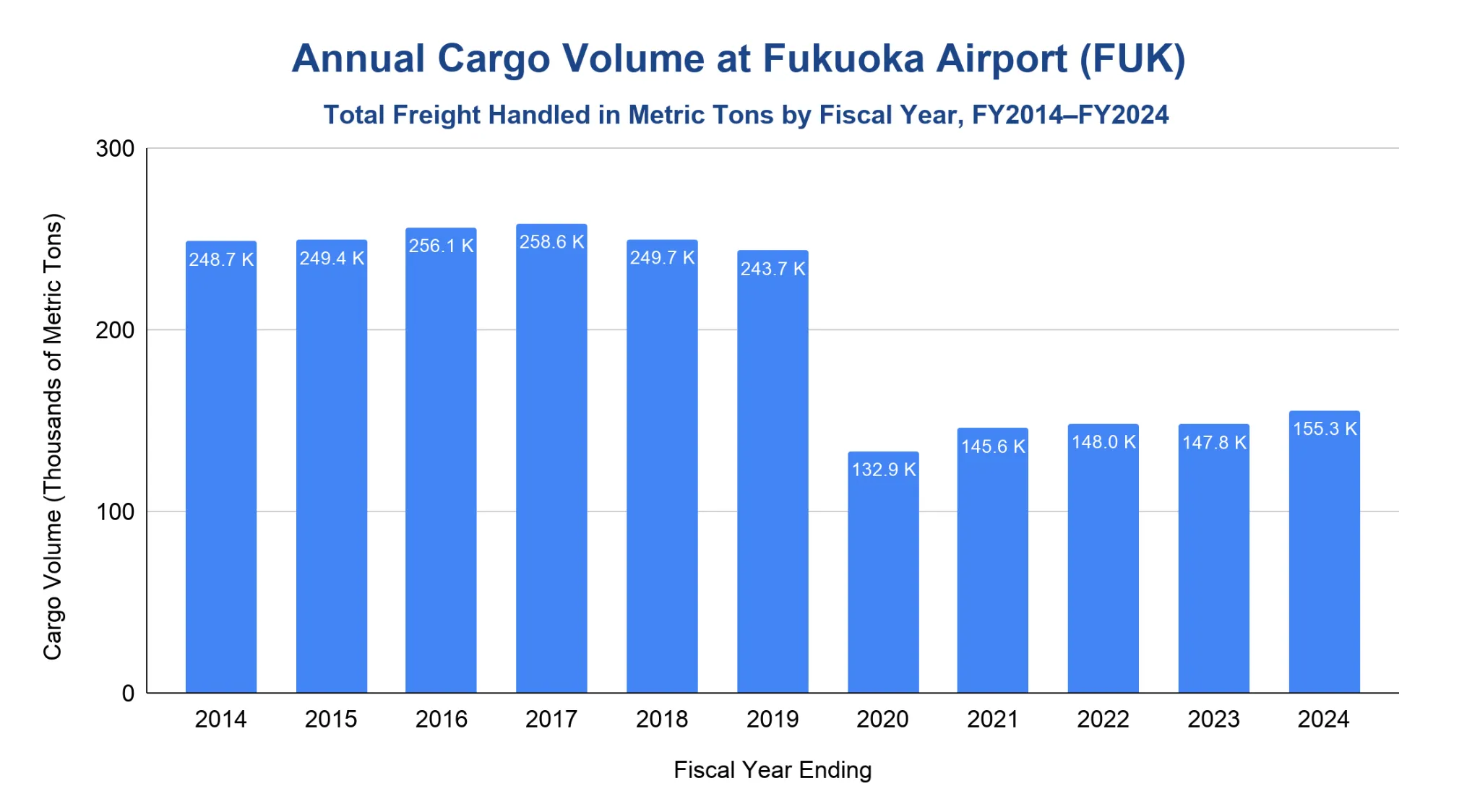
Fukuoka Airport handled 155,292 metric tons of cargo in FY2024, still below its late-2010s cargo peak.
- From FY2014 to FY2018, cargo remained high, ranging from 248,664 metric tons to 258,559 tons.
- The highest value in the available series came in FY2017, when cargo reached 258,559 metric tons.
- FY2019 cargo stood at 243,675 metric tons before the pandemic disrupted airport freight flows.
- Cargo fell to 132,912 metric tons in FY2020, then improved to 145,591 metric tons in FY2021.
- Recovery has been slower than passenger traffic, with cargo reaching 155,292 metric tons in FY2024 following a minor dip in FY2023.
Major Expansion Projects at Fukuoka Airport
Fukuoka Airport's 2,500m second runway opened in March 2025, raising annual runway capacity to 188,000–211,000 takeoffs and landings.
- The runway expansion moved from planning into operation on March 20, 2025, when the 2,500m parallel runway entered service.
- The second runway increased annual capacity from 176,000 to 188,000–211,000 takeoffs and landings.
- The project cost was about ¥164.30 billion.
- The international terminal grand opening also took place in March 2025, following upgrades to departure and arrival functions.
- Passenger-processing upgrades included 14 self bag-drop units and 7 smart security lanes.
- The duty-free area became about 4 times larger and added 44 new brands.
- The domestic terminal complex is planned for summer 2027, with commercial, hotel, bus terminal, and parking functions.
- Kansai International Airport (KIX) Statistics
- Centrair Nagoya Airport (NGO) Statistics
- Okinawa Naha Airport (OKA) Statistics
- New Chitose Airport (CTS) Statistics
- Tokyo Narita Airport (NRT) Statistics
- Tokyo Disneyland Tourism Statistics
How does Fukuoka Airport rank globally and nationally?
Fukuoka Airport ranked 4th in Japan by total passengers and 4th by total landings in FY2024.
- By FY2018, Fukuoka had reached 24.85 million passengers, placing it among Japan's largest airports before the pandemic.
- After the FY2020 collapse to 6.50 million passengers, traffic rebuilt to 24.94 million in FY2023.
- FY2024 traffic reached 27.12 million passengers, ranking Fukuoka 4th nationally by total passenger traffic.
- Domestic passenger traffic ranked 3rd nationally in FY2024, with 18.61 million domestic passengers.
- International passenger traffic ranked 4th nationally in FY2024, with 8.51 million international passengers.
- Total landings ranked 4th nationally in FY2024, with 94,706 landings.
- Before the second runway opened, the Ministry of Land, Infrastructure, Transport and Tourism (MLIT) described Fukuoka as Japan's busiest single-runway airport by passenger and aircraft-movement scale.
Note: Official ranking support is national and metric-specific; no official global ranking is included here.
References
- Airport Traffic, Cargo, Landings and Rankings (FY2014–FY2024) · mlit.go.jp
- Operator Financial Results and Annual Reports (FY2019–FY2024) · fukuoka-airport.co.jp
- Japan Airport Ranking Summary (FY2024) · fukuoka-airport.jp
- Runway and Facility Regulations (Current) · fukuoka-airport.jp
- Second Runway Opening and Capacity (2025) · pa.qsr.mlit.go.jp
- International Terminal Expansion Metrics (2025) · fukuoka-airport.co.jp

