

 Popular Countries
 24/7 Support
Published
New Chitose Airport (CTS) is the largest aviation gateway on Japan's northern island of Hokkaidō. The airport connects the Sapporo metropolitan area to destinations worldwide, and remains one of Japan's busiest airports by passenger volume.
How many passengers use New Chitose Airport each year?
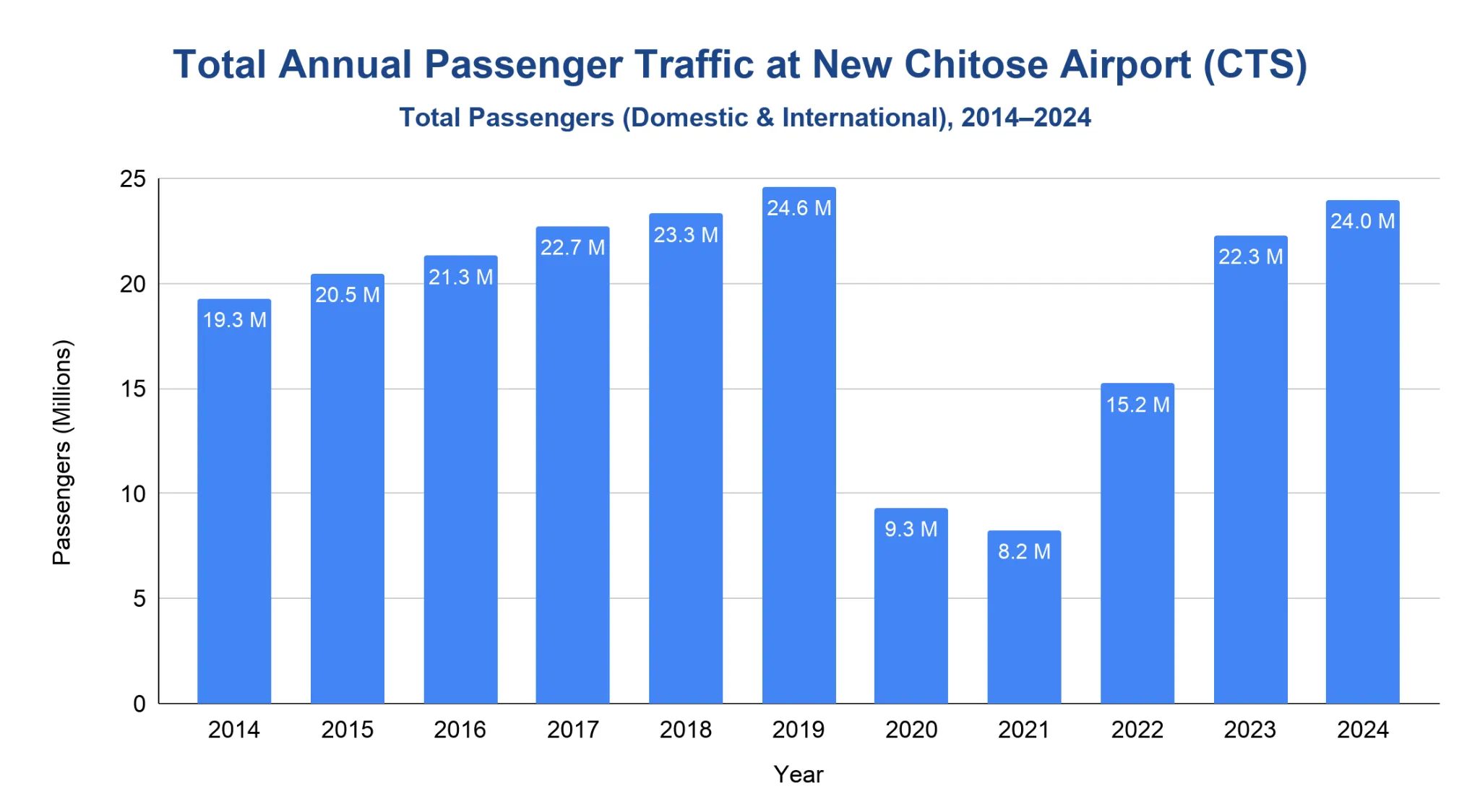
New Chitose Airport handled 23.97 million total passengers in 2024, reaching 97.4% of its 2019 pre-pandemic peak.
- Before the pandemic, the airport reached its recent high in 2019 with 24.6 million passengers.
- Traffic fell to 9.3 million passengers in 2020 and reached its lowest point in 2021 at 8.23 million passengers.
- The recovery continued through 2022 and 2023, reaching 23.97 million passengers in 2024.
- From 2015 through 2019, CTS handled more than 20 million passengers each year.
Note: Passenger figures are total passengers, meaning domestic and international passengers getting on and off at New Chitose Airport.
How many passengers use New Chitose Airport for domestic vs international travel?
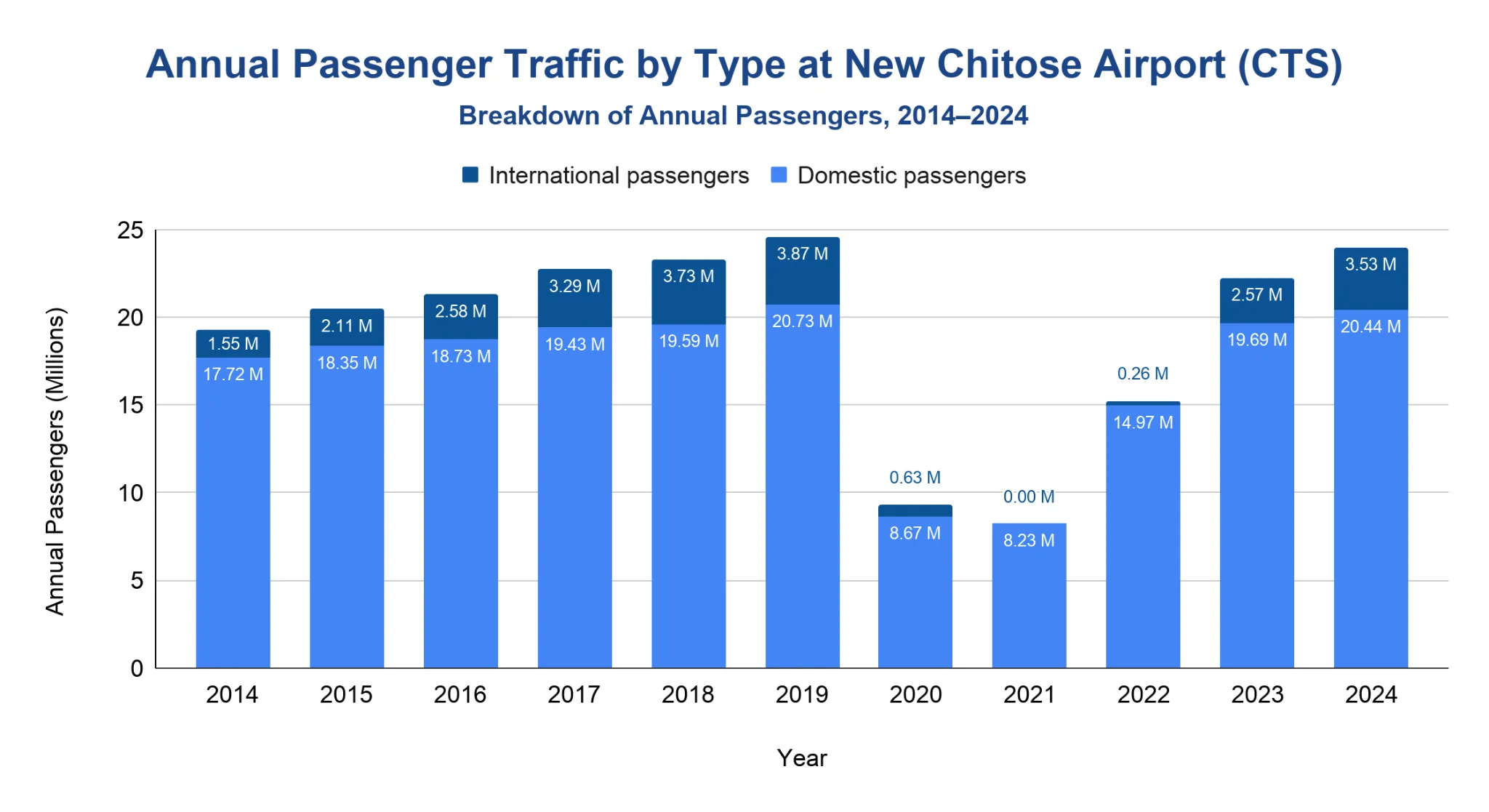
Domestic passengers accounted for 85.3% of New Chitose Airport traffic in 2024, while international passengers accounted for 14.7%.
- Domestic traffic totaled 20.44 million passengers in 2024.
- International traffic totaled 3.53 million passengers in 2024.
- The domestic share declined from 91.9% in 2014 to 84.3% in 2019, before returning to 85.3% in 2024.
- International traffic more than doubled from 1.55 million passengers in 2014 to 3.87 million in 2019, then recovered to 3.53 million in 2024.
Note: Percentages are derived from official domestic, international, and total passenger counts.
What is the total number of aircraft landings at New Chitose Airport each year?
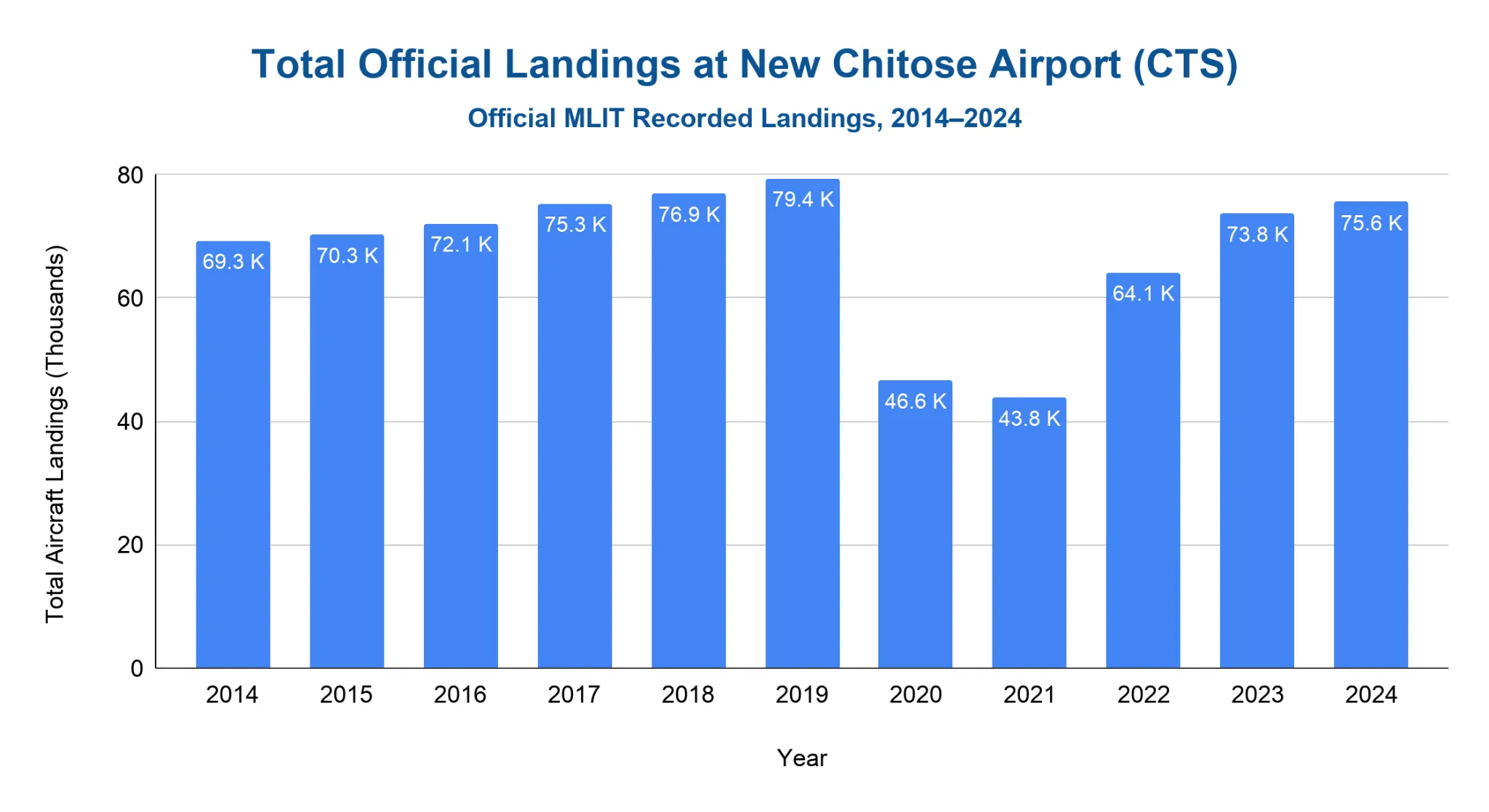
New Chitose Airport recorded 75,577 official landings in 2024, continuing its recovery toward the 2019 peak.
- Landings increased from 69,301 in 2014 to 79,367 in 2019, the highest amount between 2014–2024.
- During the pandemic, landings fell to 46,644 in 2020 and reached a low of 43,814 in 2021.
- Activity recovered to 73,768 landings in 2023 and 75,577 in 2024.
Note: Official MLIT airport-management data reports landings, so this section uses landings only.
Most Popular Destinations from New Chitose Airport
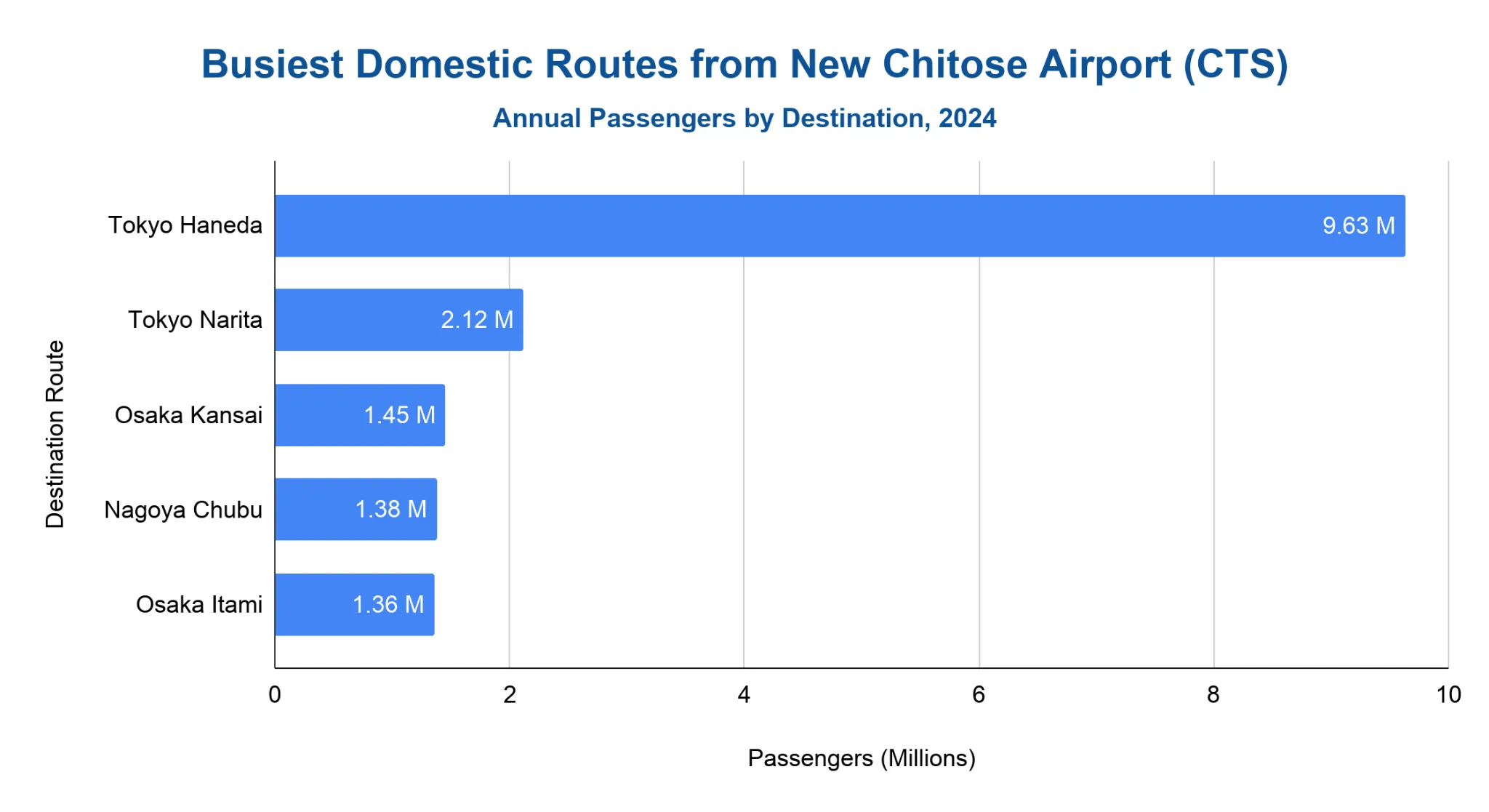
Tokyo Haneda was New Chitose Airport’s busiest domestic route in 2024, with 9.63 million passengers.
- Tokyo Haneda was the airport’s largest route, carrying 9.63 million passengers in 2024.
- Tokyo Narita ranked second with about 2.12 million passengers.
- Osaka Kansai, Nagoya Chubu, and Osaka Itami each handled between about 1.36 million and 1.45 million passengers.
- The five listed domestic routes together accounted for roughly 15.94 million passengers, or about 66.5% of all CTS passenger traffic in 2024.
Note: HAP’s route chart supports the top domestic routes; the international route totals in the original draft need separate official route-level sourcing before publication.
How much revenue does New Chitose Airport generate each year?
New Chitose Airport generated ¥48.6 billion in official New Chitose segment revenue in FY2024.
- Revenue rose from ¥42.12 billion in FY2023 to ¥48.6 billion in FY2024.
- Facility-management operations were the largest revenue source in FY2024, generating ¥34.09 billion.
- Retail revenue reached ¥11.33 billion in FY2024, while food and beverage revenue reached ¥3.18 billion.
- Total segment revenue increased by 15.4% from FY2023 to FY2024.
| Metric | FY2023 | FY2024 |
|---|---|---|
| Facility-management operations revenue | ¥29.85 billion | ¥34.09 billion |
| Retail revenue | ¥9.46 billion | ¥11.33 billion |
| Food and beverage revenue | ¥2.80 billion | ¥3.18 billion |
| Total revenue | ¥42.12 billion | ¥48.60 billion |
Source · Figures are official New Chitose segment revenues reported by Hokkaido Airports. Hokkaido Airports’ fiscal year runs from April 1 to March 31.
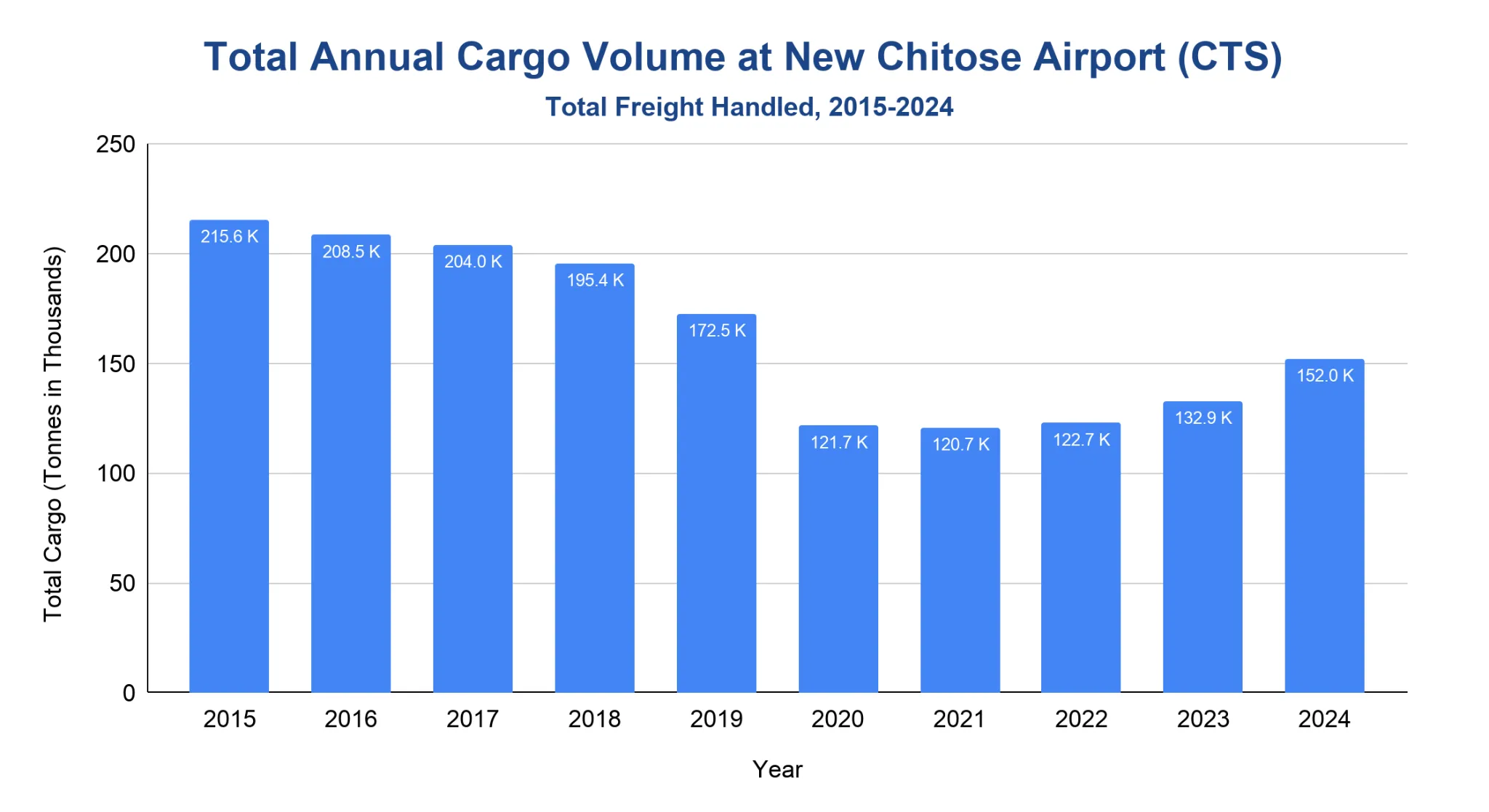
How much cargo moves through New Chitose Airport each year?
New Chitose Airport handled 152,048 tonnes of cargo in 2024, equal to 88.1% of its 2019 cargo-only total.
- Cargo volume declined from 215,556 tonnes in 2015 to 172,498 tonnes in 2019.
- Cargo fell further during the pandemic, reaching 121,725 tonnes in 2020 and 120,697 tonnes in 2021.
- The recovery was gradual at first, with 122,746 tonnes in 2022 and 132,888 tonnes in 2023.
- By 2024, cargo had risen to 152,048 tonnes, with domestic cargo making up 95% of the total.
Major Expansion Projects at New Chitose Airport
New Chitose Airport’s official facility record shows two 3,000-meter runways that operate 24 hours a day, a 2019 international terminal extension completion, and a dedicated business aviation facility opened in December 2023.
- International Terminal expansion: HAP’s airport history records the international terminal extension as completed in 2019.
- Business Aviation Terminal: The Hokkaido Business Aviation Center opened on December 8, 2023, next to the international terminal.
- Airport facilities: Current basic facilities include Runway A and Runway B, each 3,000 meters × 60 meters.
- Vision target: HAP’s official vision targets 45.84 million passengers across the seven Hokkaidō airports, not 100 million.
References
- HAP — Official Airport Authority Data (2014–2024) · hokkaido-airports.com
- Airport Traffic, Cargo, Landings and Rankings (FY2014–FY2024) · mlit.go.jp

