

 Popular Countries
 24/7 Support
Updated
How many passengers use Tokyo Narita Airport each year?
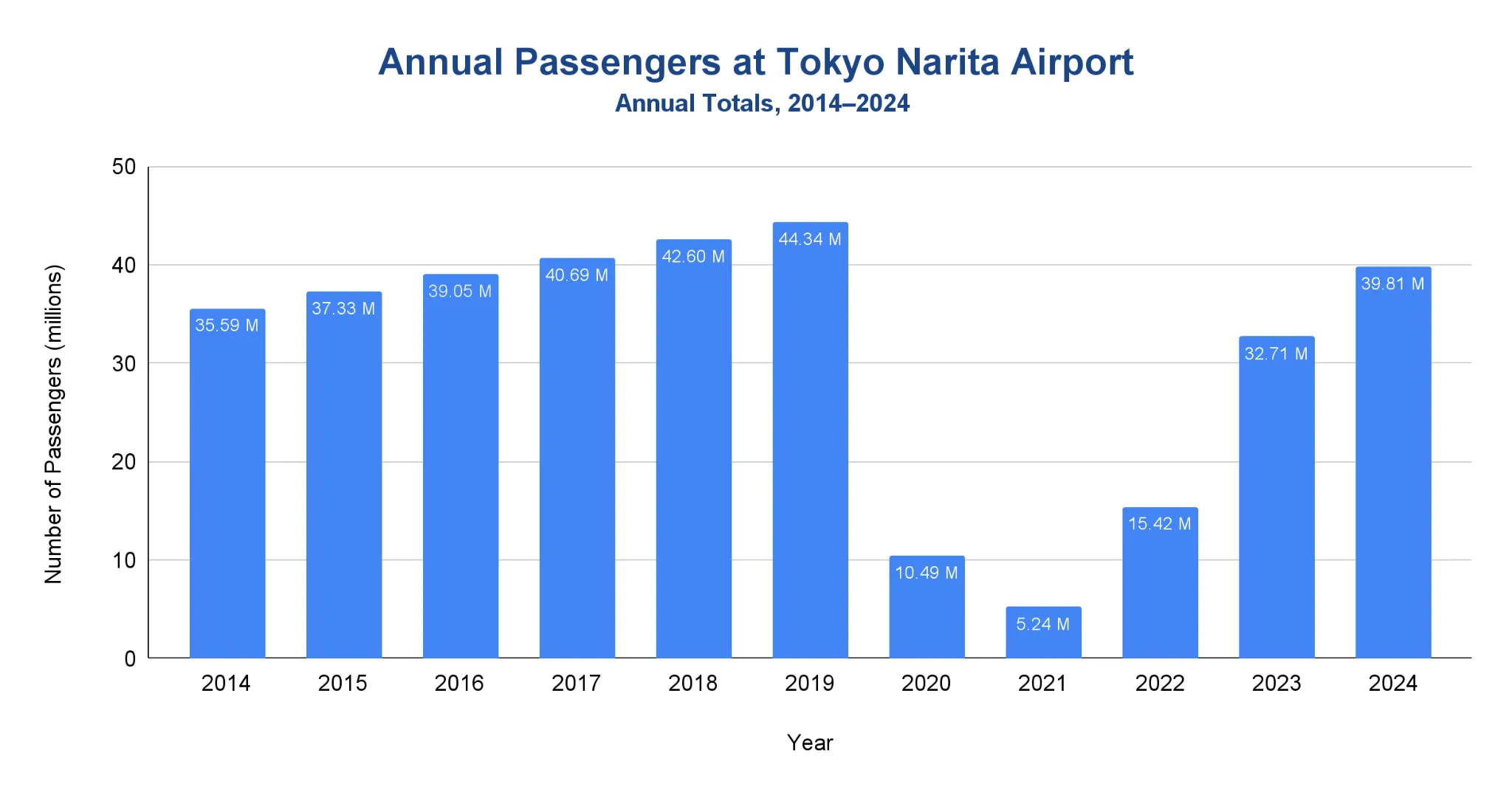
Around 40 million passengers travel through Tokyo Narita Airport each year.
- Traffic climbed from 35.59 million in 2014 to 44.34 million in 2019 before the pandemic upended travel patterns.
- The pandemic triggered a steep decline. Numbers dropped to 10.49 million in 2020 and bottomed out at 5.24 million in 2021.
- Narita Airport handled 39.81 million passengers in 2024, about 90% of its 2019 pre-pandemic volume.
How many aircraft operations take place at Tokyo Narita Airport each year?
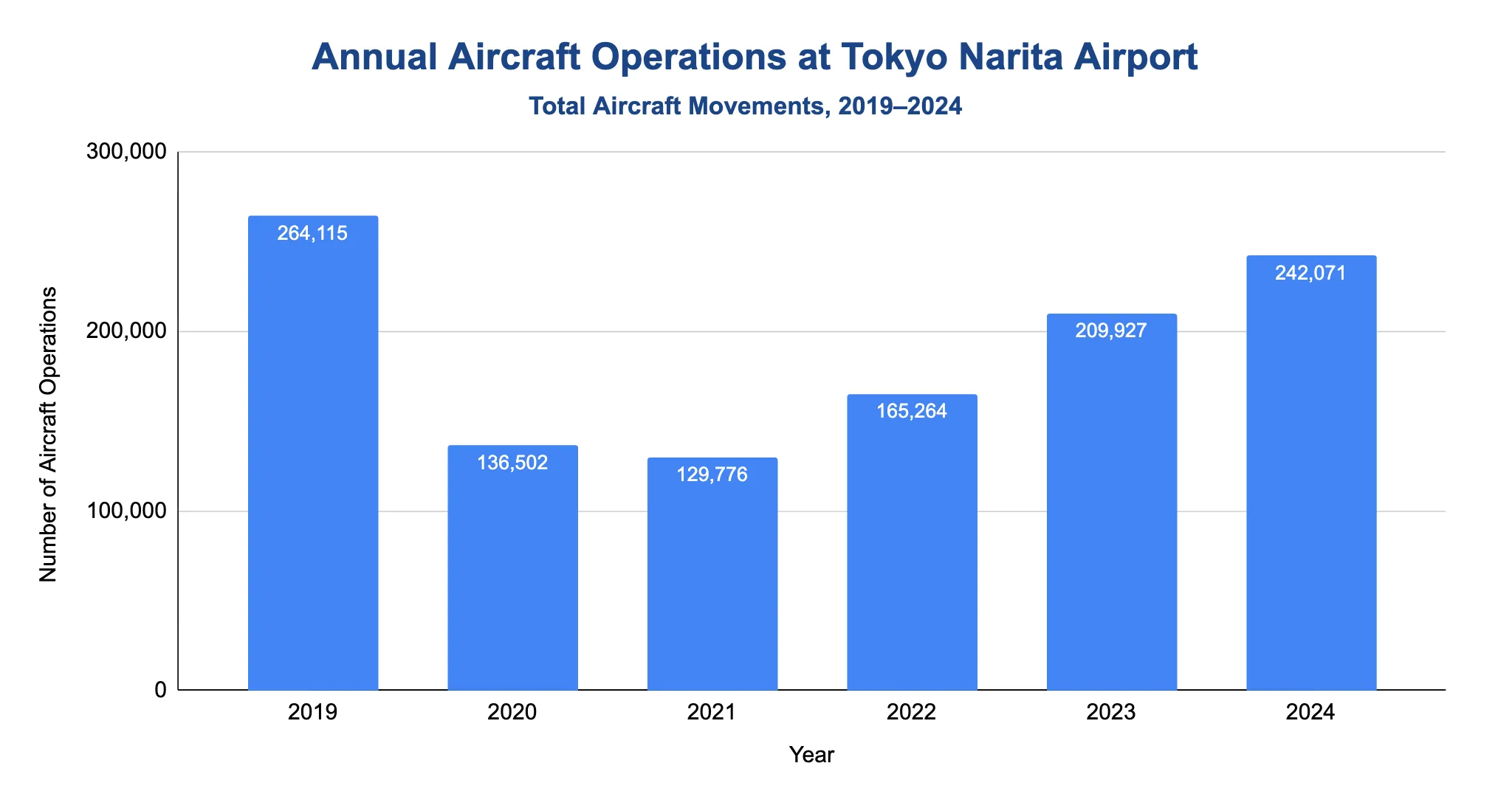
In typical years, aircraft movements at NRT exceed 200,000 flights. The pandemic broke that rhythm, but operations have been rising steadily.
- The airport logged 264,115 operations in 2019 before COVID-19 struck.
- Operations fell to 136,502 in 2020, then rebounded to 165,264 in 2022 and 209,927 in 2023.
- In 2024, Narita recorded 242,071 total operations: 190,977 international and 51,094 domestic, or roughly 79% international and 21% domestic.
What kinds of aircraft operations occur at Tokyo Narita Airport?
Narita groups aircraft movements into three categories: passenger flights, cargo flights and other operations, with separate tallies for international and domestic traffic.
- Narita processed 157,703 international passenger flights and 47,721 domestic passenger flights in 2024. International services made up about 77% of passenger movements, with domestic flights accounting for roughly 23%.
- Cargo activity included 30,069 international cargo flights and 2,100 domestic cargo flights in 2024, reflecting a sharp expansion of domestic freighter networks.
- Other movements (ferry flights, technical stops, private aircraft) totaled 3,205 international operations and 1,273 domestic operations that year.
- Unlike US FAA classifications, NAA's reports do not break out air taxi, general aviation and military operations.
| International Aircraft Movements by Type (2018–2024) | |||||||
|---|---|---|---|---|---|---|---|
| Type | 2018 | 2019 | 2020 | 2021 | 2022 | 2023 | 2024 |
| PAX Flight | 176,409 | 181,837 | 62,331 | 47,542 | 69,747 | 124,964 | 157,703 |
| Cargo Flight | 23,665 | 24,316 | 37,311 | 50,961 | 43,300 | 31,297 | 30,069 |
| Others | 2,879 | 3,053 | 6,341 | 3,011 | 2,825 | 2,584 | 3,205 |
| Domestic Aircraft Movements by Type (2018–2024) | |||||||
|---|---|---|---|---|---|---|---|
| Type | 2018 | 2019 | 2020 | 2021 | 2022 | 2023 | 2024 |
| PAX Flight | 50,693 | 53,185 | 29,427 | 27,737 | 48,908 | 50,346 | 47,721 |
| Cargo Flight | 498 | 502 | 145 | 22 | 3 | 9 | 2,100 |
| Others | 859 | 1,222 | 947 | 503 | 481 | 727 | 1,273 |
Which airlines operate most flights from Tokyo Narita Airport?
All Nippon Airways (ANA) and Japan Airlines (JAL) account for the largest share of passenger traffic at NRT.
What are the most popular destinations from Tokyo Narita Airport?
Narita's busiest routes connect Japan with major Asian cities, and short-haul flights generate the highest passenger volumes.
- The Seoul–Incheon (ICN) route ranked third among the world's busiest city pairs in 2024, with 5.4 million scheduled airline seats. According to OAG’s ranking methodology, this figure covers flights in both directions on the route.
- Hong Kong (HKG) remains a strong financial hub with year-round demand.
- Bangkok (BKK) and Singapore (SIN) round out the top five Asian destinations, serving both leisure travelers and business passengers.
- Domestically, Sapporo (CTS) and Fukuoka (FUK) lead the rankings from NRT.
What are the monthly traffic trends at Tokyo Narita Airport?
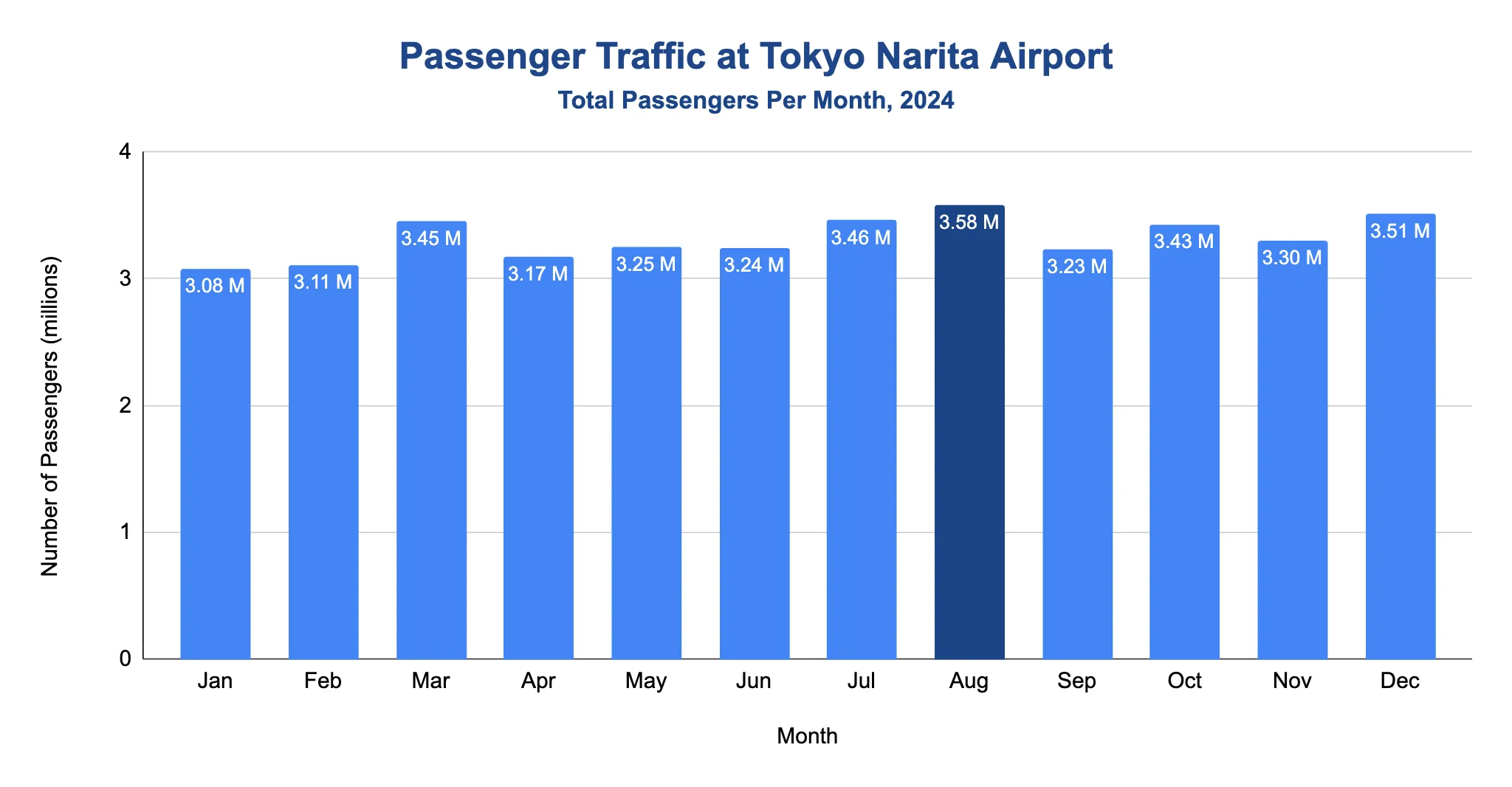
Passenger volume at Narita reached its peak in August 2024 with 3.58 million passengers, and December came close behind at 3.51 million.
- Summer drives international demand. July attracted 3.46 million passengers during the vacation rush.
- Spring and fall feature their own peaks. March and October both surpassed 3.40 million passengers.
- January marked the low point at 3.08 million passengers as post-holiday travel slowed.
How much cargo moves through Tokyo Narita Airport each year?
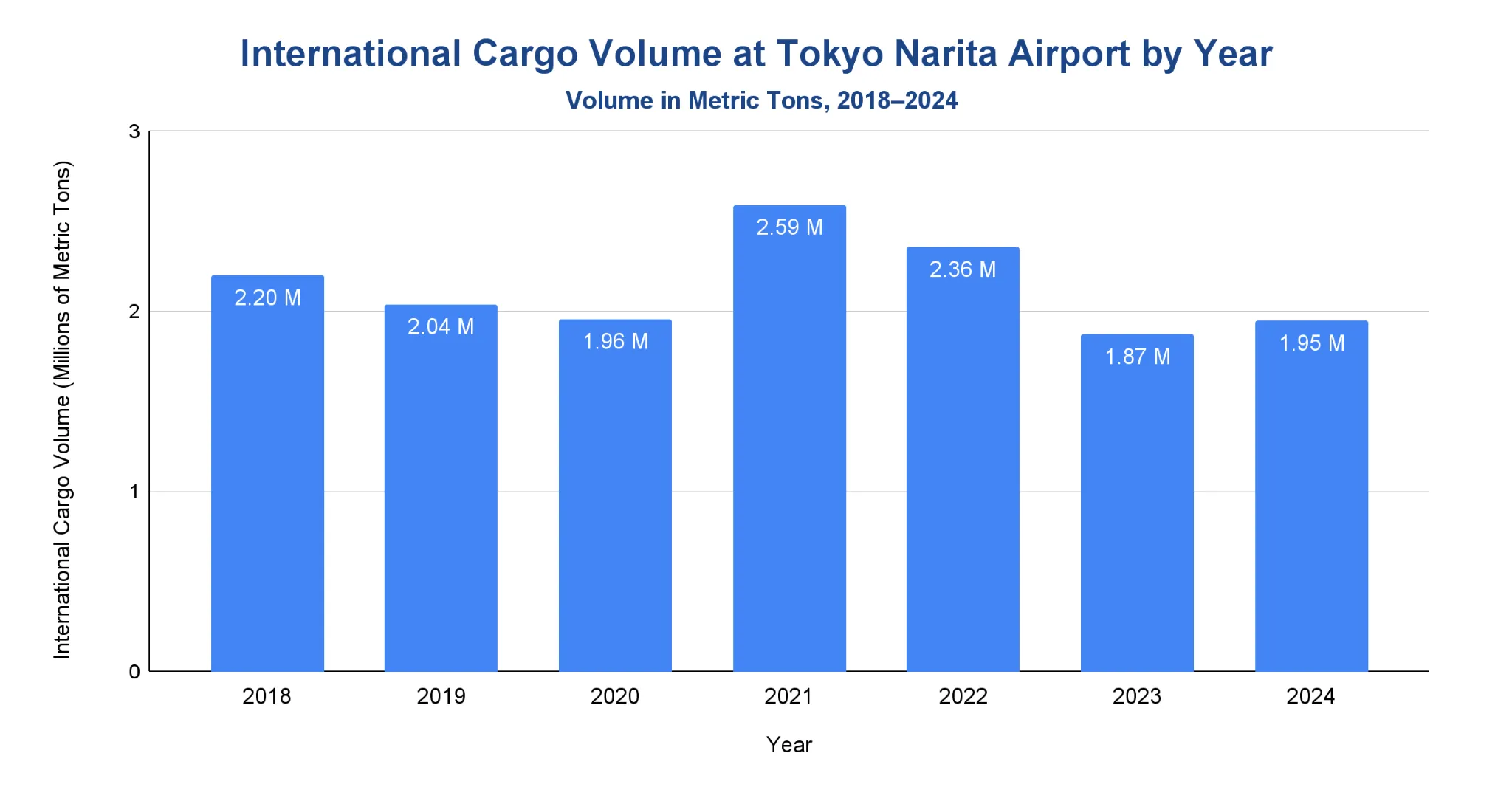
- The airport handled 1.87 million metric tons of international cargo in 2023.
- International cargo peaked at 2.59 million metric tons in 2021, driven by rising e-commerce and medical-supply shipments.
- Pre-pandemic volumes stood at 2.04 million metric tons in 2019 and 2.20 million metric tons in 2018.
- Narita processed 1.95 million metric tons of international cargo in 2024, roughly 75% of the 2021 peak.
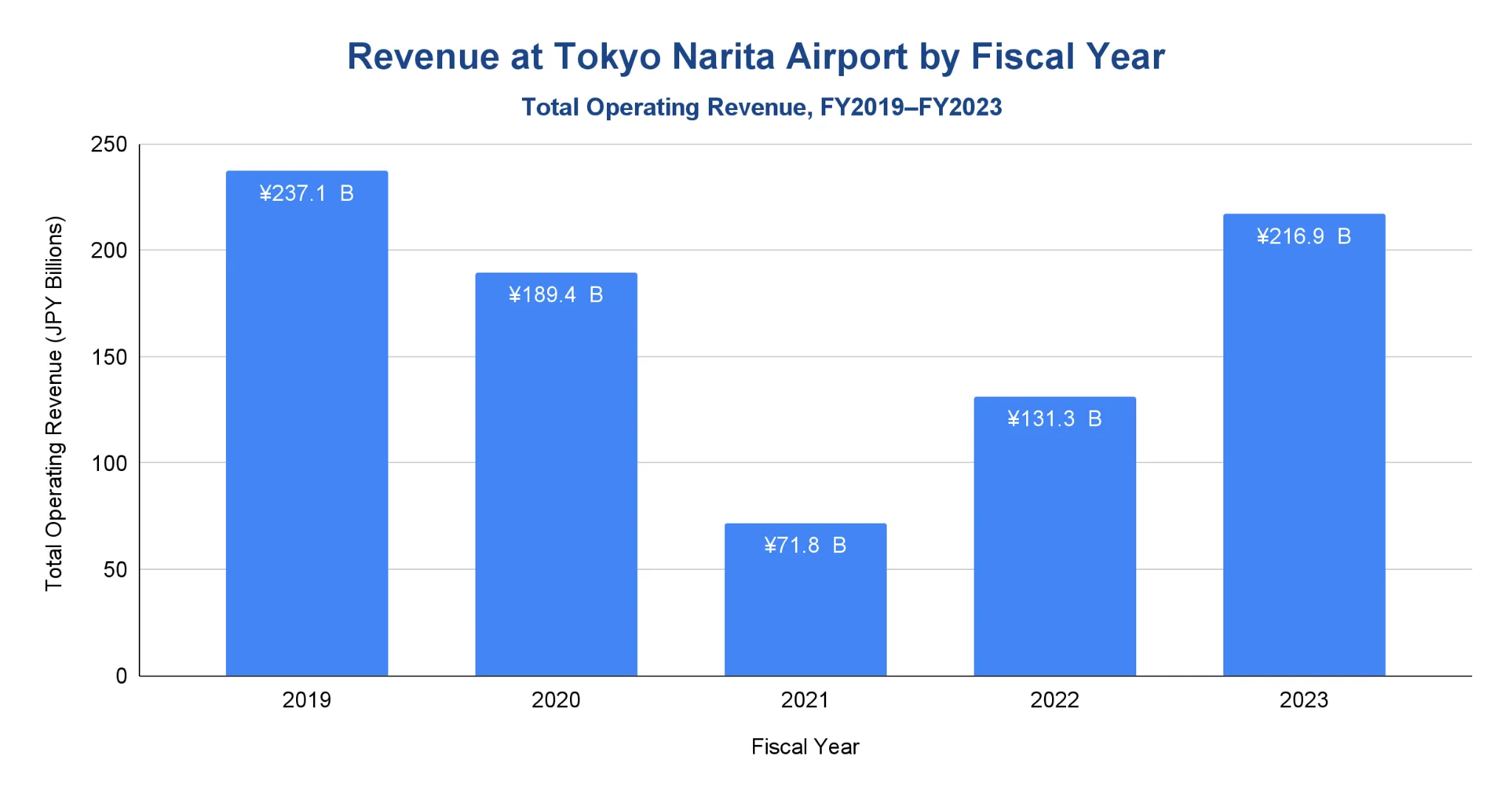
How much revenue does Tokyo Narita Airport generate each fiscal year?
NRT typically earns more than ¥200 billion annually, reported on a fiscal-year basis (April–March).
- Narita International Airport Corporation (NAA) shows revenue fell sharply during COVID-19, then rebounded as traffic returned.
- Fiscal 2019 operating revenue reached ¥237.1 billion.
- Revenue dropped to ¥189.4 billion in fiscal 2020 and hit a low of ¥71.8 billion in fiscal 2021.
- Operating revenue recovered to ¥131.3 billion in fiscal 2022 and climbed to ¥216.9 billion in fiscal 2023.
Note: Fiscal year ends on 31st March.
What is Tokyo Narita Airport's safety record?
- Narita recorded no major accidents resulting in the total loss of an aircraft (aka hull loss) or fatal passenger accidents from 2014 to 2024 (JTSB).
- The Japan Transport Safety Board investigates all incidents and issues safety recommendations.
More Statistics
What expansion projects are underway at Tokyo Narita Airport?
Narita is moving ahead with significant infrastructure upgrades. The fiscal 2025–2027 budget allocates ¥585 billion to expand capacity and improve efficiency.
- The "New Narita Airport" concept focuses on designing a passenger terminal that consolidates functions and streamlines transfers.
- Runway B will be extended and a new Runway C built under the "Further Functional Enhancement" project, with ¥360 billion set aside for runway work during 2025–2027.
- These runway projects aim for completion by the end of fiscal 2028 (March 2029).
- Cargo-area development continues with a basic plan for a "New Cargo Area" that integrates neighboring land to stay competitive as a logistics hub.
- The "Gear Up NRT" Mid-Term Management Plan (fiscal 2025–2027) targets faster transformation and added value for stakeholders.
What are Tokyo Narita Airport's environmental goals?
The airport pursues ambitious carbon-reduction targets under its "Sustainable NRT 2050" vision.
- The NAA Group aims for net-zero CO₂ emissions by 2050.
- For 2030, goals include a 50% cut versus FY2015 levels for the NAA Group (Scope 1 & 2) and a 30% reduction per flight airport-wide (Scope 3).
- Promoting Sustainable Aviation Fuel (SAF) is central to lowering aviation emissions, including efforts to secure supply and use indirect "Scope 3 environmental value".
- Renewable-energy expansion includes on-site solar generation and other clean-energy sources.
- Narita has achieved Airport Carbon Accreditation Level 4, marking real progress toward decarbonization.
References
- Passenger Traffic, Cargo & Aircraft Movements (2014–2024) · narita-airport.jp
- Integrated Report & Financial Disclosures (NAA) · narita-airport.jp
- Aviation Reports & Safety Statistics (2014–2024) · jtsb.mlit.go.jp
- OAG — Busiest International Routes by Scheduled Seats (2023–2024) · oag.com
- Narita Airport Third Runway Expansion (2025) · japantimes.co.jp
- Airport Carbon Accreditation & Sustainability (NAA) · narita-airport.jp
- Mid-Term Management Plan (NAA) · narita-airport.jp

