

 Popular Countries
 24/7 Support
Published
Wichita Dwight D. Eisenhower National Airport (ICT) is Kansas’s largest and busiest airport, serving as the primary air gateway for Wichita and the surrounding region. Located about 7 miles west of downtown Wichita, the airport connects travelers to major hubs across the United States through several airline partners.
How many passengers pass through Wichita Dwight D. Eisenhower National Airport each year?
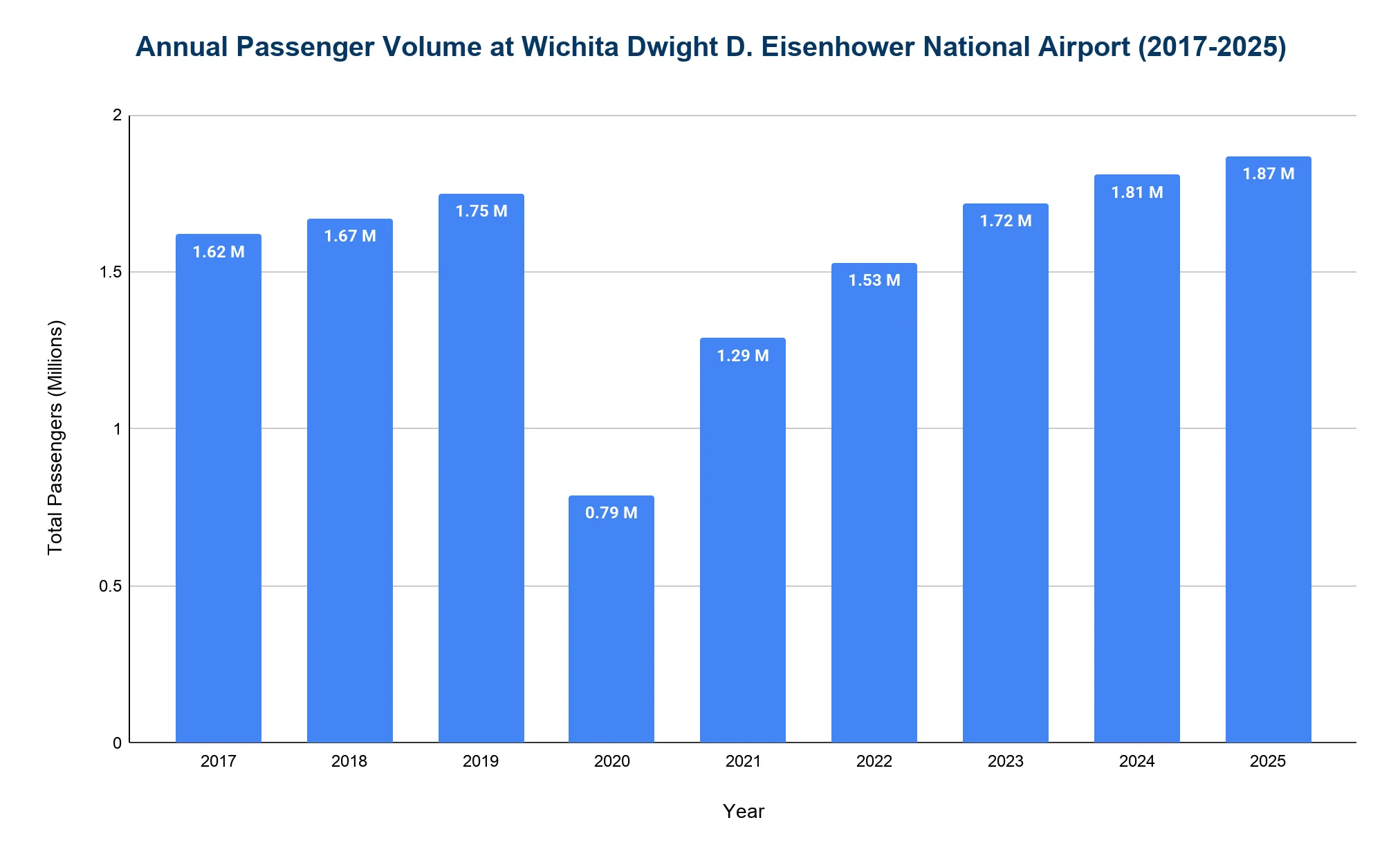
Wichita Dwight D. Eisenhower National Airport handles more than 1.8 million passengers annually. The airport set an all-time record in 2025, reflecting strong growth and full recovery from pandemic-related disruptions.
- The airport served 1.87 million passengers in 2025, a 3.3% increase from 1.81 million in 2024, marking the busiest year in its history.
- In 2019, the airport reached 1.75 million passengers before pandemic disruptions.
- Passenger traffic dropped sharply to 791,203 in 2020 (a 55% decline) and recovered to 1.29 million in 2021.
- Recovery continued with 1.53 million passengers in 2022 and 1.72 million in 2023.
What is the total number of aircraft operations at Wichita Dwight D. Eisenhower National Airport each year?
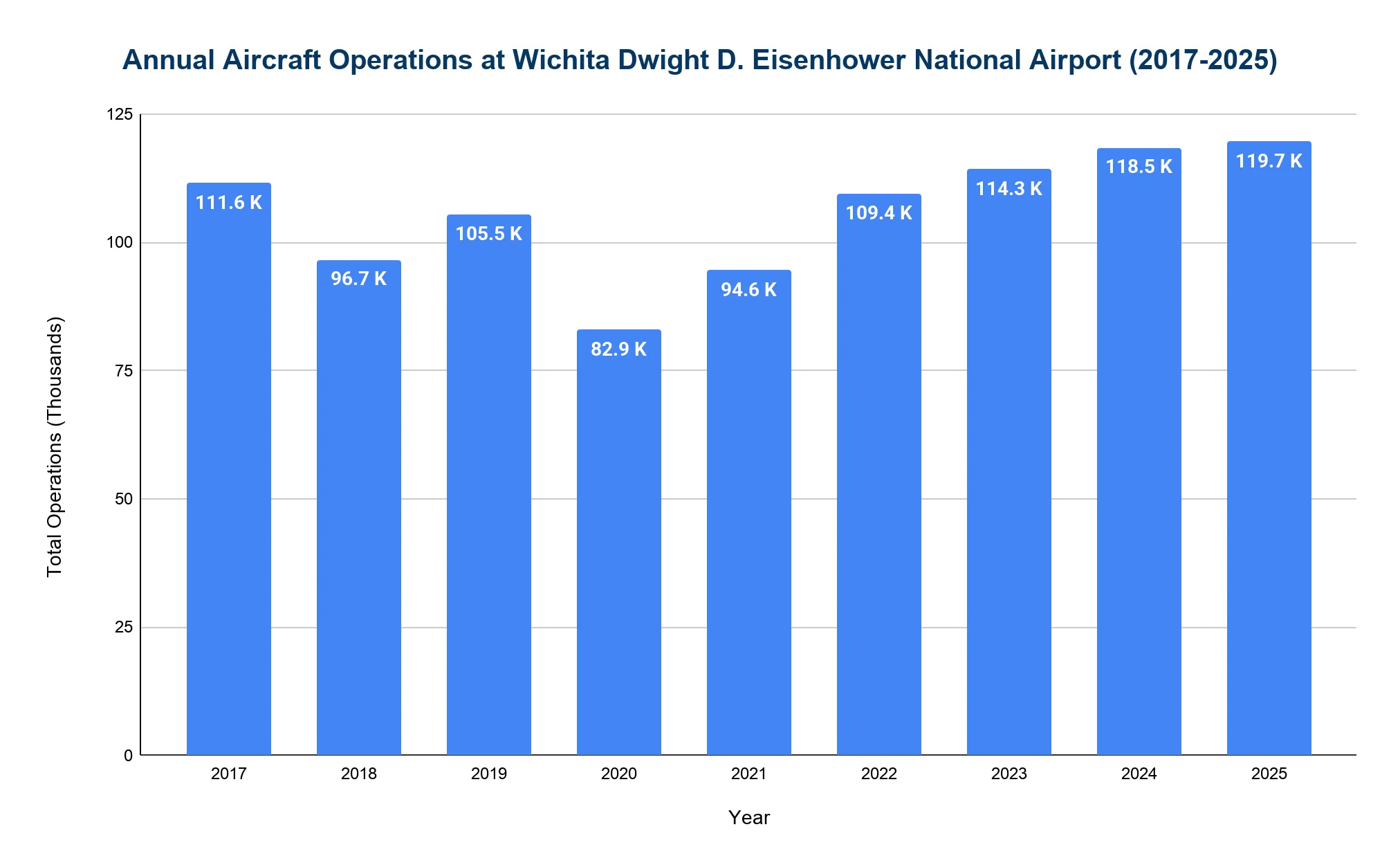
Wichita Dwight D. Eisenhower National Airport sees over 115,000 takeoffs and landings annually.
- In 2025, there were 119,654 total aircraft movements, a slight increase from 118,508 movements in 2024.
- Before the pandemic, 2019 saw about 105,465 movements, with 2018 recording 96,655 operations.
- Operations dropped to around 82,924 in 2020, the lowest during the pandemic.
- Recovery began in 2021 with 94,599 operations, then continued with 109,448 in 2022 and 114,293 in 2023.
Types of Aircraft Operations
General aviation makes up the majority of operations at Wichita Dwight D. Eisenhower National Airport.
- In 2025, general aviation accounted for 70,407 operations.
- Air carrier and commuter operations totaled 38,490.
- Military operations added 10,757.
| Aircraft Operation Types at ICT (2019-2025) | |||
|---|---|---|---|
| Year | Air Carrier and Commuter | General Aviation | Military |
| 2019 | 36,939 | 45,048 | 23,478 |
| 2020 | 28,911 | 36,721 | 17,292 |
| 2021 | 34,855 | 46,272 | 13,472 |
| 2022 | 35,780 | 56,018 | 17,650 |
| 2023 | 35,015 | 63,694 | 15,584 |
| 2024 | 37,123 | 72,597 | 8,788 |
| 2025 | 38,490 | 70,407 | 10,757 |
Which airlines operate the most flights out of Wichita Dwight D. Eisenhower National Airport?
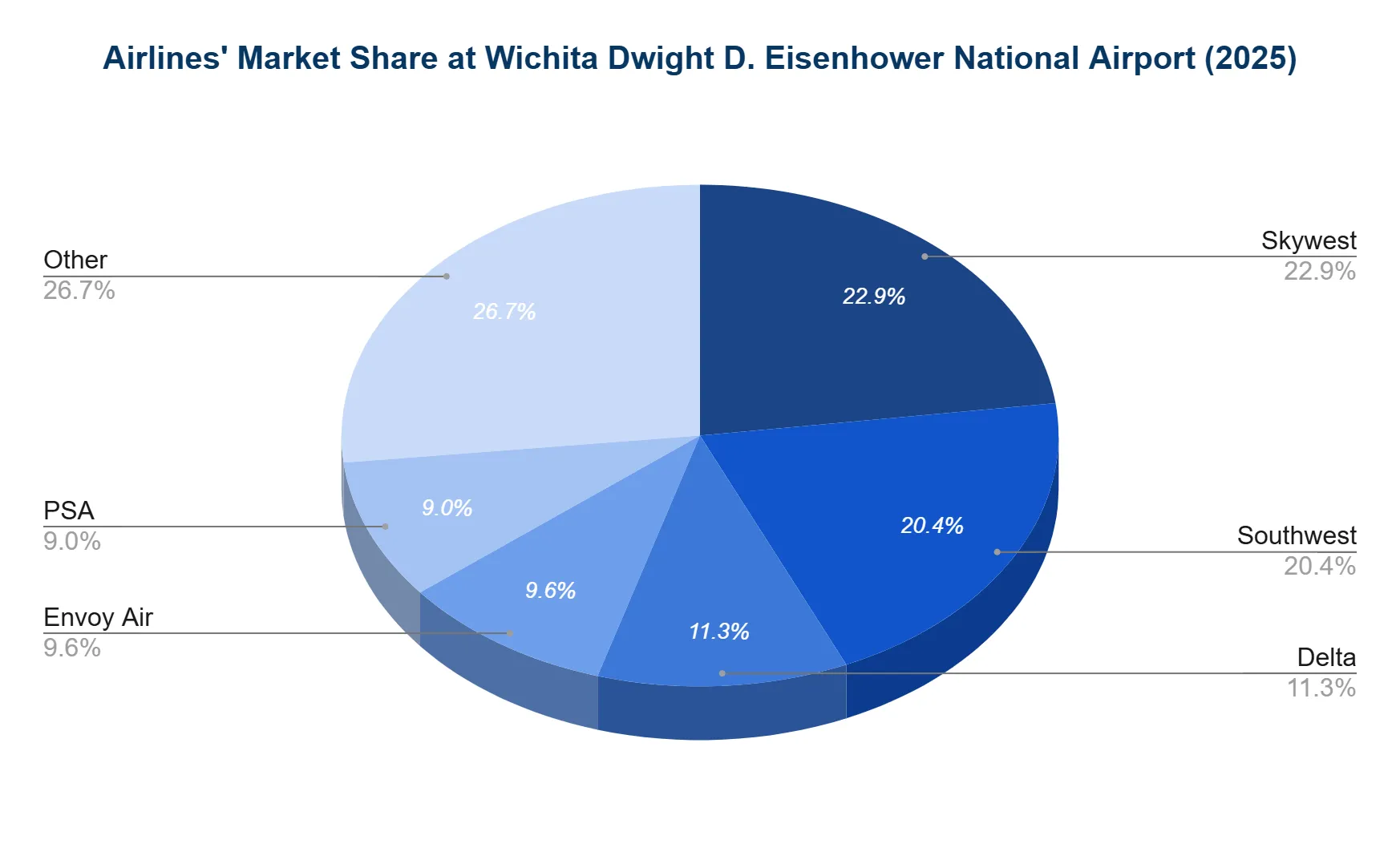
Multiple carriers serve ICT with relatively balanced market shares, reflecting the airport's role as an origin-and-destination facility rather than a hub.
- SkyWest Airlines (operating as United Express) led in ICT in 2025 with 22.9% of enplaned passengers.
- Southwest Airlines carried 20.4% of enplaned passengers.
- Delta Air Lines accounted for 11.3%.
- Envoy Air (operating as American Eagle) held 9.6% market share, serving American's hub routes.
- PSA Airlines had 9% of total market share.
What are the monthly trends in passenger traffic at Wichita Dwight D. Eisenhower National Airport?
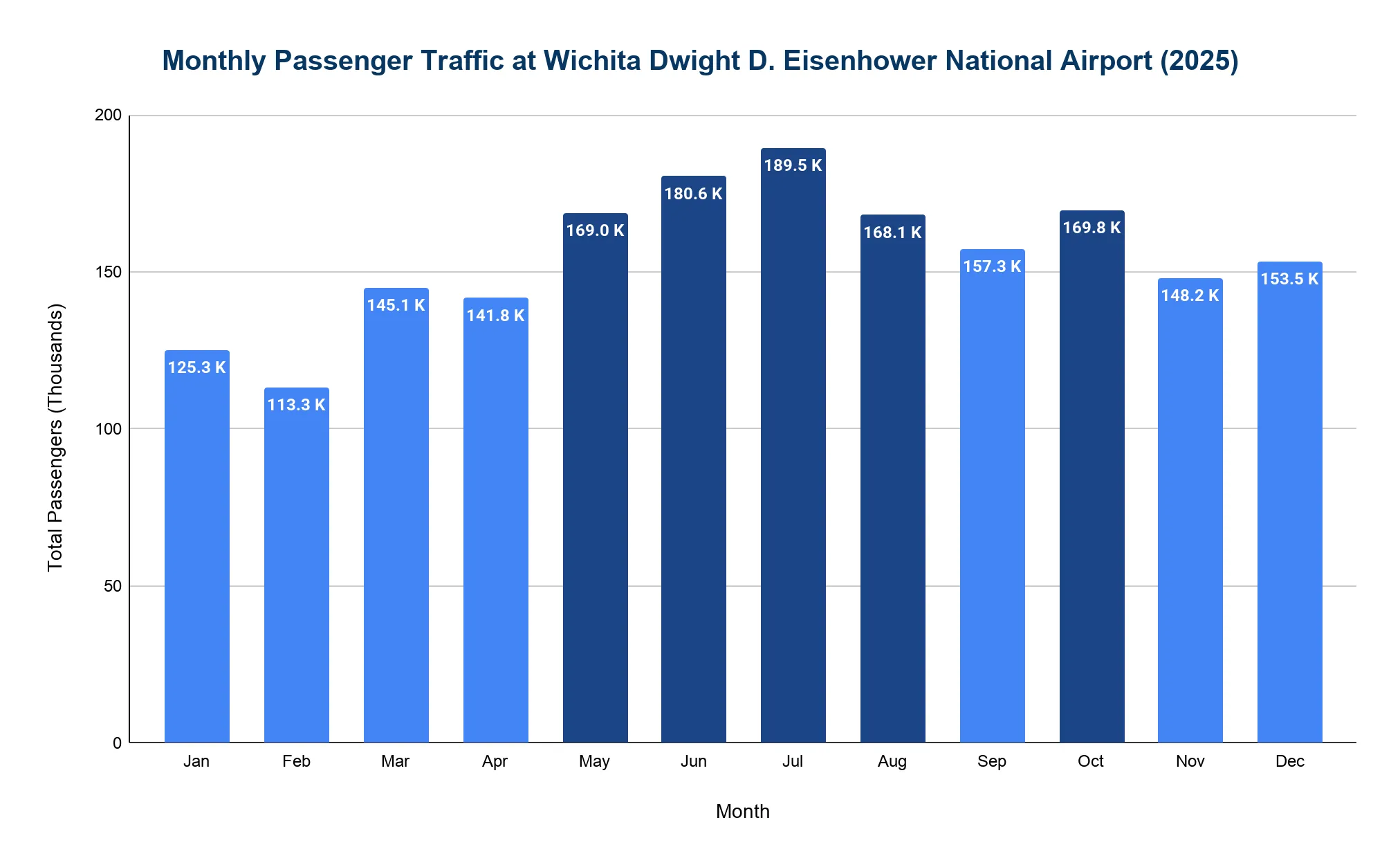
Wichita Dwight D. Eisenhower National Airport shows strong seasonal patterns, with peak summer months driving the highest traffic through 2025.
- July was the busiest month with 189,533 passengers, representing the peak of summer travel season.
- June recorded 180,605 passengers, confirming the summer surge.
- October had 169,759 passengers, supported by sustained fall leisure demand.
- May and August reached 168,950 and 168,106 passengers respectively, maintaining strong summer demand.
- The slowest months were January with 125,292 passengers and February with 113,275, typical of post-holiday winter travel patterns.
How many routes are there at Wichita Dwight D. Eisenhower National Airport?
- The airport serves only domestic destinations with no scheduled international passenger service as of 2025.
- ICT offers nonstop service to major airline hubs and popular leisure destinations across the United States.
- Recent route additions include American Airlines’ nonstop service to Miami (launched June 2025) and expanded frequencies to existing destinations.
- The network provides connections to business centers and vacation markets, serving both corporate and leisure travelers.
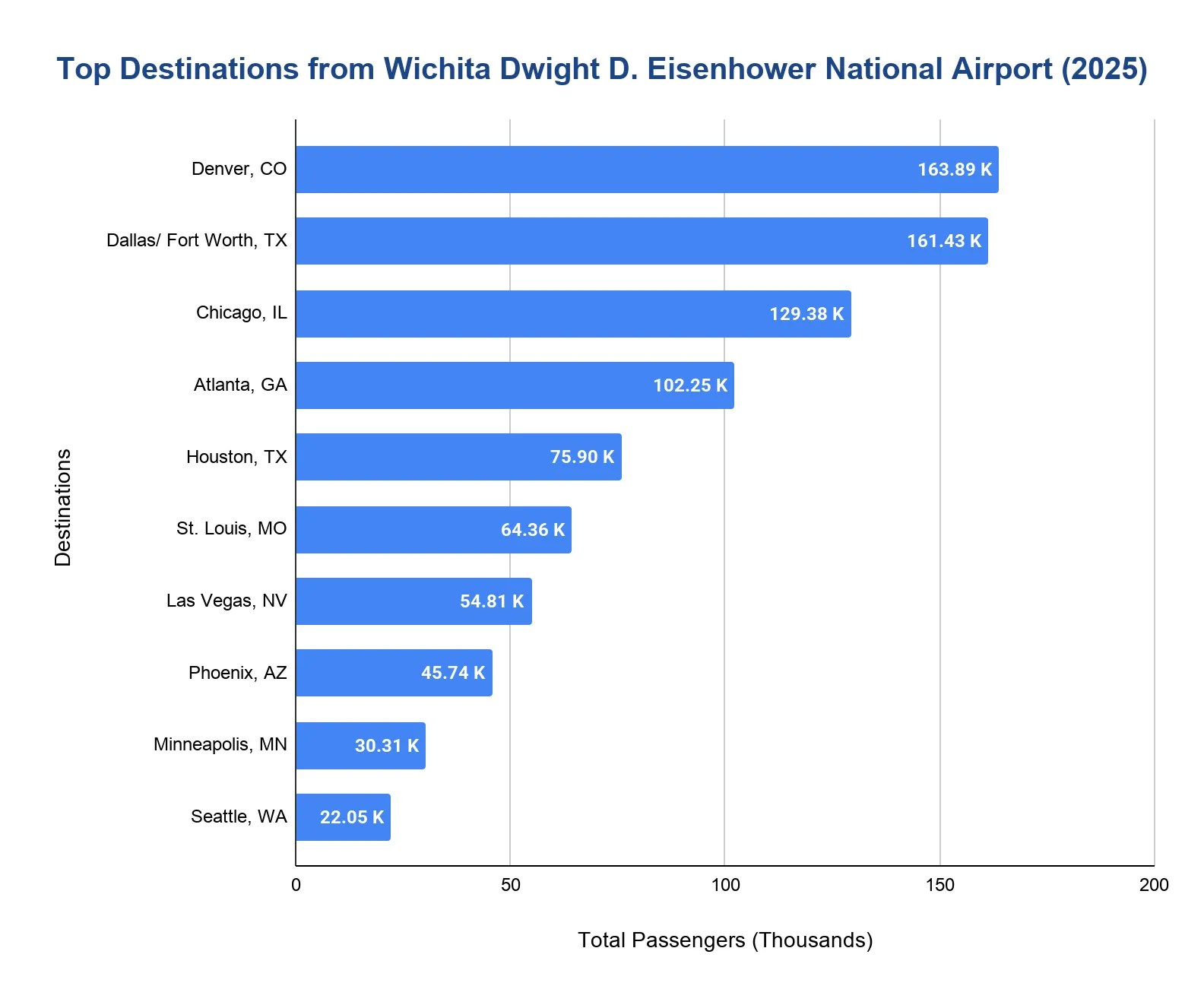
Which destinations are the most popular from Wichita Dwight D. Eisenhower National Airport?
- Denver, CO (DEN) served 163,890 passengers, making it the busiest route.
- Dallas/Fort Worth, TX (DFW) carried 161,430 passengers, maintaining its position as the second-busiest route.
- Chicago O'Hare, IL (ORD) handled 129,380 passengers, providing essential connectivity to the Midwest.
- Atlanta, GA (ATL) served 102,250 passengers.
- Houston, TX (IAH) handled 75,900 passengers, completing the top five domestic destinations.
How much cargo does Wichita Dwight D. Eisenhower National Airport handle annually?
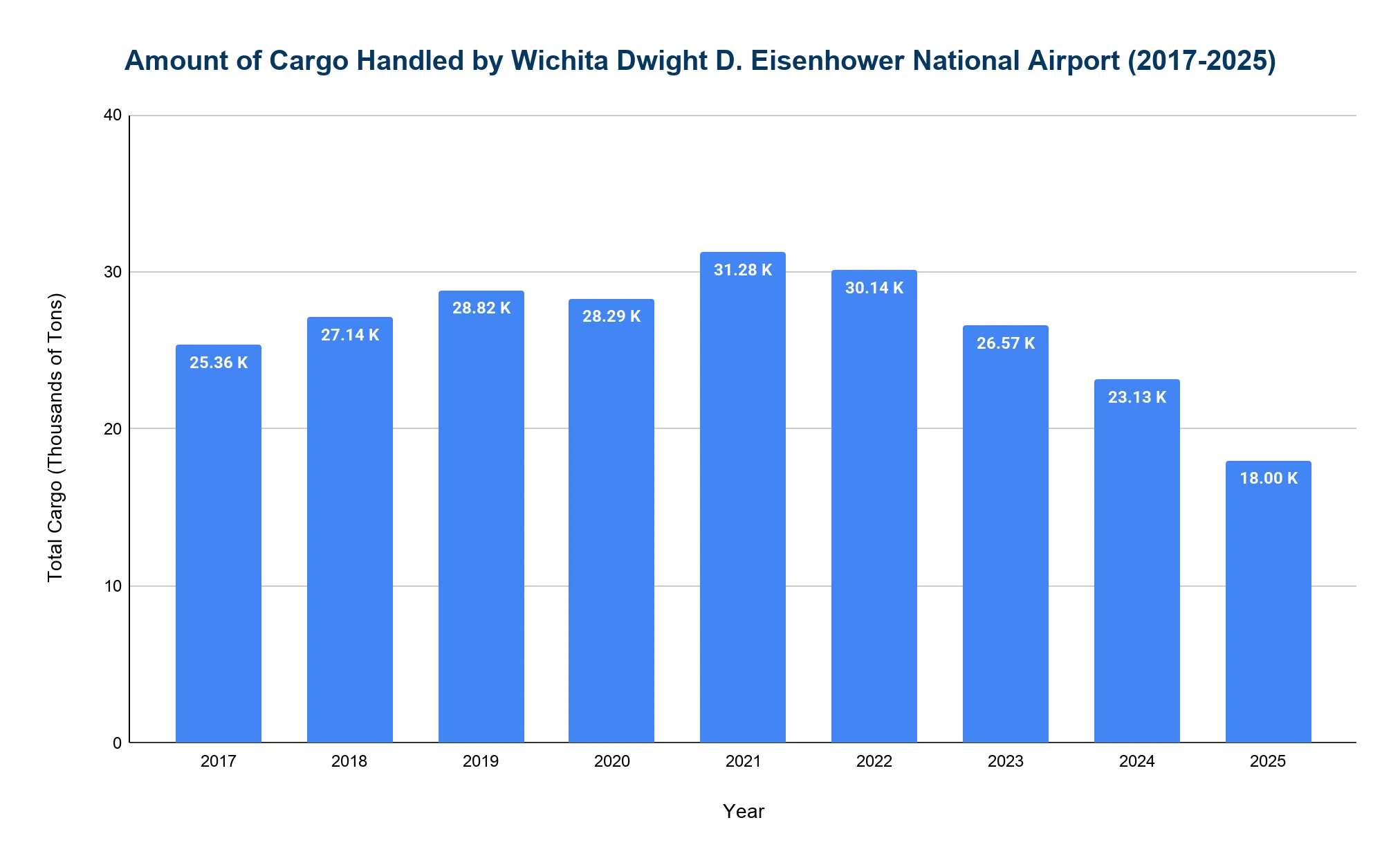
Wichita Dwight D. Eisenhower National Airport handles more than 18,000 tons of air cargo per year, supporting the region's manufacturing and logistics sectors.
- The airport handled 18,004 tons in 2025, a 22.2% decrease from 23,129 tons in 2024.
- The pandemic boosted cargo demand, with 2021 reaching a peak of 31,276 tons due to e-commerce growth.
- In 2020, cargo volume was 28,292 tons, and 2022 saw 30,136 tons.
- By 2023, cargo reached 26,568 tons before moderating in 2024.
How many cancellations occur at Wichita Dwight D. Eisenhower National Airport annually?
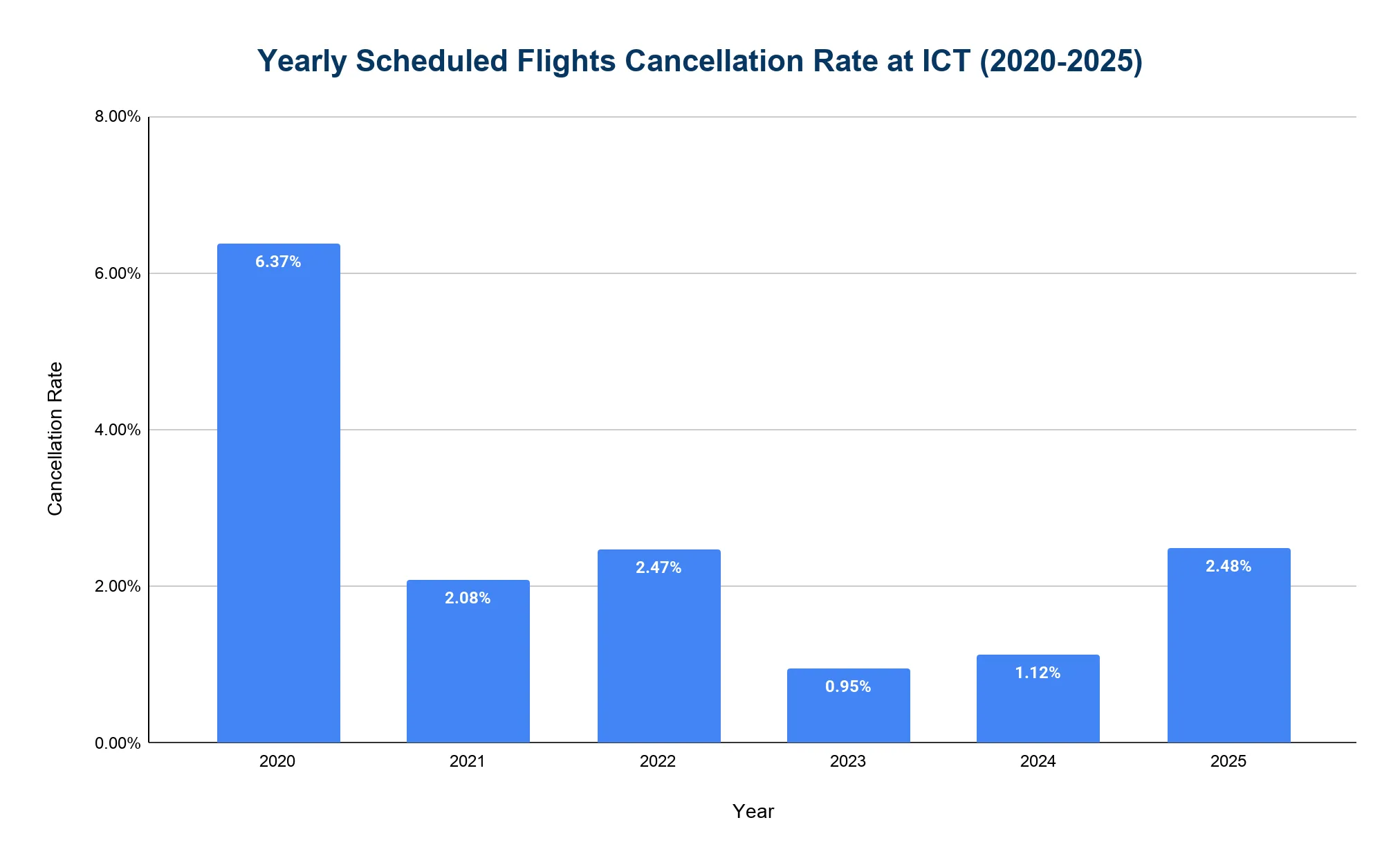
Flight cancellations at ICT are generally low, reflecting reliable operations and efficient management.
- 2.48% of domestic flights were cancelled in 2025.
- The highest rate occurred in 2020 during the pandemic when approximately 6.37% of flights were cancelled.
- In 2021, the cancellation rate dropped to 2.08%, representing a return toward normal operations.
- The rate was 2.47% in 2022, reflecting industry-wide staffing challenges.
- In 2023, only 0.95% of flights were cancelled, the lowest rate in recent years, before rising slightly to 1.12% in 2024.
Related Travel Statistics
- Charlotte Douglas Airport Statistics
- Eugene Airport (EUG) Statistics
- Fort Lauderdale Airport (FLL) Statistics
- Houston Hobby Airport Statistics
- Logan International Airport (BOS) Statistics
- Tweed–New Haven Airport (HVN) Statistics
- O’Hare International Airport Statistics
- Pittsburgh Airport (PIT) Statistics
- Richmond International Airport Statistics
- Seattle-Tacoma International Airport Statistics
- Palm Beach Airport (PBI) Statistics
- Worcester Regional Airport (ORH) Statistics
What are the main causes of flight disruptions at Wichita Dwight D. Eisenhower National Airport?
- Winter weather conditions, including snow and ice requiring de-icing operations, especially from December through March.
- Thunderstorms in spring and summer, causing delays both at ICT and at connecting hub airports.
- Airline operational issues at major hubs such as Dallas Denver Chicago and Atlanta can create arrival delays for incoming aircraft.
- Air traffic control delays at busy hub airports occasionally impact connecting flights.
- Mechanical issues with aircraft, though less common than weather-related disruptions.
What are the notable incidents at Wichita Dwight D. Eisenhower National Airport?
- October 30, 2014: A Beechcraft King Air B200 crashed into the FlightSafety International training center shortly after takeoff due to engine failure, resulting in 4 fatalities (pilot and 3 people in the building) and 6 injuries. The NTSB attributed the cause to engine failure on takeoff.
- December 13, 2013: A foiled bomb plot was intercepted when FBI agents arrested Terry Loewen during an undercover sting operation. The suspect, an airport avionics technician, was apprehended before carrying out the attempted attack. Airport operations continued normally.
- October 10, 2000: A Canadair Challenger CL-604 business jet on a test flight crashed west of the airport due to pilot-induced oscillation and fuel imbalance issues, resulting in 3 fatalities among the test crew.
- January 19, 2014: A security breach occurred when an individual drove a pickup truck through a perimeter gate onto the airport ramp. Airport police quickly intercepted and arrested the individual with no injuries or damage.
- October 20, 2023: A Cessna 172 experienced engine failure after takeoff and made an emergency landing on a city street near the airport. The pilot sustained minor injuries with no ground casualties.

