

 Popular Countries
 24/7 Support
Published
Idaho Falls Regional Airport (IDA) is eastern Idaho's primary air gateway and the state's second busiest airport after Boise. The airport links Idaho Falls and surrounding communities to major U.S. hubs and popular vacation destinations through several airline partners.
How many passengers pass through Idaho Falls Regional Airport each year?
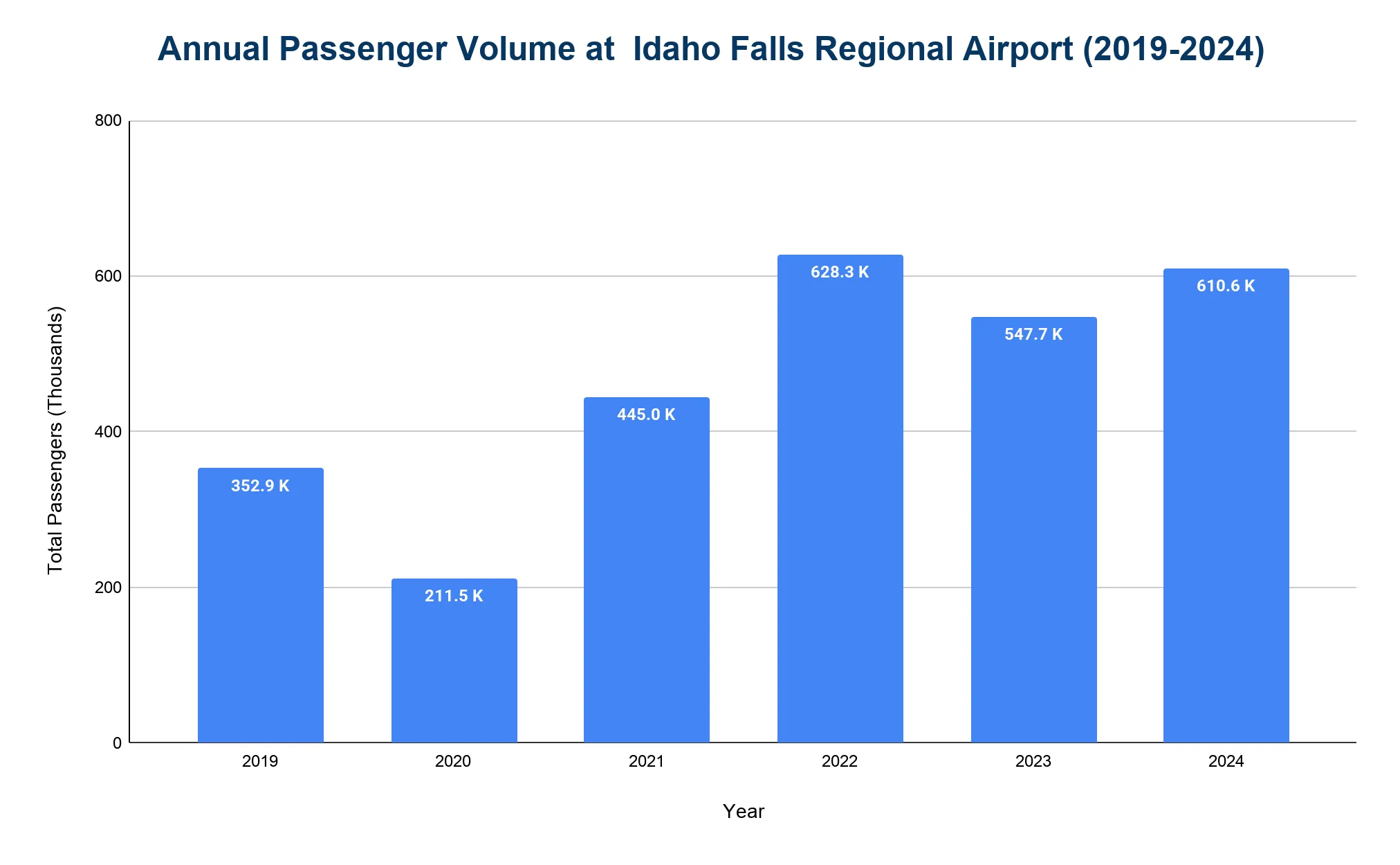
Idaho Falls Regional Airport handles an average of 550,000 to 630,000 passengers annually in recent years.
- The airport served 610,641 passengers in 2024, an 11.5% increase from 2023.
- In 2019, the airport reached 352,893 passengers before pandemic disruptions.
- Passenger traffic dropped sharply to 211,451 in 2020 (a 40.1% decline) and recovered to 445,041 in 2021.
- Recovery accelerated from 2022, with 628,329 passengers, then 547,710 in 2023.
What is the total number of aircraft operations at Idaho Falls Regional Airport each year?
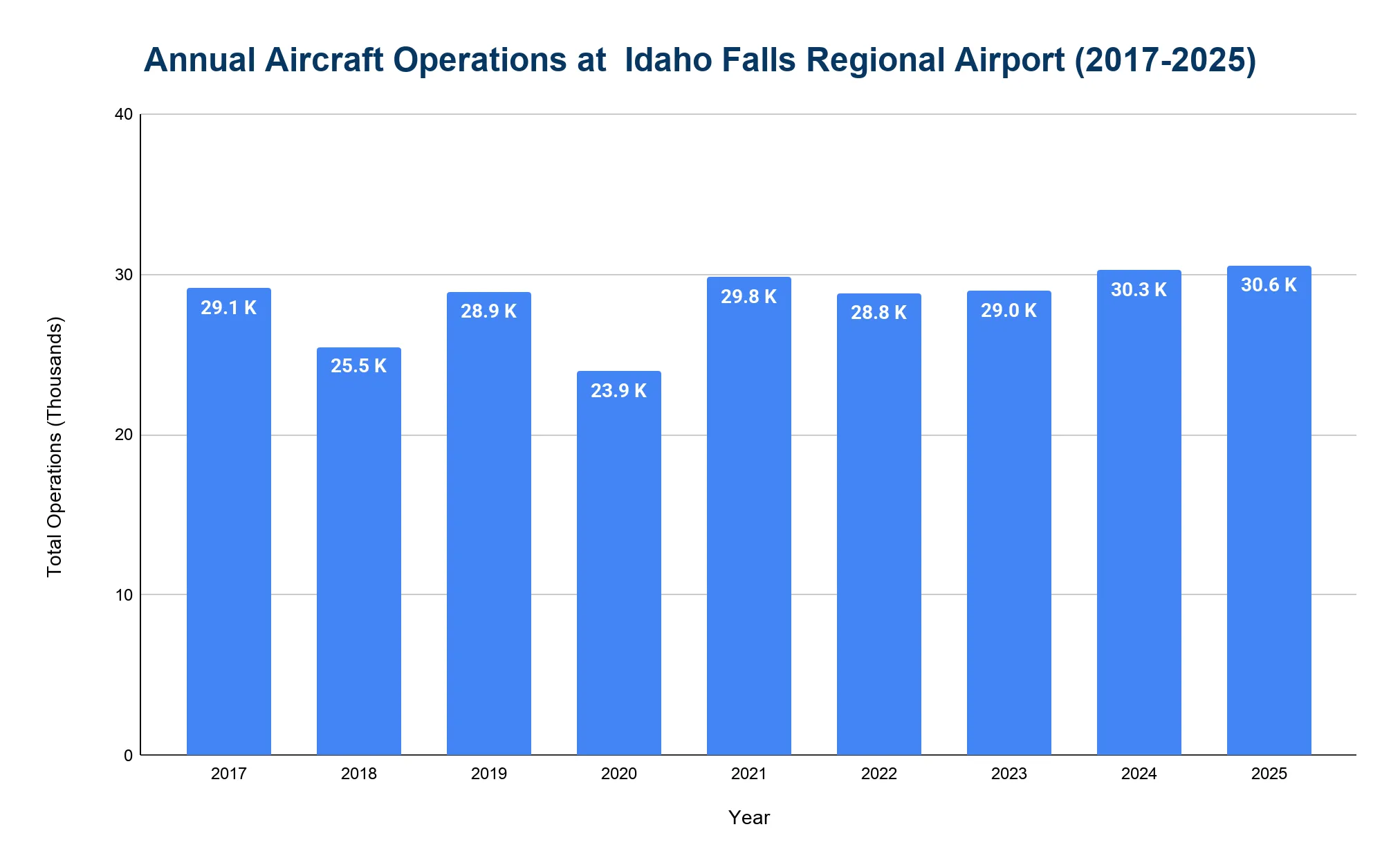
Idaho Falls Regional Airport sees approximately 28,000 to 31,000 aircraft takeoffs and landings annually.
- In 2025, there were 30,566 total aircraft movements, a 1% increase from 30,267 movements in 2024.
- Before the pandemic, 2019 saw approximately 28,895 movements.
- Operations dropped to around 23,940 in 2020, the lowest during the pandemic.
- Recovery fluctuated, reaching 29,813 in 2021, dipping slightly to 28,837 in 2022 and rising to 28,971 in 2023.
Which airlines operate the most flights out of Idaho Falls Regional Airport?
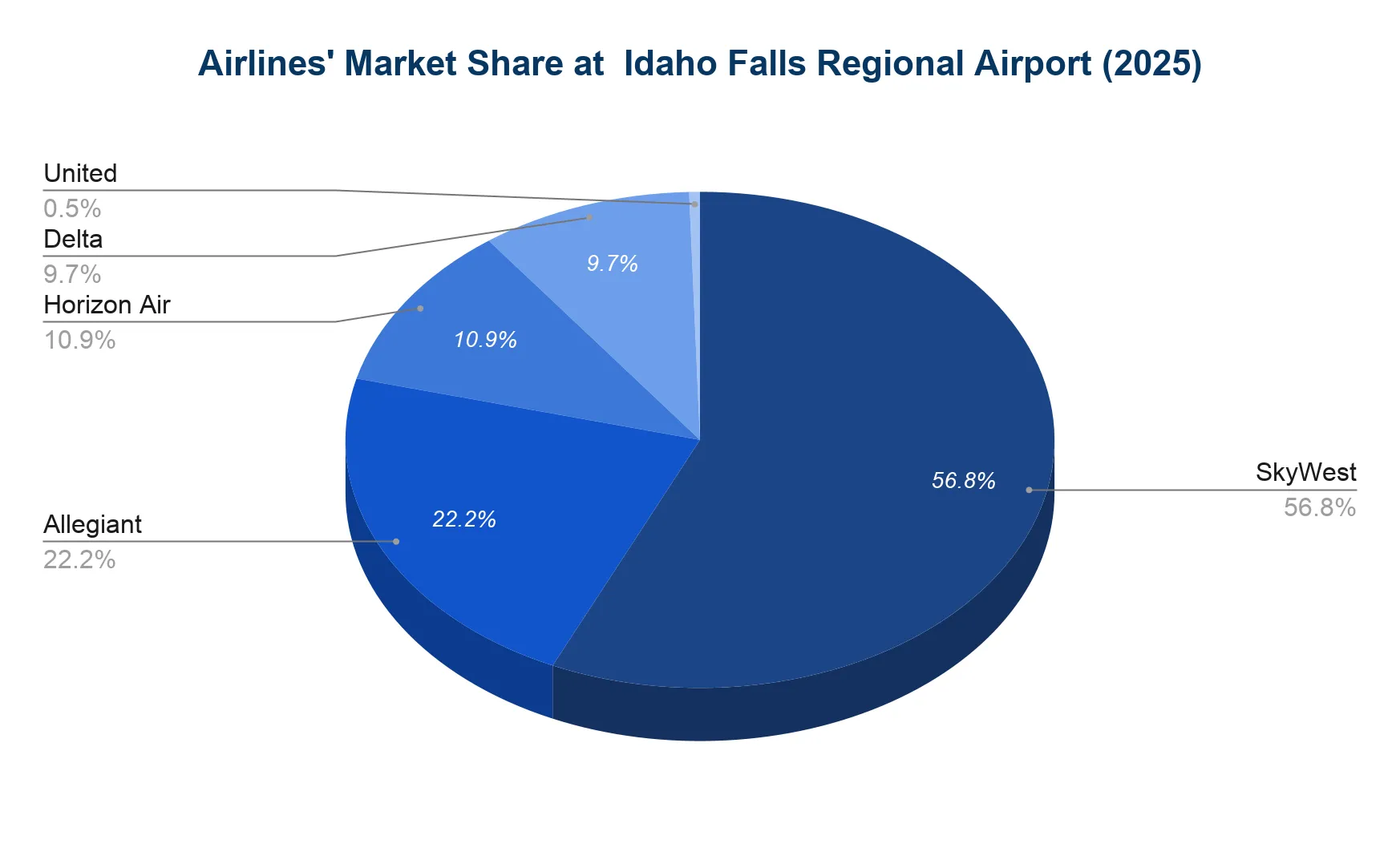
Regional carriers and low-cost airlines dominate IDA operations, with SkyWest Airlines holding the largest market share by a significant margin.
- In 2025, SkyWest Airlines led with a 56.8% market share, operating flights on behalf of United and Delta through regional partnerships.
- Allegiant Air followed with 22.2%, providing leisure-focused service to vacation destinations.
- Horizon Air held 10.9%, operating Alaska Airlines-branded flights to Pacific Northwest destinations.
- Delta Air Lines accounted for 9.7% while United Airlines represented 0.5% of operations.
- Combined, the top five carriers controlled 100% of scheduled passenger service, underscoring IDA's concentrated airline market.
How many routes are there at Idaho Falls Regional Airport?
As of 2025, Idaho Falls Regional Airport (IDA) had 10 nonstop routes connecting to 9 cities across the United States.
- The route network balances major airline hubs (Denver, Seattle, Salt Lake City) with leisure destinations (Las Vegas, Florida markets, Phoenix).
- All routes are domestic, with no scheduled international service currently available.
Which destinations are the most popular from Idaho Falls Regional Airport?
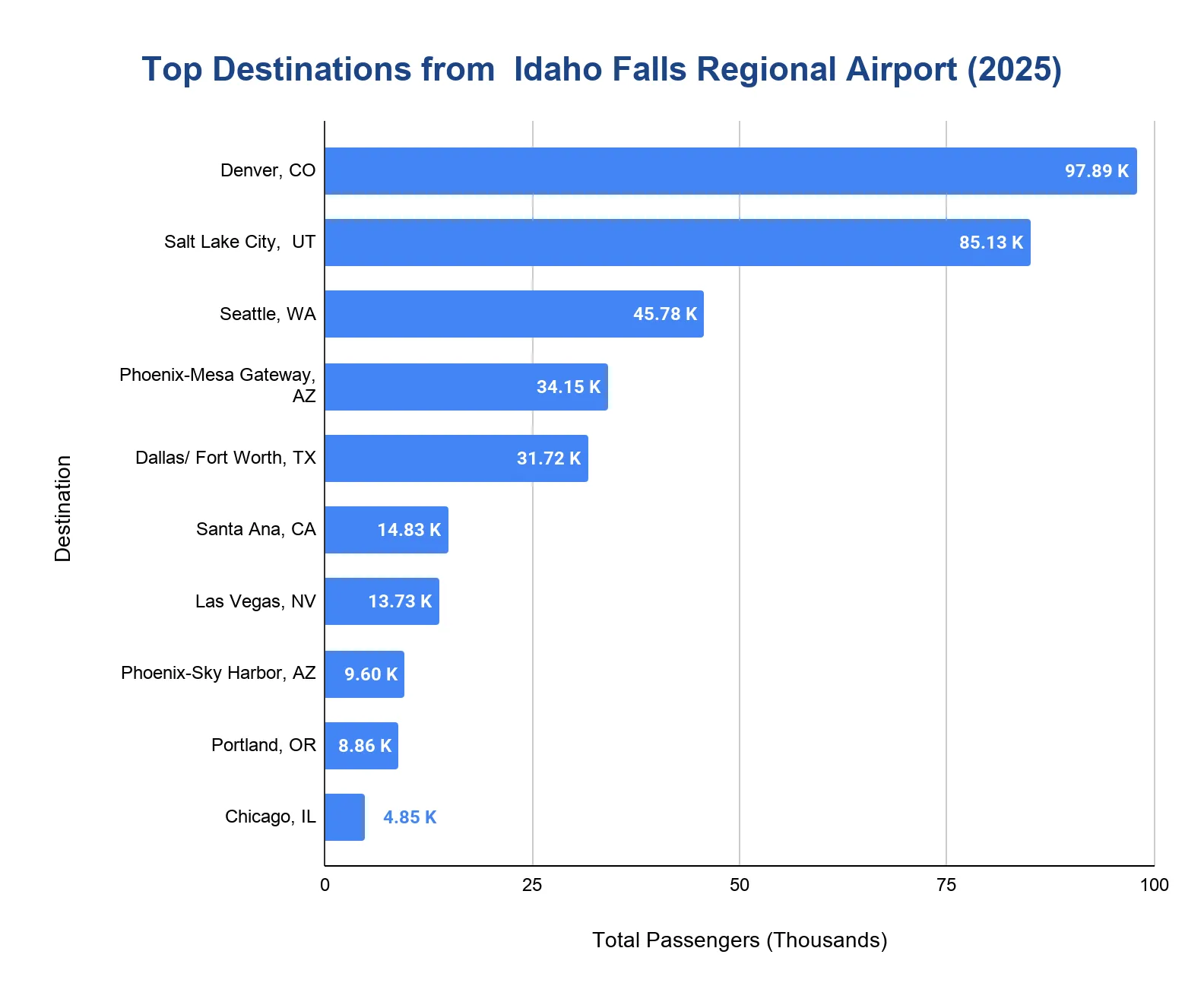
The busiest routes from Idaho Falls connect to major airline hubs and popular vacation destinations across the western United States.
- Denver, CO (DEN) carried 97,890 passengers in 2025, making it the busiest route and serving as a major United Airlines hub connection.
- Salt Lake City, UT (SLC) served 85,130 passengers, maintaining its position as the second-busiest route and providing Delta connectivity to the intermountain region.
- Seattle, WA (SEA) handled 45,780 passengers, offering essential Pacific Northwest connectivity via Alaska Airlines.
- Phoenix-Mesa Gateway, AZ (AZA) served 34,150 passengers and Dallas/Fort Worth, TX (DFW) handled 31,720 passengers, completing the top 5 domestic destinations.
How many cancellations occur at Idaho Falls Regional Airport annually?
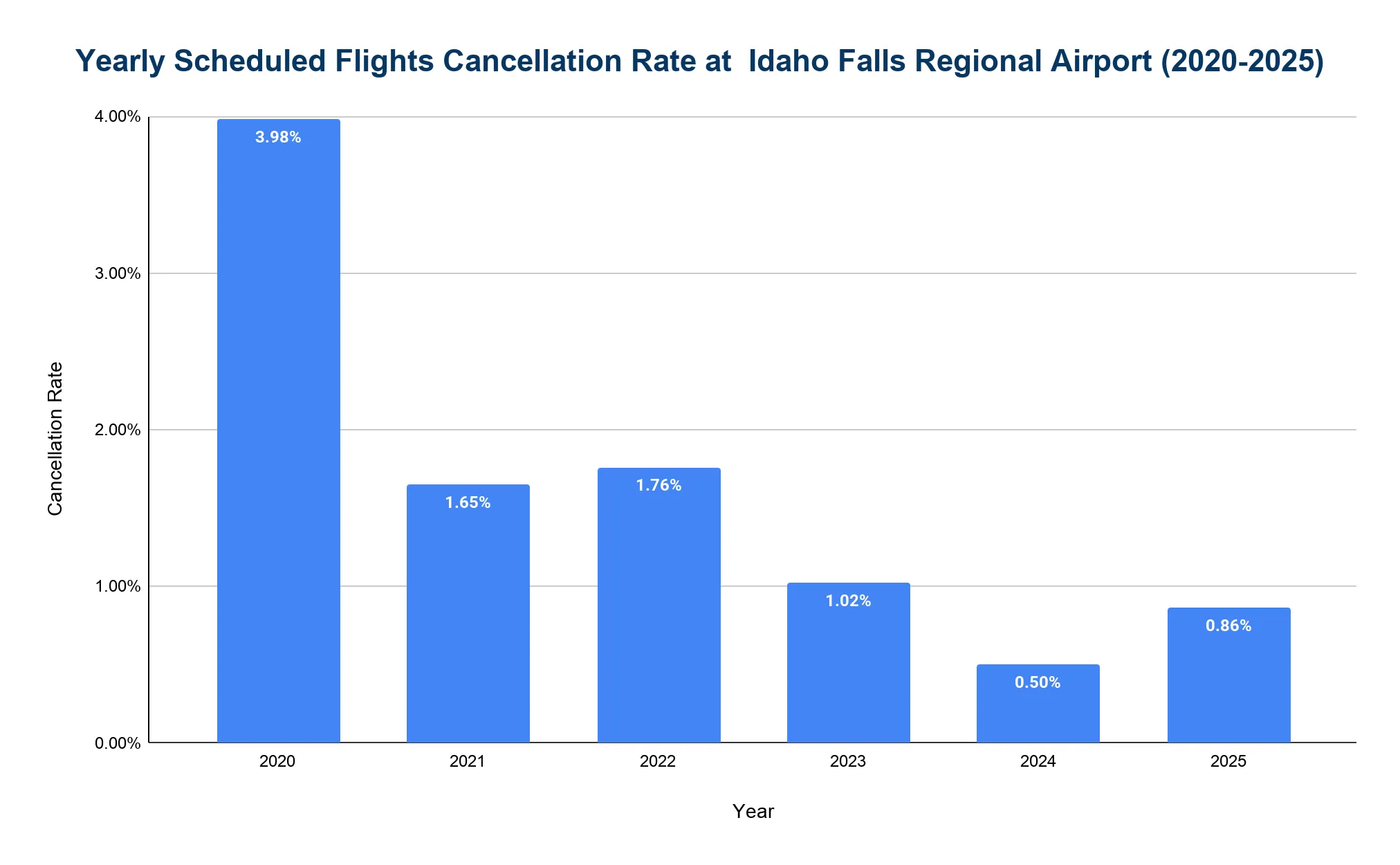
Flight cancellations at IDA are generally low, typically below 2%.
- In 2025, the cancellation rate at IDA was 0.86%, a slight increase from the previous year.
- The highest rate occurred in 2020 during the pandemic when approximately 3.98% of flights were cancelled.
- The cancellation rate dropped to around 1.65% in 2021, reflecting improved operations.
- The rate remained stable in 2022 at 1.76%, reflecting industry-wide operational challenges.
- In 2023, only approximately 1.02% of flights were cancelled, continuing the trend of improved reliability.
- 0.50% of domestic flights were cancelled in 2024, representing the lowest rate in recent years.
Related Travel Statistics
- Lehigh Valley International Airport Statistics
- Fairbanks International Airport (FAI) Statistics
- Fresno Yosemite International Airport Statistics
- Gainesville Regional Airport Statistics
- Los Angeles International Airport Statistics
- Myrtle Beach Airport (MYR) Statistics
- Tweed–New Haven Airport (HVN) Statistics
- Newark Airport (EWR) Statistics
- Orlando Airport (MCO) Statistics
- Rapid City Regional Airport Statistics
- Chicago Rockford Airport Statistics
- Westchester County Airport (HPN) Statistics
What are the main causes of flight disruptions at Idaho Falls Regional Airport?
- Winter weather conditions, including snow, ice and freezing temperatures requiring de-icing procedures, especially from December through March.
- Thunderstorms and summer weather at connecting hub airports (Denver, Seattle, Salt Lake City) can create downstream delays.
- Air traffic control delays at major hubs occasionally impact connecting flights to and from Idaho Falls.
- Mechanical issues with aircraft, though less common than weather-related disruptions.
- Airline operational challenges, including crew scheduling and aircraft availability, particularly affecting regional carrier operations.
References
- Idaho Falls Regional Airport Data · idahofallsidaho.gov
- FAA OPSNET — George Bush Intercontinental Airport Operations Data · aspm.faa.gov
- BTS TranStats — Airport profiles (route information by airport) · transtats.bts.gov

