

 Popular Countries
 24/7 Support
Published Sep 9, 2026
Rapid City Regional Airport (RAP) is South Dakota’s secondary commercial airport and the primary gateway to Mount Rushmore and the Black Hills region. It connects western South Dakota to destinations across the United States through multiple partner airlines.
How many passengers pass through Rapid City Regional Airport each year?
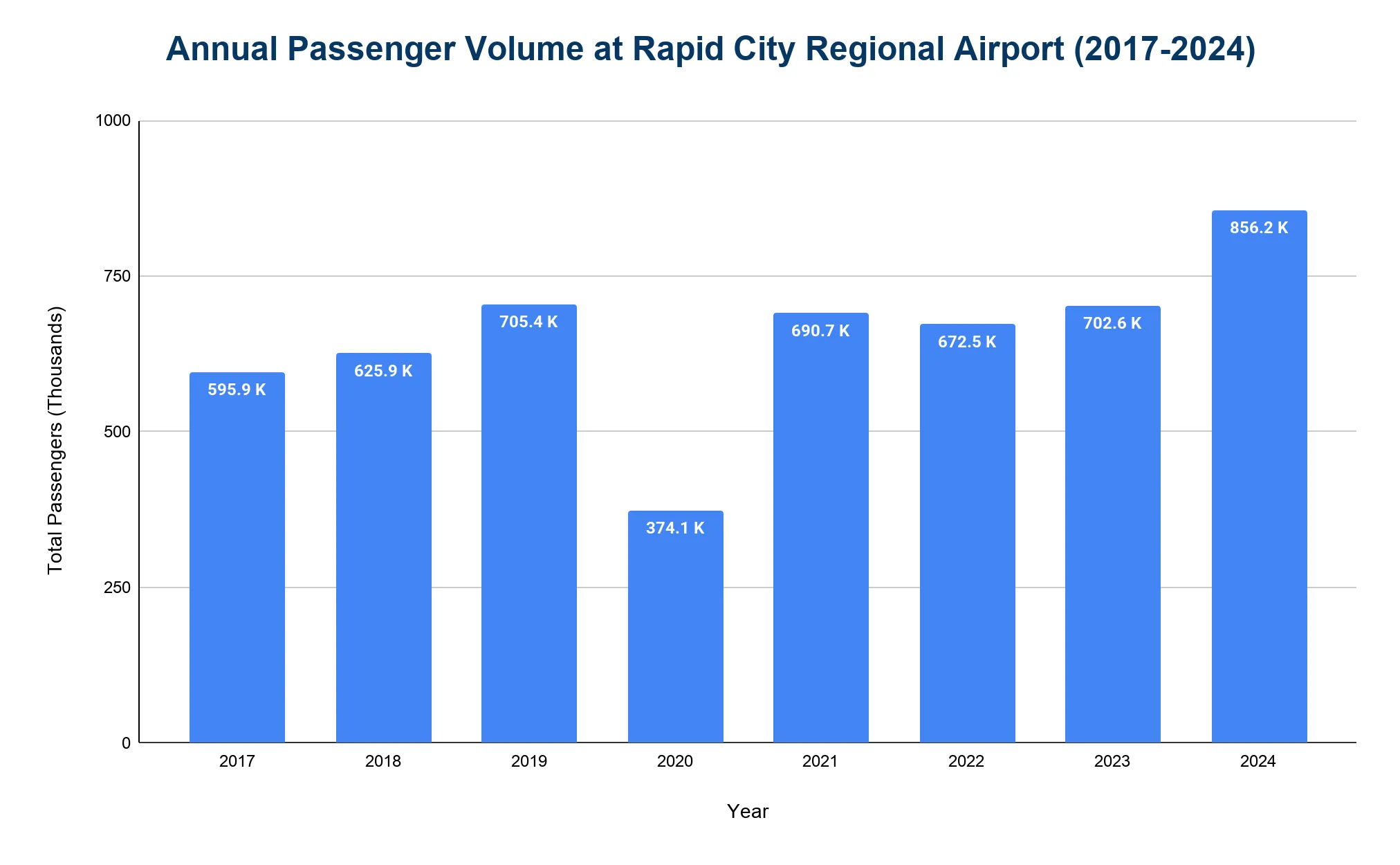
Rapid City Regional Airport handles approximately 700,000 to 850,000 passengers annually.
- The airport served 856,248 passengers in 2024, setting an all-time record and reflecting a 22% increase over 2023.
- In 2019, before the pandemic, the airport handled 705,429 passengers.
- Passenger traffic dropped sharply in 2020, with 374,079 passengers, a 47% decline due to COVID-19 travel restrictions.
- Traffic rebounded in 2021 with 690,740 passengers before dipping slightly to 672,549 in 2022.
- The airport served 702,581 passengers in 2023, nearly returning to pre-pandemic levels before officially surpassing them in 2024.
What is the total number of aircraft operations at Rapid City Regional Airport each year?
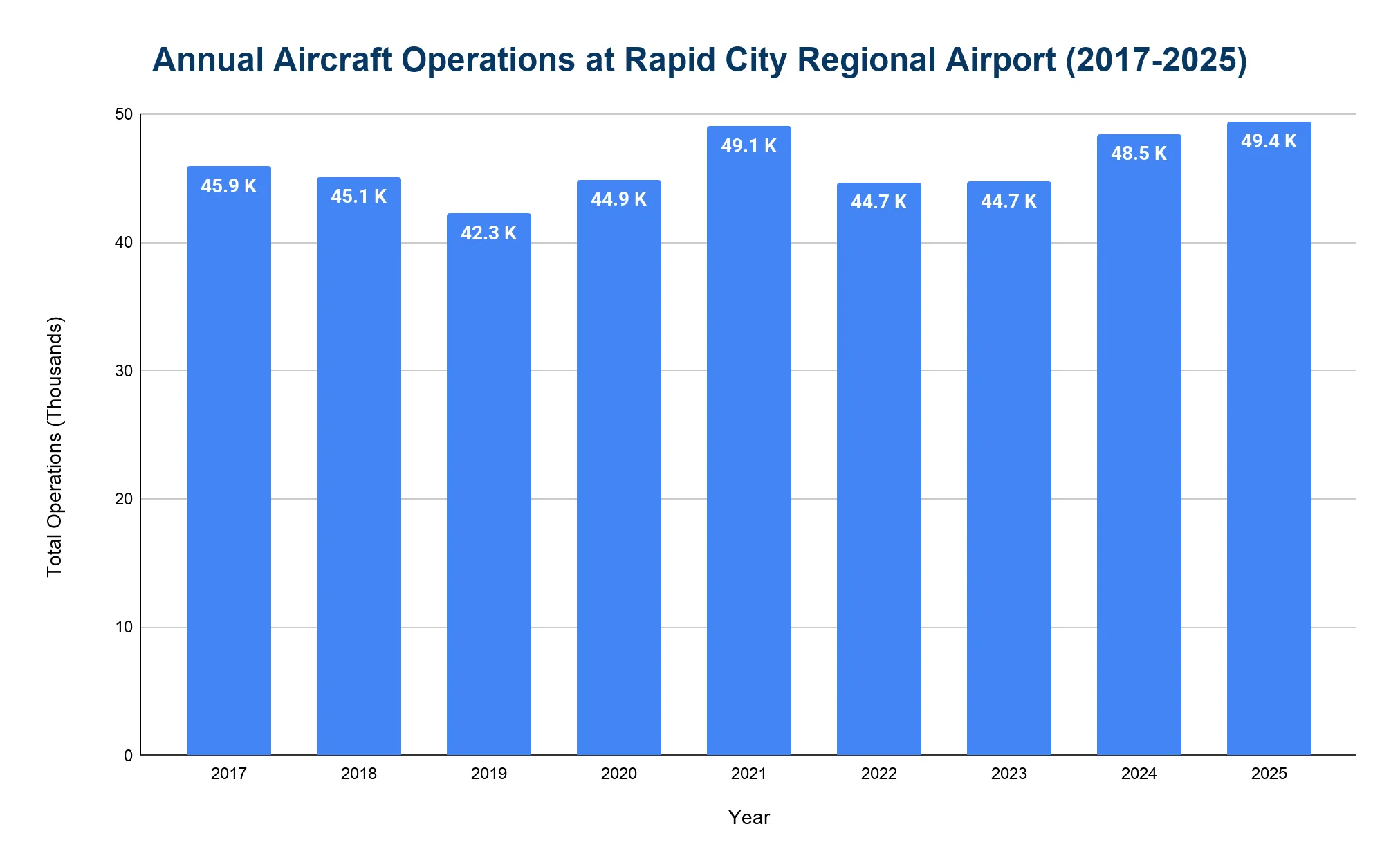
Rapid City Regional Airport records approximately 42,000 to 50,000 aircraft movements each year, including commercial, general aviation and military operations.
- The airport recorded 49,396 total operations in 2025, the highest level in recent years and a sign of strong activity.
- In 2019, there were 42,266 movements.
- Operations rose to 44,873 in 2020 as general aviation held steady despite reduced commercial traffic.
- Activity reached 49,055 movements in 2021, which stood as the record until the all-time high in 2025.
- In 2022, operations declined slightly to 44,664 and ticked up to 44,743 in 2023 before rising again to 48,470 in 2024.
Which airlines operate the most flights out of Rapid City Regional Airport?
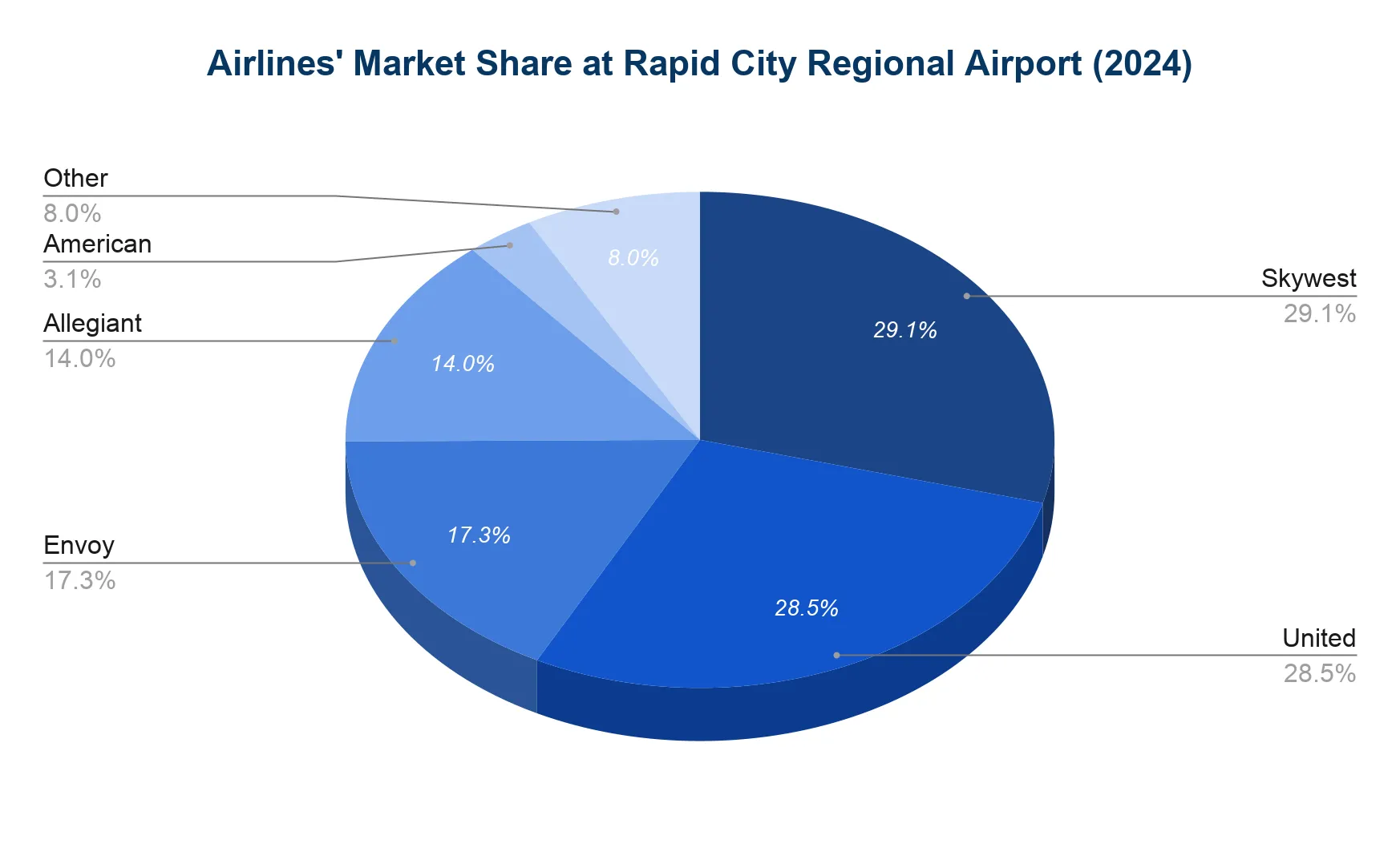
Several carriers serve RAP, including regional operators for major airlines and low-cost carriers. The market is concentrated among a few leading operators.
- SkyWest Airlines held a 29.1% market share in 2024, making it the top carrier. It operates regional flights for United Airlines and Delta Air Lines, connecting passengers to major hubs.
- United Airlines accounted for 28.5%, offering mainline and regional service, with year-round flights to Denver and seasonal service to San Francisco.
- Envoy Air had a 17.3% share, operating American Eagle flights for American Airlines, with service to Dallas/Fort Worth, Chicago O’Hare and seasonal Charlotte.
- Allegiant Air held 14.0%, offering low-cost flights to Las Vegas, Phoenix and Orlando.
- American Airlines operated 3.1% of flights directly, complementing regional service provided by Envoy.
- Other carriers made up 8.0%, including Southwest Airlines (serving Denver, Las Vegas and Phoenix), Delta Air Lines mainline and Frontier Airlines (Denver connections).
What are the monthly trends in passenger traffic at Rapid City Regional Airport?
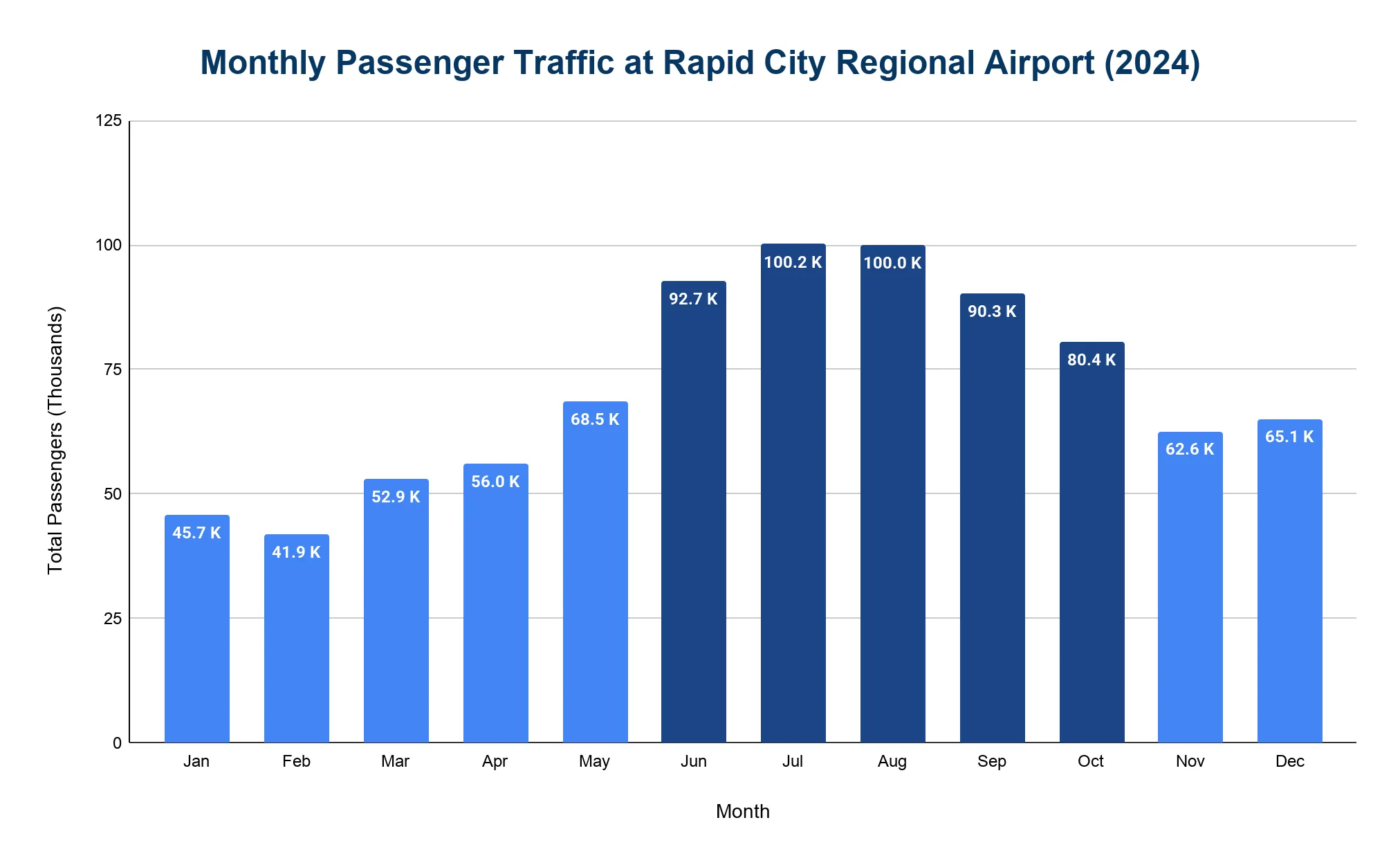
Passenger traffic at RAP is highly seasonal, driven by tourism to the Black Hills. Summer months see significantly higher volumes than winter.
- July was the busiest month in 2024 with 100,150 passengers, marking the peak of the summer season.
- August followed closely with 99,975 passengers, boosted by the Sturgis Motorcycle Rally, one of the world’s largest motorcycle events.
- June saw 92,661 passengers and September had 90,275, reflecting strong summer and early fall demand.
- October recorded 80,447 passengers and May had 68,549, showing consistent shoulder-season activity.
- The slowest month was February with 41,862 passengers, followed by January with 45,701, due to post-holiday and winter weather impacts.
How many routes are there at Rapid City Regional Airport?
- RAP serves only domestic routes within the United States.
- All scheduled flights are 100% domestic.
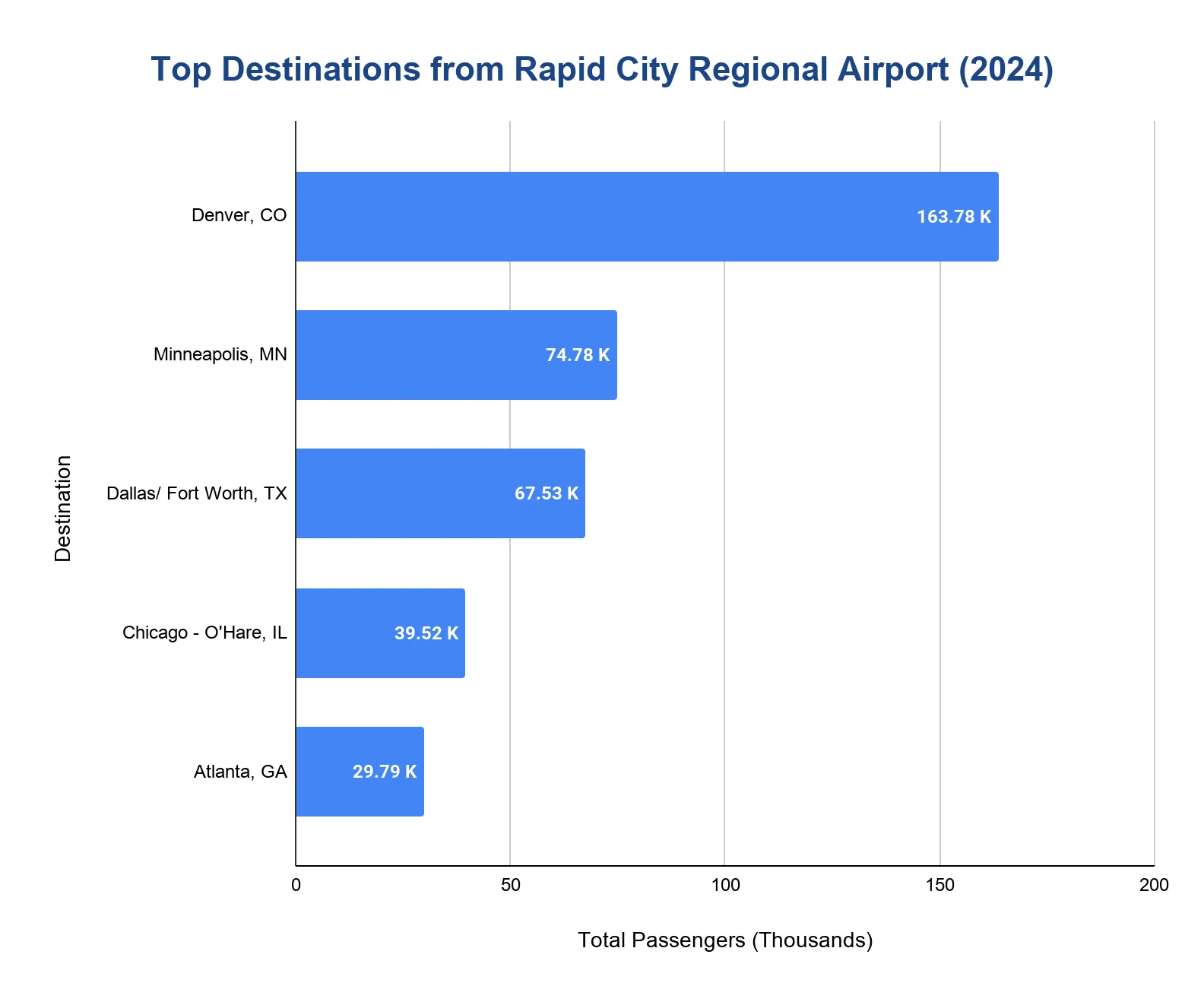
- Major hub destinations include Denver (DEN), the airport’s largest market, as well as Minneapolis/St. Paul (MSP), Dallas/Fort Worth (DFW), Chicago O’Hare (ORD) and seasonal Atlanta (ATL).
- In 2025, new seasonal service to Atlanta and Charlotte was added, enhancing Southeast connections.
- The airport’s route network focuses on connecting travelers to major hubs and facilitating access to the Black Hills region.
Which destinations are the most popular from Rapid City Regional Airport?
- Denver, CO (DEN): 163,780 passengers in 2024, making it the busiest route with daily service by United Airlines and Southwest Airlines.
- Minneapolis/St. Paul, MN (MSP): 74,780 passengers, the second-busiest route with service by Delta and Sun Country, providing Upper Midwest and East Coast connections.
- Dallas/Fort Worth, TX (DFW): 67,530 passengers with daily American Airlines flights, offering access to the South and Southwest and international connections.
- Chicago O’Hare, IL (ORD): 39,520 passengers via American and United, serving Midwest and East Coast business markets.
- Atlanta, GA (ATL): 29,790 passengers, with seasonal Delta service added in 2025 connecting to the Southeast and beyond.
How much cargo does Rapid City Regional Airport handle annually?
RAP handles a modest amount of cargo compared to major freight airports, with around 17 to 20 million pounds of freight per year.
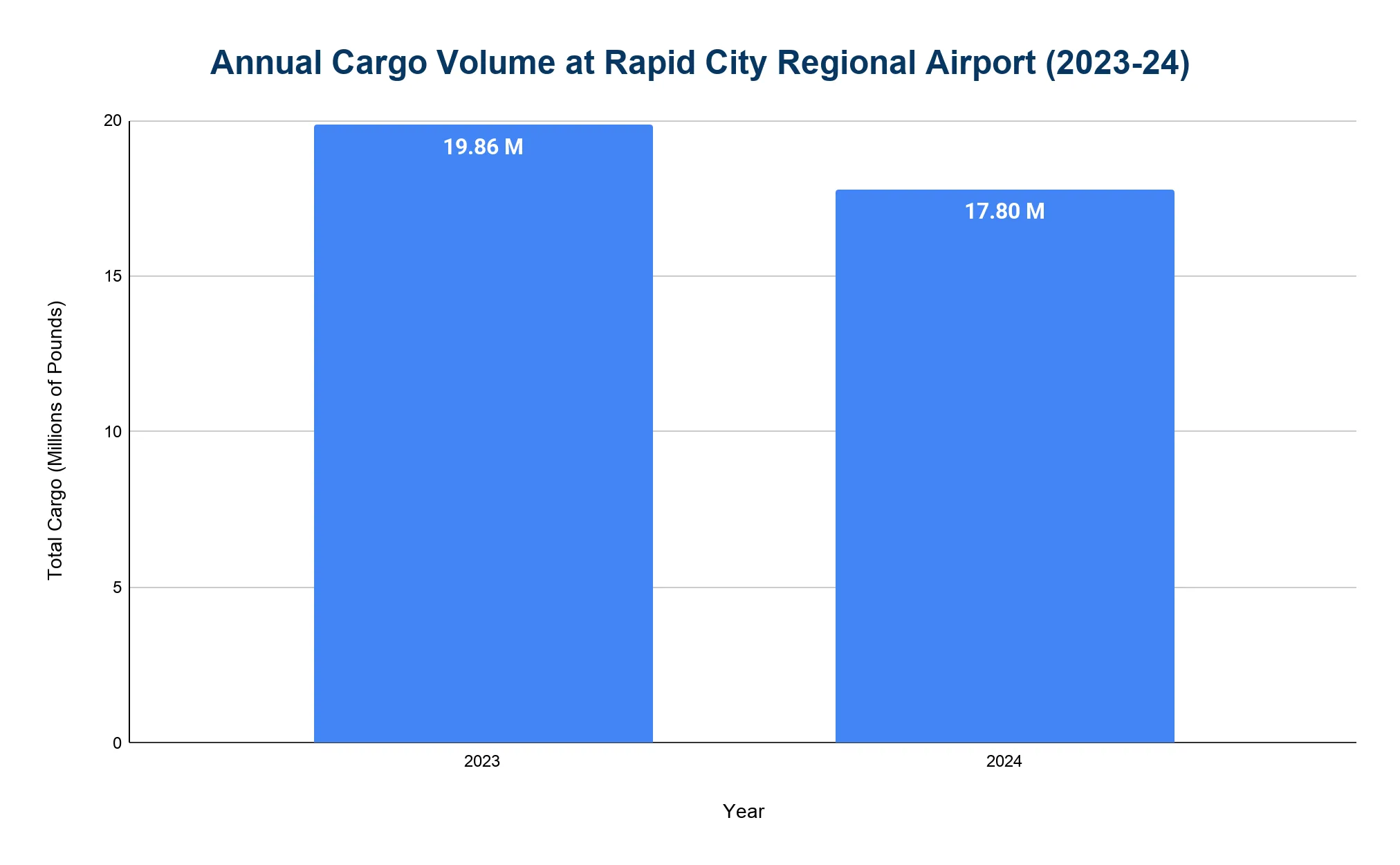
- The airport handled 17.80 million pounds of landed cargo in 2024.
- In 2023, total cargo was 19.86 million pounds, showing consistent volume year over year.
How many cancellations occur at Rapid City Regional Airport annually?
Flight cancellations at RAP have improved significantly in recent years.
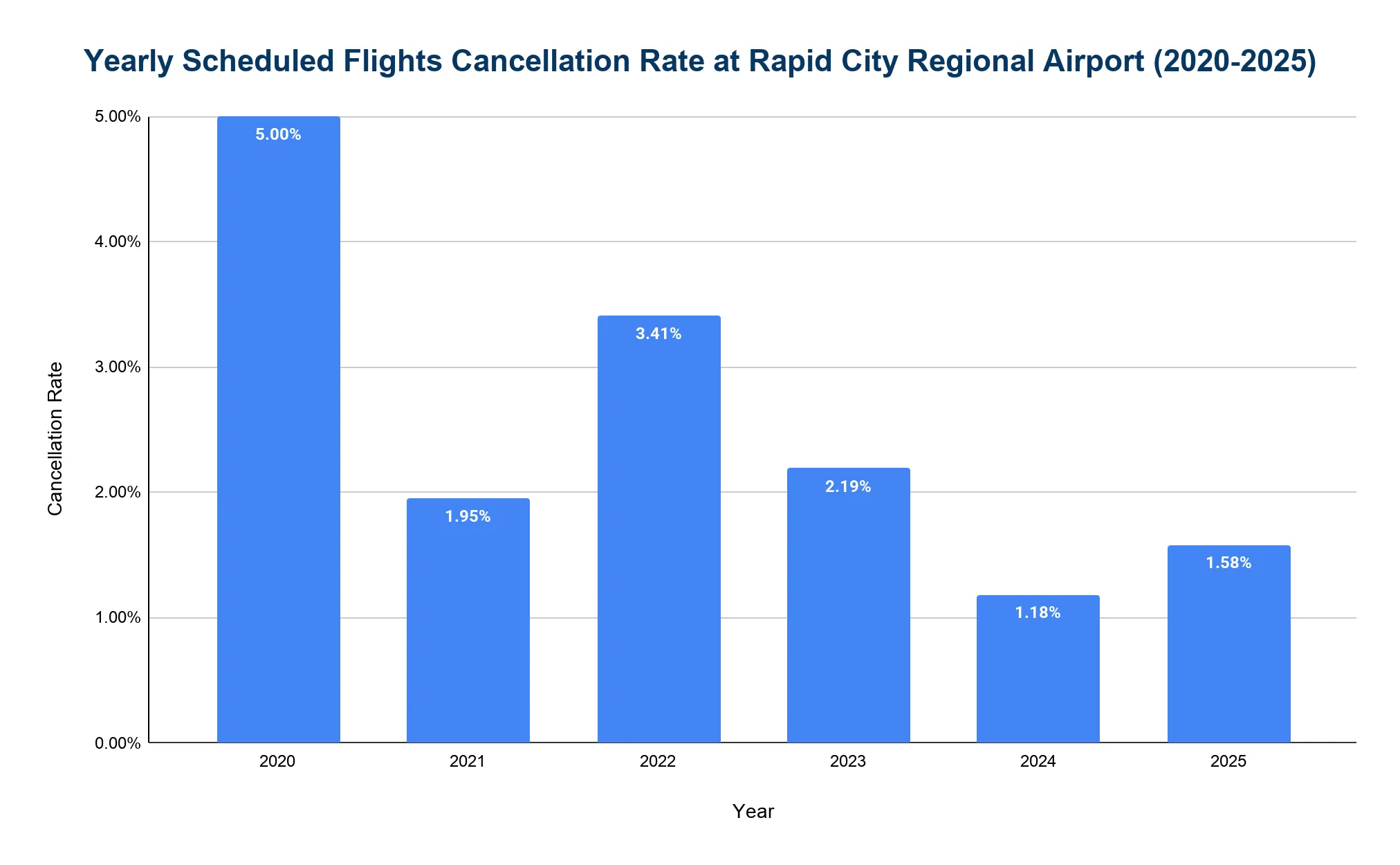
- In 2025, the cancellation rate was 1.58%, a slight increase from 1.18% in 2024.
- The highest rate was 5.00% in 2020, due to pandemic-related disruptions.
- Cancellations dropped to 1.95% in 2021 as service normalized.
- The rate rose in 2022 to 3.41%, reflecting staffing and operational challenges across the industry.
- In 2023, it improved again to 2.19%, continuing a return toward pre-pandemic reliability.
Related Travel Statistics
- Albuquerque International Sunport Statistics
- Cleveland Hopkins Airport Statistics
- Gainesville Regional Airport Statistics
- Greenville–Spartanburg Airport Statistics
- Idaho Falls Regional Airport Statistics
- LaGuardia Airport (LGA) Statistics
- Missoula Montana Airport (MSO) Statistics
- New Orleans Airport (MSY) Statistics
- Reno-Tahoe International Airport Statistics
- Palm Beach Airport (PBI) Statistics
- Westchester County Airport (HPN) Statistics
- Worcester Regional Airport (ORH) Statistics
What are the main causes of flight disruptions at Rapid City Regional Airport?
- Winter weather conditions, including snow, ice and blizzards from December through March.
- Summer thunderstorms, especially affecting connections through Denver and Minneapolis.
- Delays from late-arriving aircraft from hub airports.
- High wind conditions at RAP’s elevated location, though mitigated by runway design.
- Mechanical issues with aircraft, though these are less common.
- Delays at major connecting hubs like Denver and Chicago affecting inbound and outbound flights.
What safety measures and certifications does Rapid City Regional Airport maintain?
RAP maintains high safety standards and updated infrastructure to support safe operations.
- The airport is certified under FAA Part 139 and has passed all inspections with no findings.
- A new Aircraft Rescue and Fire Fighting (ARFF) station opened in 2023, improving emergency response.
- TSA security screening is in place, following all federal security requirements.
- The airport’s 8,701-foot primary runway (Runway 14/32), completed in 2024, supports safe operations for all aircraft types.
- No major accidents have been recorded in recent years, reflecting a strong safety record..
References
- Rapid City Regional Airport Passenger Data · rapairport.com
- FAA OPSNET — George Bush Intercontinental Airport Operations Data · aspm.faa.gov
- BTS TranStats — Airport profiles (route information by airport) · transtats.bts.gov
- Rapid City Regional Enplaned Passenger Data (FAA) · faa.gov

