

 Popular Countries
 24/7 Support
Published
Columbia Metropolitan Airport (CAE) serves as South Carolina’s capital city airport and the primary air gateway for the Midlands region, connecting Columbia to destinations across the United States through multiple partner airlines and operating as a major cargo hub for UPS Airlines.
How many passengers pass through Columbia Metropolitan Airport each year?
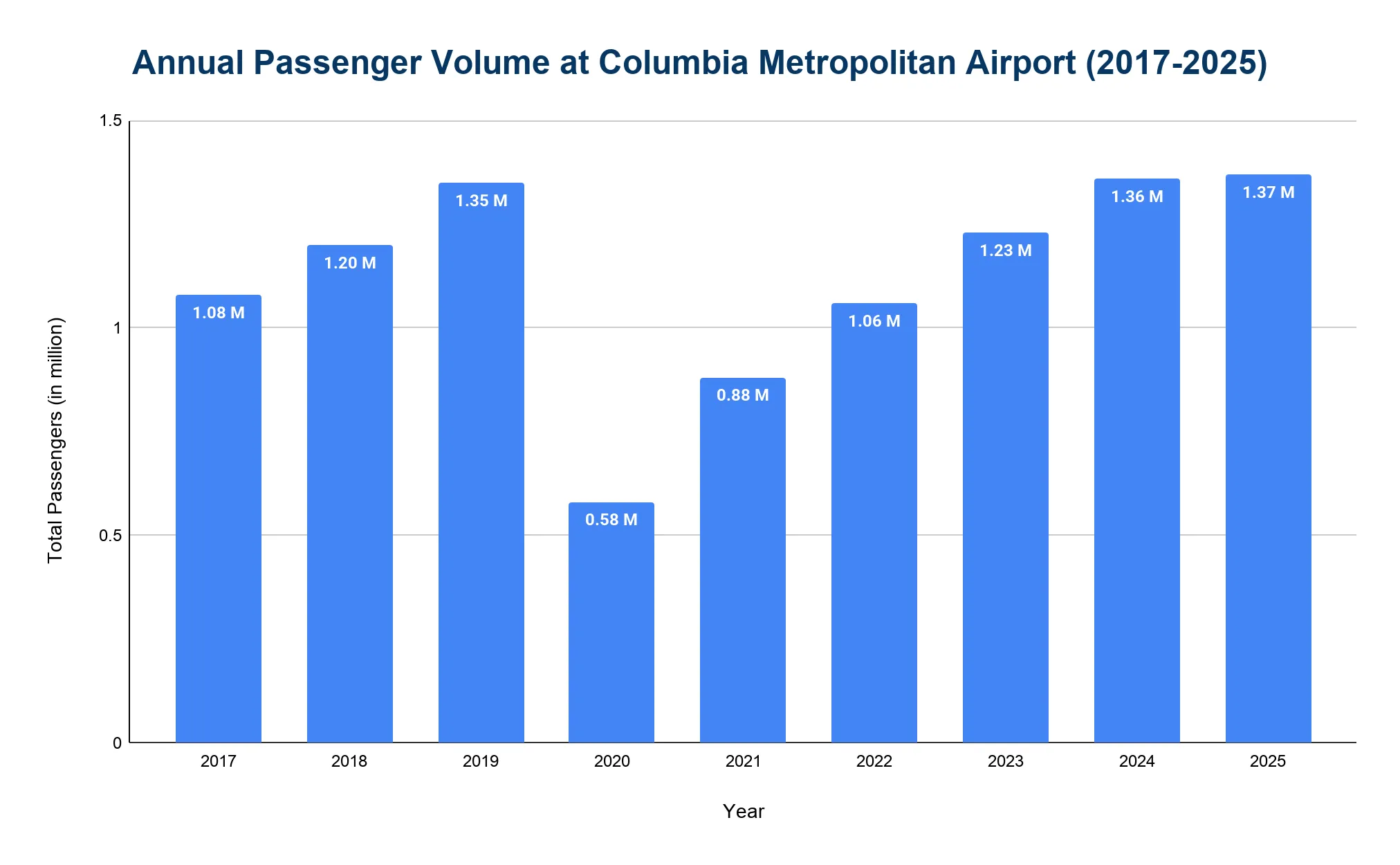
Columbia Metropolitan Airport handles over 1.3 million passengers annually. It set a new record in 2025, following a strong recovery from pandemic-related declines.
- The airport served 1.37 million passengers in 2025, a 0.7% increase from 1.36 million in 2024, marking the busiest year in the airport’s history.
- In 2019, the airport reached 1.35 million passengers before pandemic disruptions.
- Passenger traffic dropped sharply to 577,187 in 2020 (a 57% decline) and recovered to 877,806 in 2021.
- Recovery continued in 2022 with 1.06 million passengers, then 1.23 million in 2023.
What is the total number of aircraft operations at Columbia Metropolitan Airport each year?
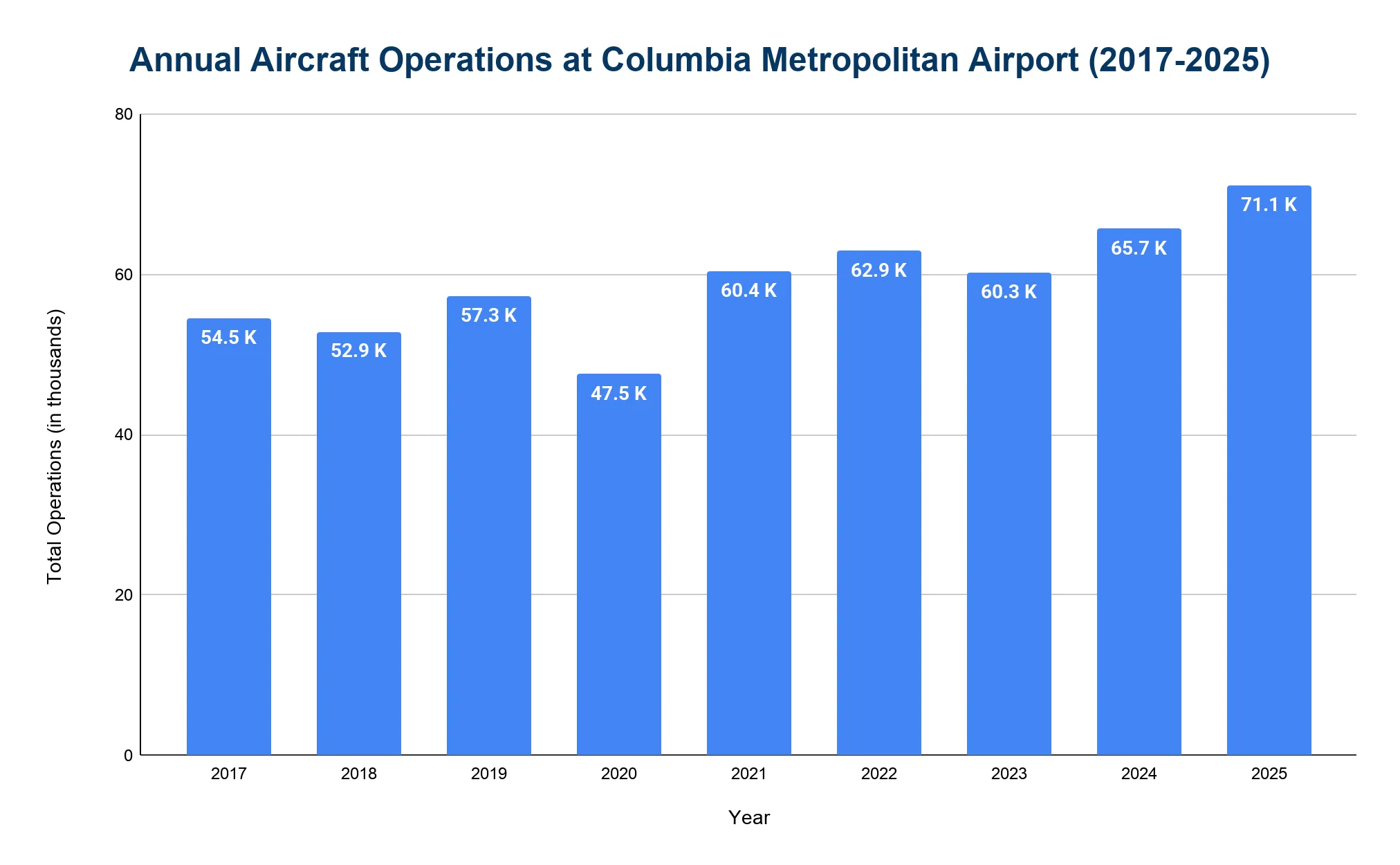
Columbia Metropolitan Airport sees over 70,000 aircraft takeoffs and landings annually.
- In 2025, there were 71,123 total aircraft movements, the highest operations count in the airport’s modern history.
- Before the pandemic, 2019 recorded 57,284 movements and 2018 had 52,862.
- Operations dropped to 47,540 in 2020, the lowest during the pandemic as passenger traffic declined.
- Recovery strengthened with 60,376 operations in 2021, 62,946 in 2022, a slight dip to 60,261 in 2023, then again rising to 65,702 in 2024.
Which airlines operate the most flights out of Columbia Metropolitan Airport?
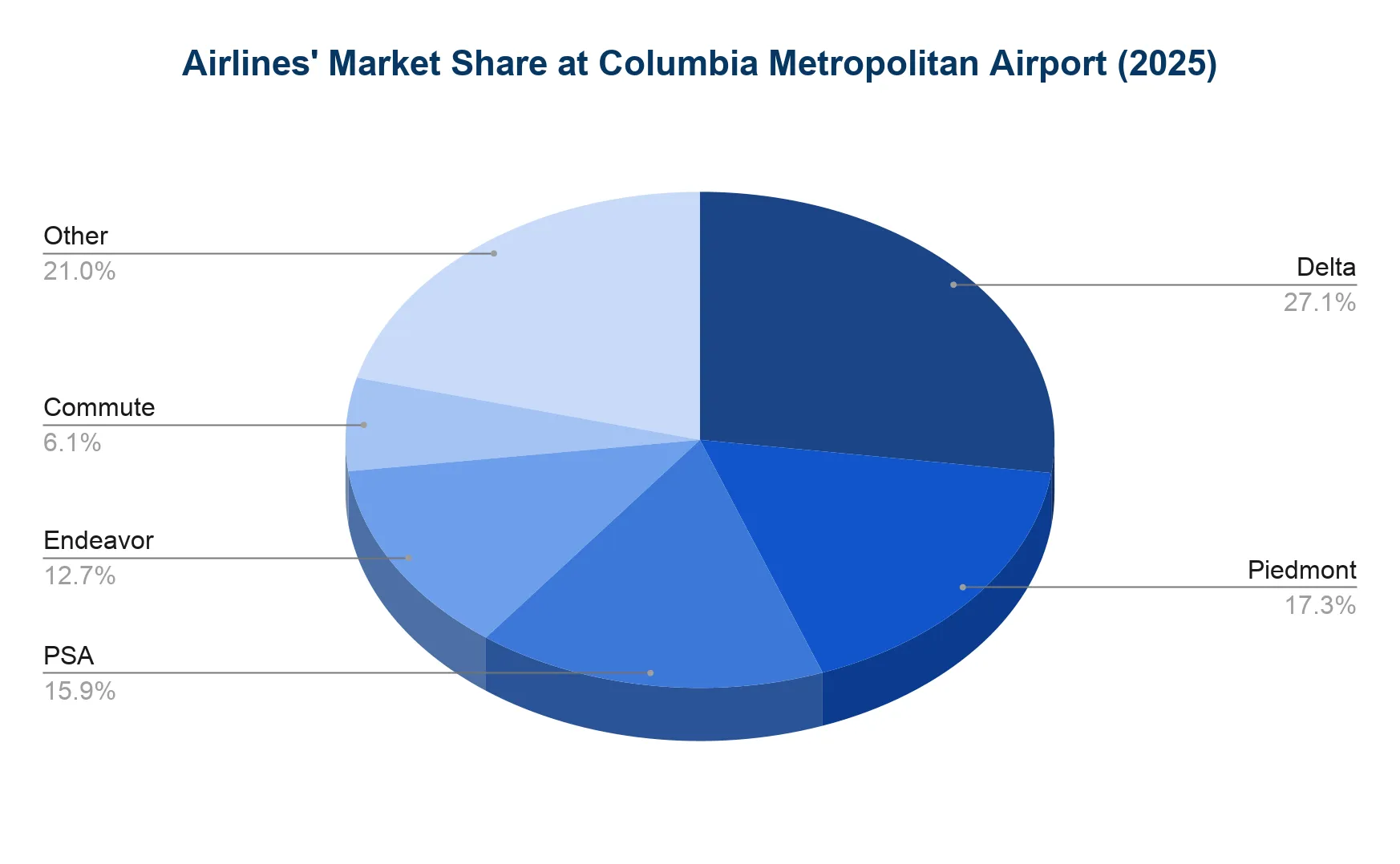
Legacy carriers and their regional affiliates dominate CAE’s operations, with Delta Air Lines holding the largest individual market share.
- In 2025, Delta Air Lines led with 27.1% of market share, operating primarily through mainline flights to Atlanta and other hubs.
- Piedmont Airlines held 17.3% of the market, offering regional jet service.
- PSA Airlines and Endeavor Air accounted for 15.9% and 12.7% respectively, also offering regional jet service.
- Commute Air represented 6.1% of operations.
What are the monthly trends in passenger traffic at Columbia Metropolitan Airport?
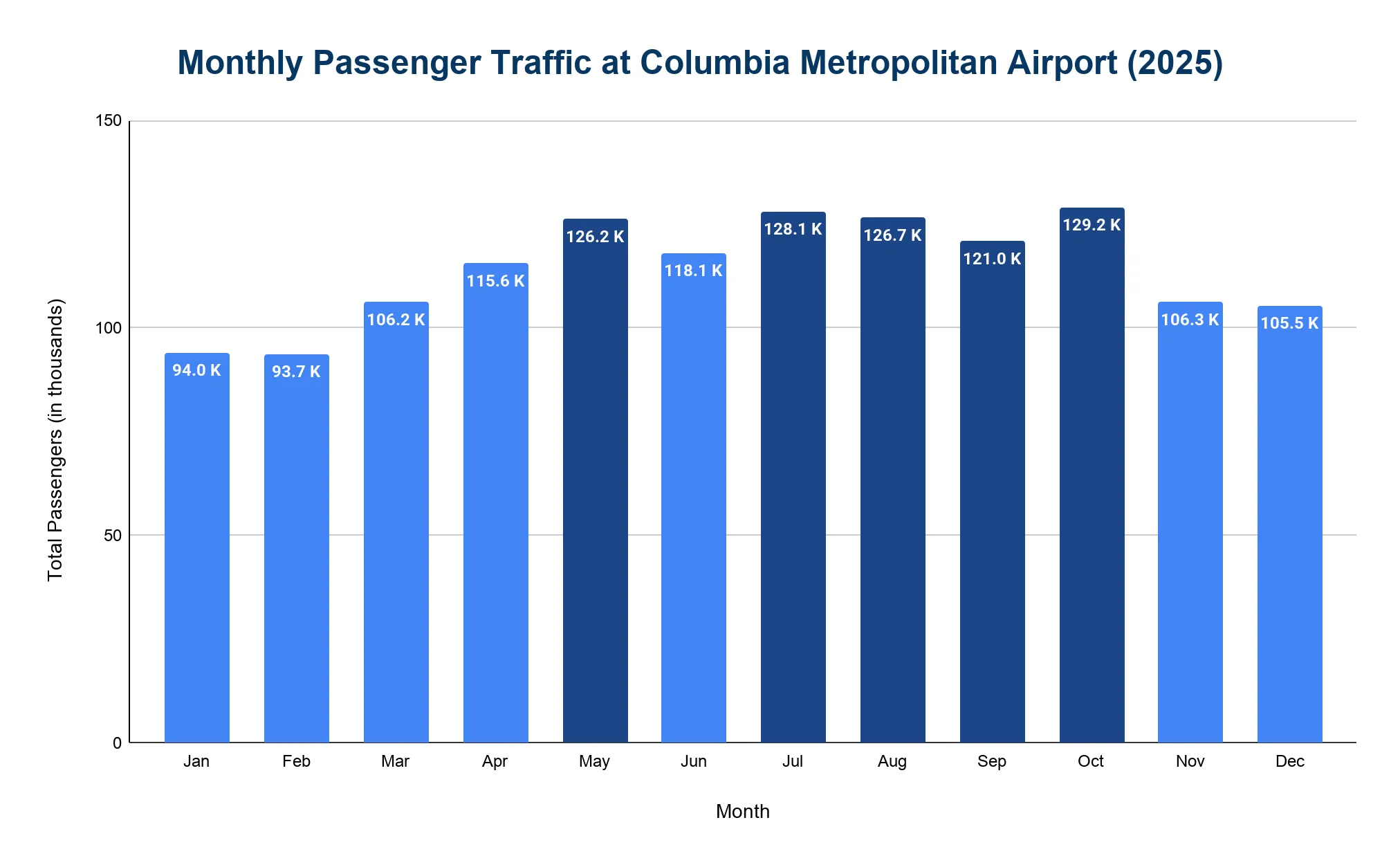
Columbia Metropolitan Airport shows clear seasonal patterns, with spring and early fall seeing the highest travel volumes.
- October was the busiest month with 129,176 passengers, reflecting strong early fall travel.
- July followed closely with 128,121 passengers, marking the peak of summer travel demand.
- Numbers also remained high in August (126,672) and May (126,241), reflecting consistently strong travel demand during the late-summer and pre-holiday periods.
- January and February were the lowest months with 94,003 and 93,675 passengers respectively, consistent with post-holiday travel slowdowns.
How many routes are there at Columbia Metropolitan Airport?
- As of 2025, Columbia Metropolitan Airport (CAE) had 12 direct (non-stop) routes/destinations served by commercial airlines.
- New routes introduced in 2025 include Newark (Spirit), Fort Lauderdale (Spirit & Allegiant) and Orlando (Spirit & Allegiant).
Which destinations are the most popular from Columbia Metropolitan Airport?
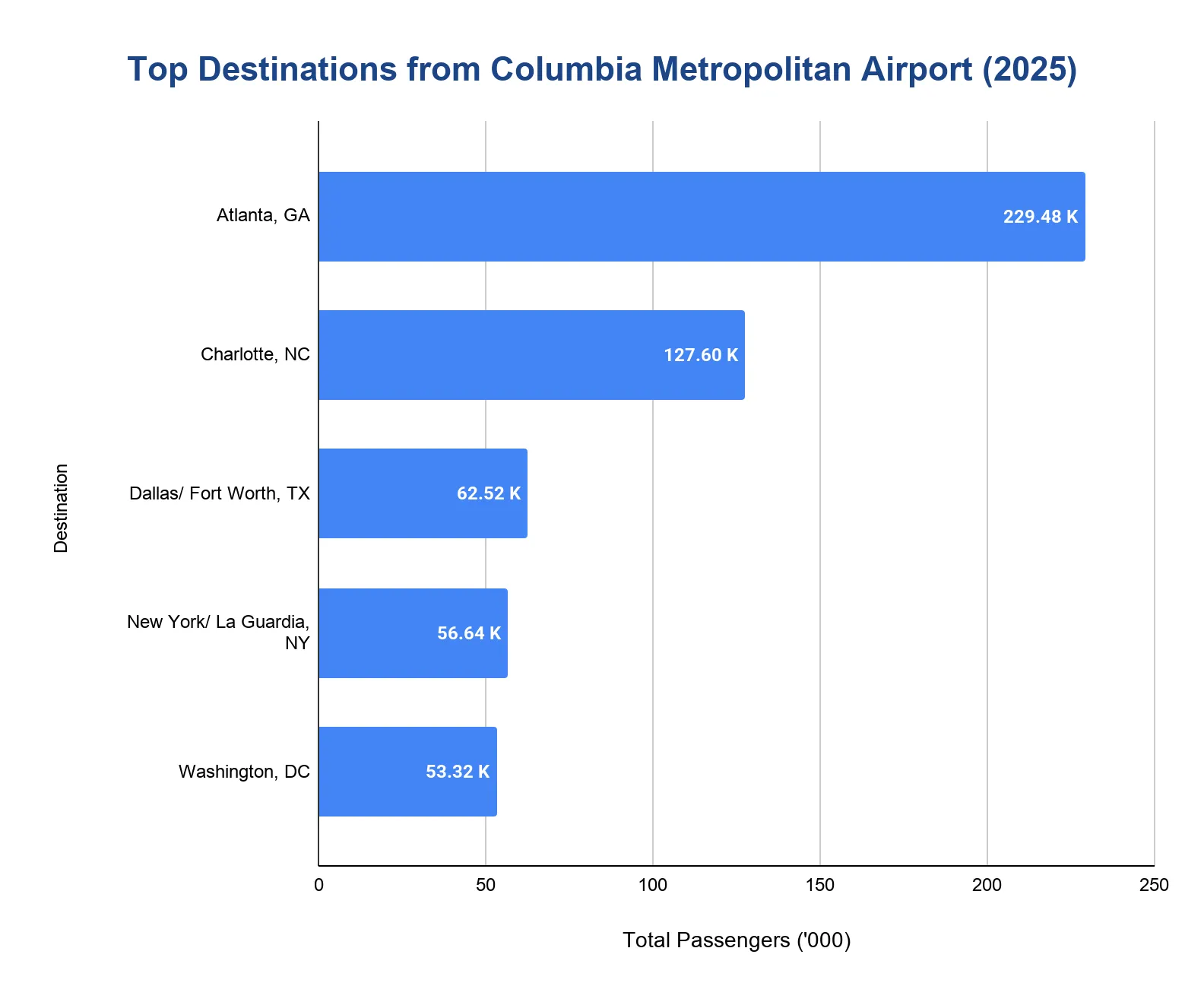
- Atlanta, GA (ATL) served 229,480 passengers in 2025, making it the busiest route via Delta’s hub with 5-6 daily flights.
- Charlotte, NC (CLT) handled 127,600 passengers as the second-busiest route via American Airlines.
- Dallas/Fort Worth, TX (DFW) carried 62,520 passengers, offering extensive West Coast connectivity through American’s hub.
- New York/ La Guardia, NY (LGA) served 56,640 passengers, supporting strong business and connecting traffic demand.
- Washington, DC (DCA/IAD) handled 53,320 passengers combined, with service to both Reagan National and Dulles airports.
How much cargo does Columbia Metropolitan Airport handle annually?
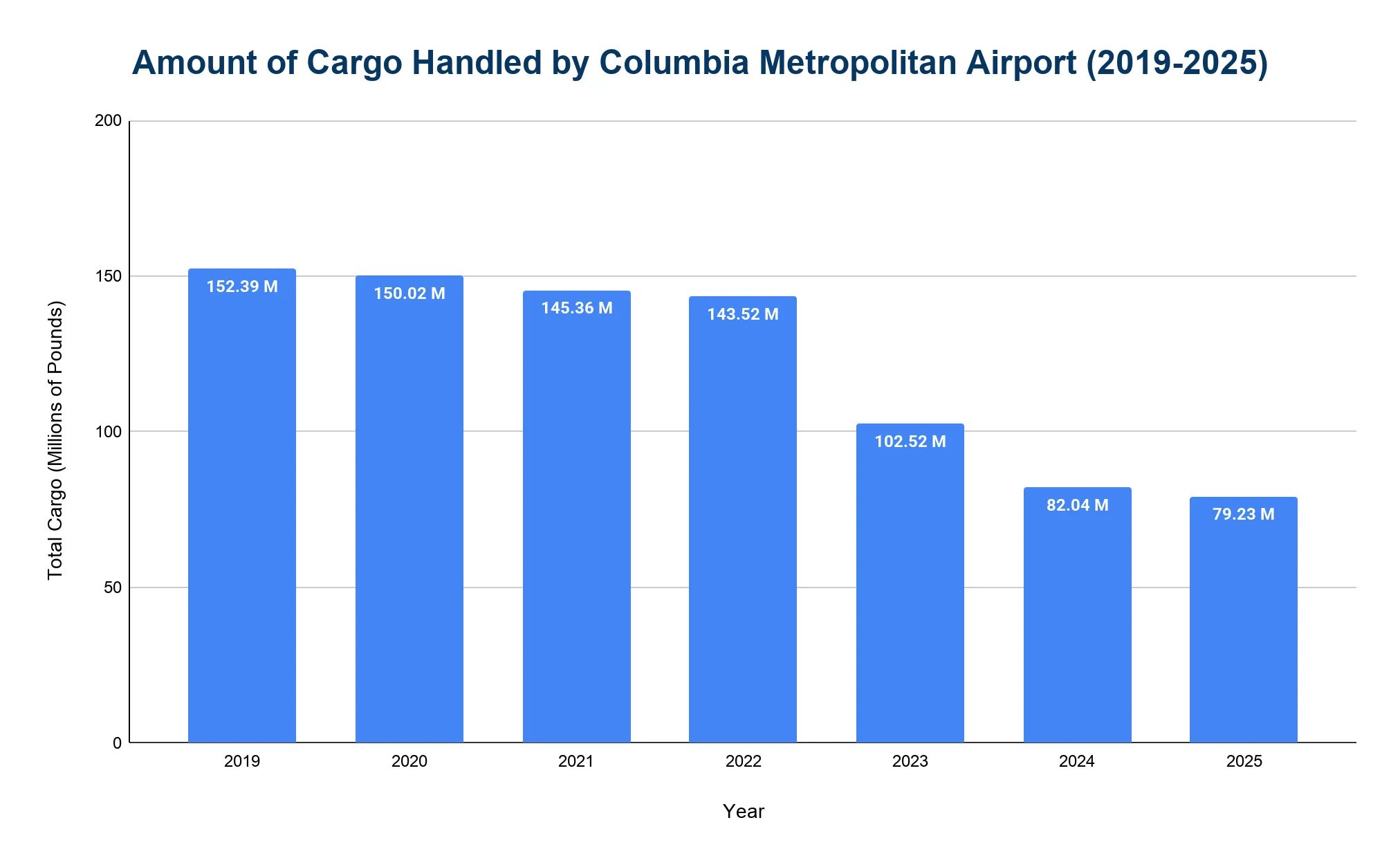
Cargo activity at Columbia Metropolitan Airport has shown a consistent downward trend in recent years, with freight volumes gradually declining from pre-2020 levels.
- In 2025, Columbia Metropolitan Airport handled 79.23 million pounds of cargo, down slightly from 82.04 million pounds in 2024, continuing the recent downward trend in freight activity.
- Before the pandemic, the airport processed 152.39 million pounds of cargo in 2019.
- During the pandemic period, cargo volumes remained relatively stable compared with passenger traffic trends, totaling 150.02 million pounds in 2020 and 145.36 million pounds in 2021.
- In the post-pandemic recovery phase, cargo throughput gradually weakened, declining to 143.52 million pounds in 2022 before falling more sharply to 102.52 million pounds in 2023 as shipping demand normalized.
How many cancellations occur at Columbia Metropolitan Airport annually?
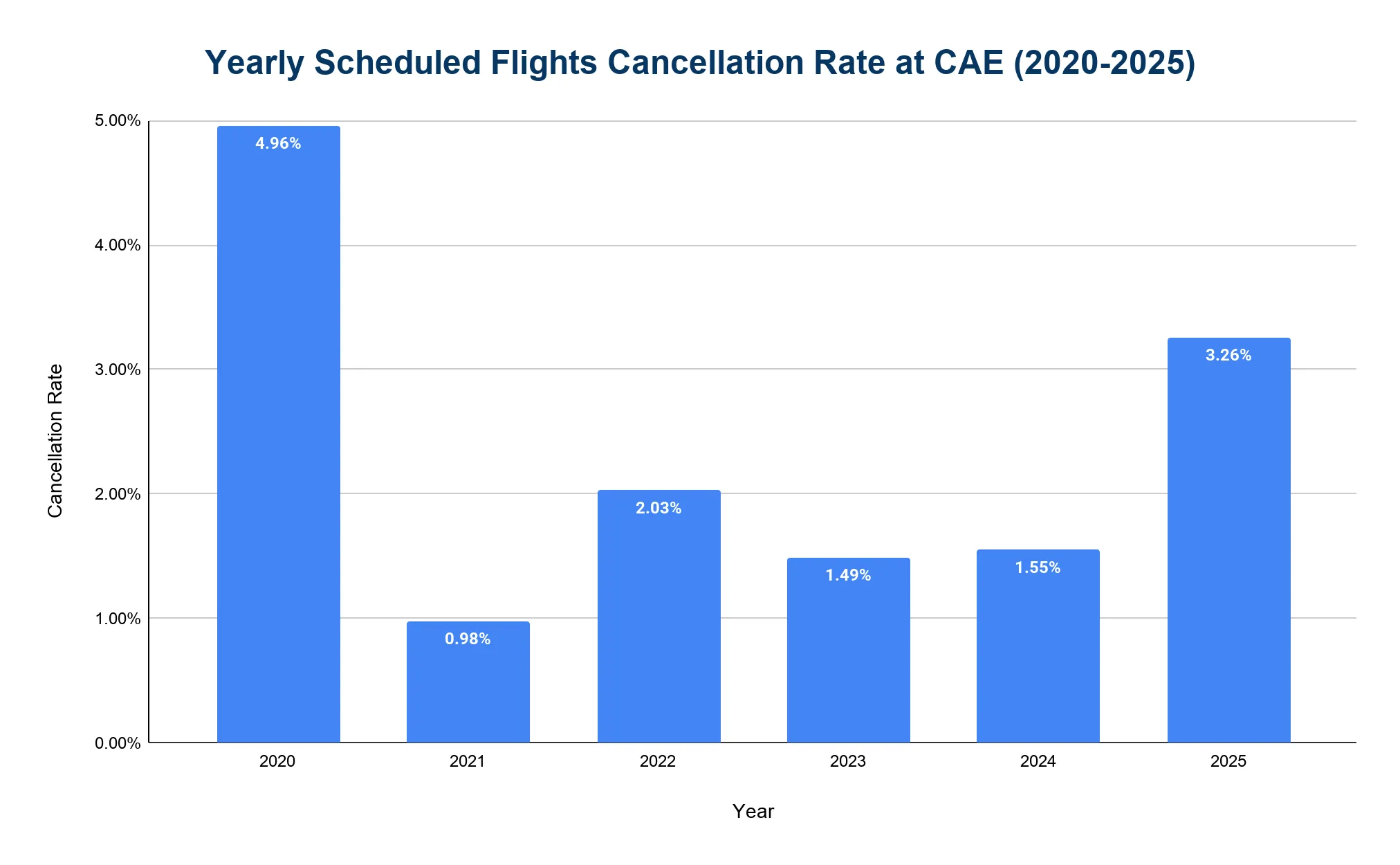
- In 2025, 3.26% of domestic flights were cancelled, an increase from 1.55% in 2024.
- The highest rate occurred in 2020, with about 4.96% of flights cancelled due to reduced schedules and restrictions.
- The rate dropped to 0.98% in 2021, signaling a return to regular operations.
- It rose slightly to 2.03% in 2022 due to industry-wide staffing and operational challenges.
- In 2023, 1.49% of flights were cancelled, in line with improving national airline performance.
What are the main causes of flight disruptions at Columbia Metropolitan Airport?
- Thunderstorms and severe weather during summer (June-August), affecting CAE and hub airports like Atlanta and Charlotte.
- Congestion at major hubs such as Atlanta (ATL) and Charlotte (CLT), leading to ripple delays at CAE.
- Occasional winter weather requiring de-icing, though less frequent due to Columbia’s moderate climate.
- Air traffic control delays at major East Coast hubs like Washington and New York.
- Airline operational issues including crew scheduling and aircraft positioning, though less common than weather-related delays.
How much revenue has Columbia Metropolitan Airport generated each year?
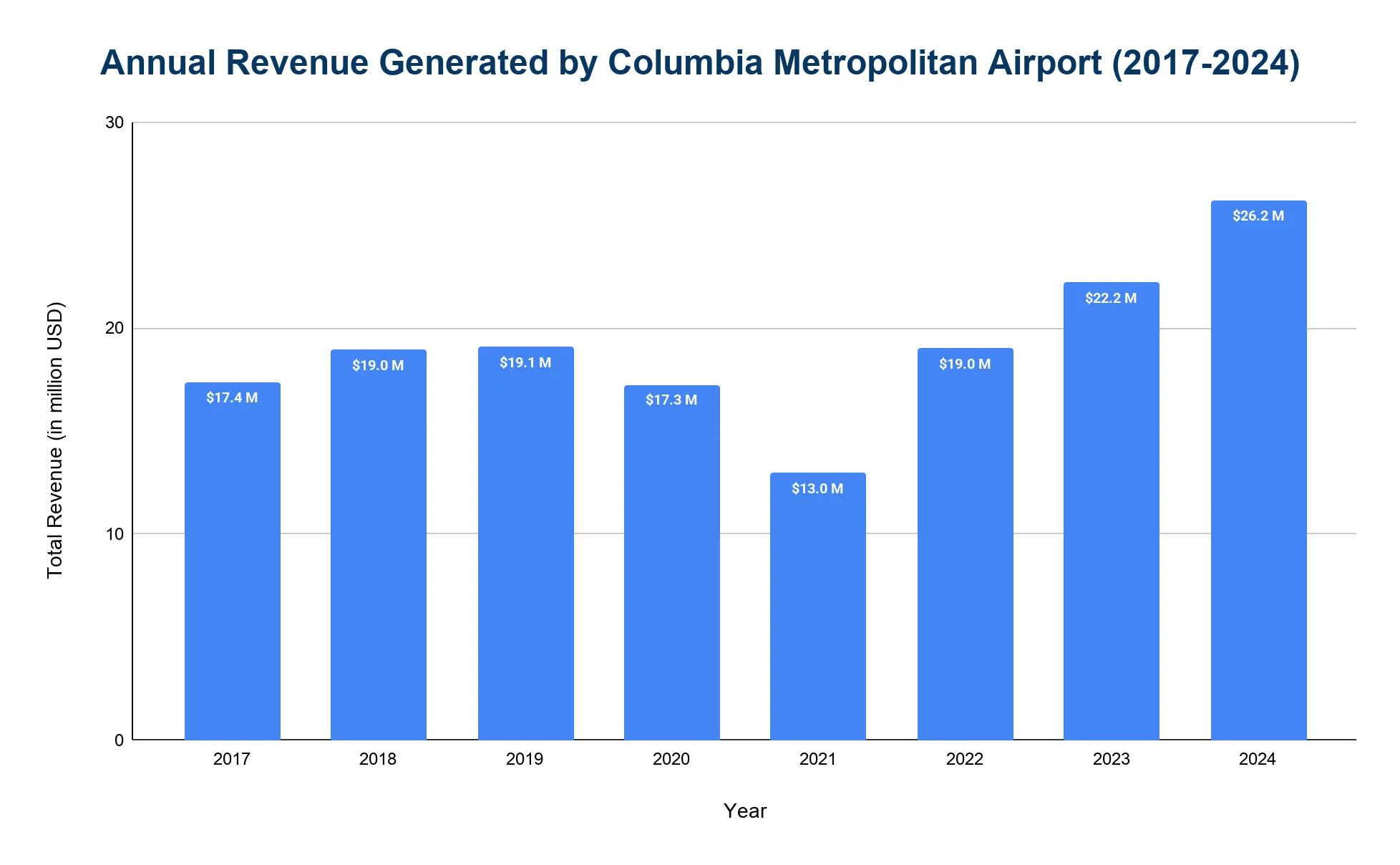
Columbia Metropolitan Airport generates over $20 million in annual operating revenue and is financially self-sustaining without local tax funding.
- Operating revenue reached $26.2 million in 2024, an all-time high reflecting strong post-pandemic recovery.
- Pre-pandemic revenue peaked at $19.1 million in 2019 and fell to $17.3 million in 2020.
- The figure dropped further to $13 million in 2021.
- By 2022, operating revenue recovered to $19.0 million, nearing the pre-pandemic levels.
- The revenue further increased to $22.2 million in 2023, crossing the $20 million mark for the first time.
Note: 2025 annual operating revenue data is not yet available
Related Travel Statistics
- Albany International Airport (ALB) Statistics
- Bangor International Airport (BGR) Statistics
- Fairbanks International Airport (FAI) Statistics
- Fresno Yosemite International Airport Statistics
- Grand Junction Regional Airport (GJT) Statistics
- Piedmont Triad Airport Statistics
- Hilton Head Island Airport (HHH) Statistics
- Huntsville Airport (HSV) Statistics
- Tweed–New Haven Airport (HVN) Statistics
- OKC Will Rogers Airport Statistics
- Seattle-Tacoma International Airport Statistics
- Spokane International Airport (GEG) Statistics
What are the notable incidents at Columbia Metropolitan Airport?
- September 19, 2008: A Learjet 60 crashed on takeoff from Runway 11, killing four including both pilots. Musicians Travis Barker and DJ AM survived with serious injuries. The NTSB found under-inflated tires caused the crash, prompting updated FAA tire pressure guidance for charter jets.
- December 20, 2020: A Western Global Airlines Boeing 747-400F cargo plane struck a structure while taxiing, shearing off a wingtip. No injuries occurred. The runway was temporarily closed for debris removal.
- August 12, 2025: A homebuilt Velocity XL aircraft suffered a nose gear collapse on landing. The pilot, the sole occupant, had only minor injuries. Runway 11 was briefly closed for removal.
References
- Columbia Metropolitan Airport Detailed Data · flycae.com
- FAA OPSNET — George Bush Intercontinental Airport Operations Data · aspm.faa.gov
- BTS TranStats — Airport profiles (route information by airport) · transtats.bts.gov

