

 Popular Countries
 24/7 Support
Published
Santa Fe Regional Airport (SAF) is New Mexico's second busiest commercial airport, providing air connectivity for Santa Fe, Los Alamos and nearby communities through regional affiliates of American Airlines and United Airlines.
How many passengers pass through Santa Fe Regional Airport each year?
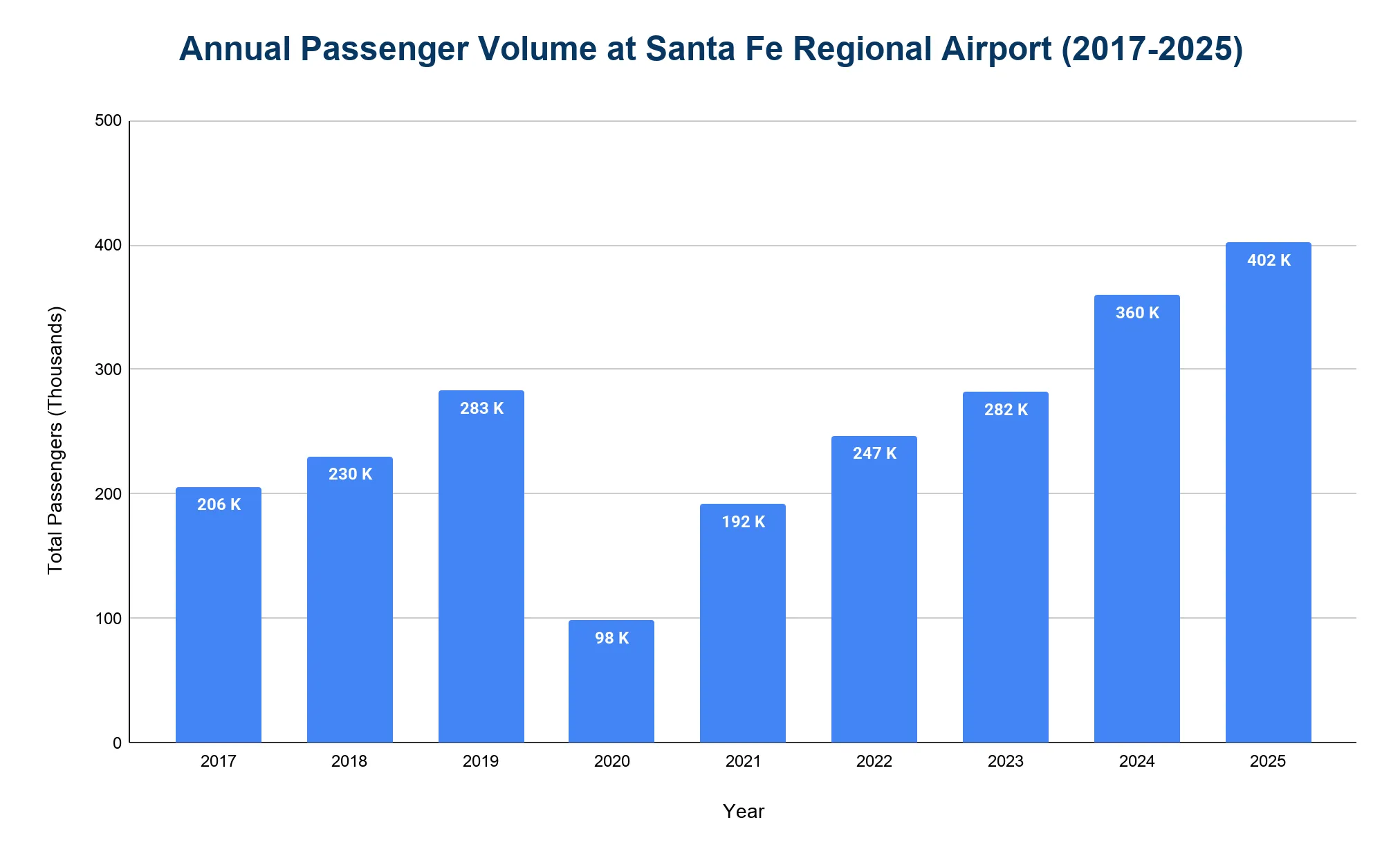
Santa Fe Regional Airport handles over 400,000 passengers annually.
- The airport served approximately 402,000 passengers in 2025, setting a new all-time record and marked a 11.7% increase over the previous year.
- In 2019, the airport handled 283,238 passengers before the pandemic.
- Passenger traffic dropped to 98,479 in 2020 (a 65% decline) and recovered to 192,000 in 2021.
- Recovery continued in 2022 with 247,000 passengers, followed by 282,000 in 2023 and 360,000 in 2024.
What is the total number of aircraft operations at Santa Fe Regional Airport each year?
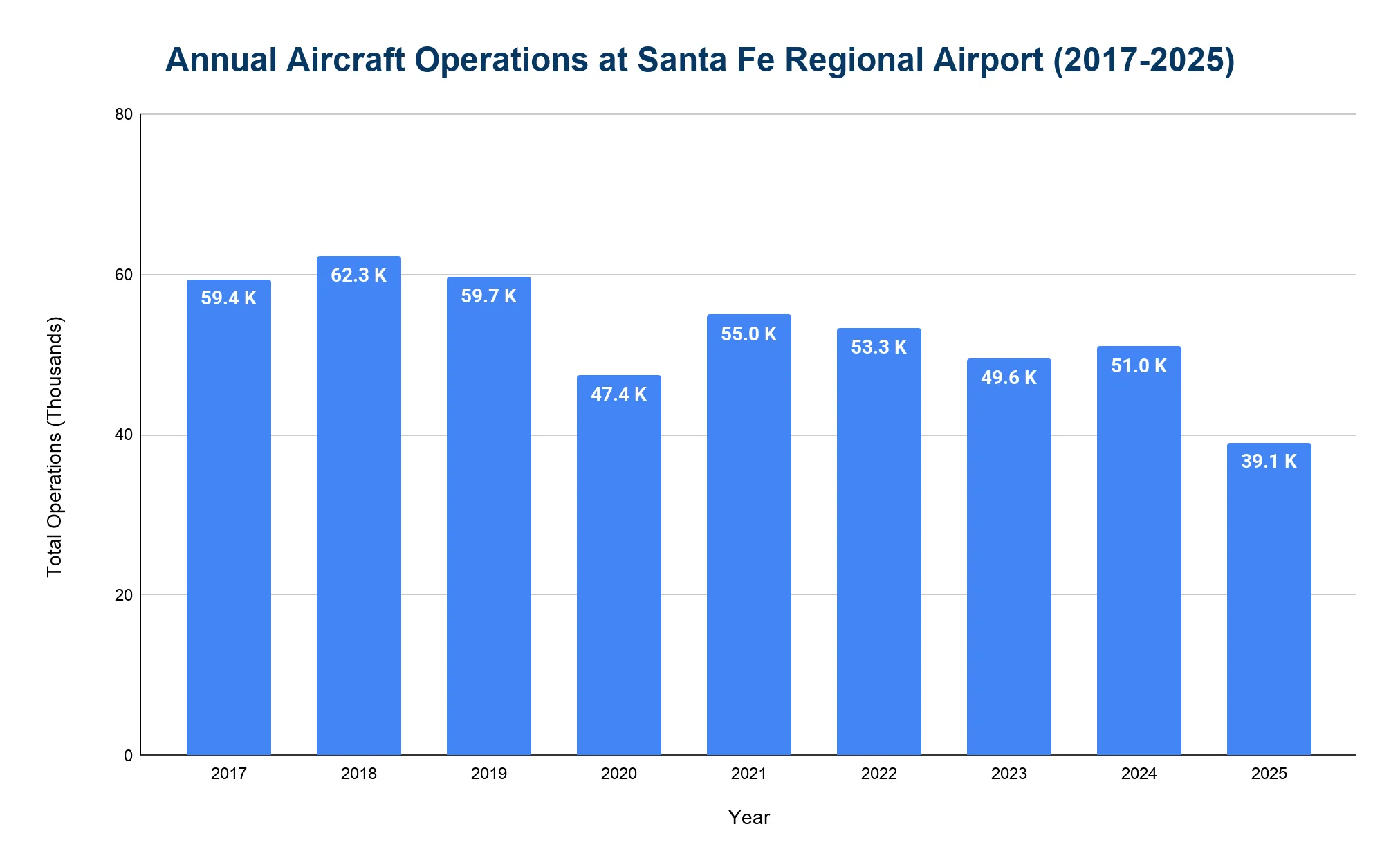
SAF records approximately 40,000-60,000 total aircraft operations annually, including commercial, general aviation and military flights.
- In 2025, there were 39,068 aircraft movements, reflecting a 23.5% decrease from the previous year.
- Operations totaled 59,699 in 2019 before dropping to 47,439 in 2020, which was the lowest point of the pandemic era.
- Activity rose to 54,969 in 2021, then dipped slightly to 53,318 in 2022.
- Movements fell in 2023 to 49,561 before rebounding to 51,035 in 2024.
Which airlines operate the most flights out of Santa Fe Regional Airport?
Skywest Airlines dominates at Santa Fe Regional Airport.
- By operating carrier, SkyWest Airlines handled 99.78% of all SAF passengers, flying for both American Eagle and United Express.
- PSA accounted for the remaining 0.22% market share.
How many routes are there at Santa Fe Regional Airport?
- SAF offers domestic-only routes within the United States, with no international service.
- As of late 2025, SAF offers nonstop service to 5-6 destinations: Dallas/Fort Worth (DFW), Denver (DEN), Phoenix (PHX), Houston Intercontinental (IAH - seasonal), Los Angeles (LAX - new in October 2025), and Dallas Love Field (DAL - via JSX charter).
- Major destinations include hub airports that provide connectivity nationwide, particularly to Texas, Colorado, and Arizona.
Which destinations are the most popular from Santa Fe Regional Airport?
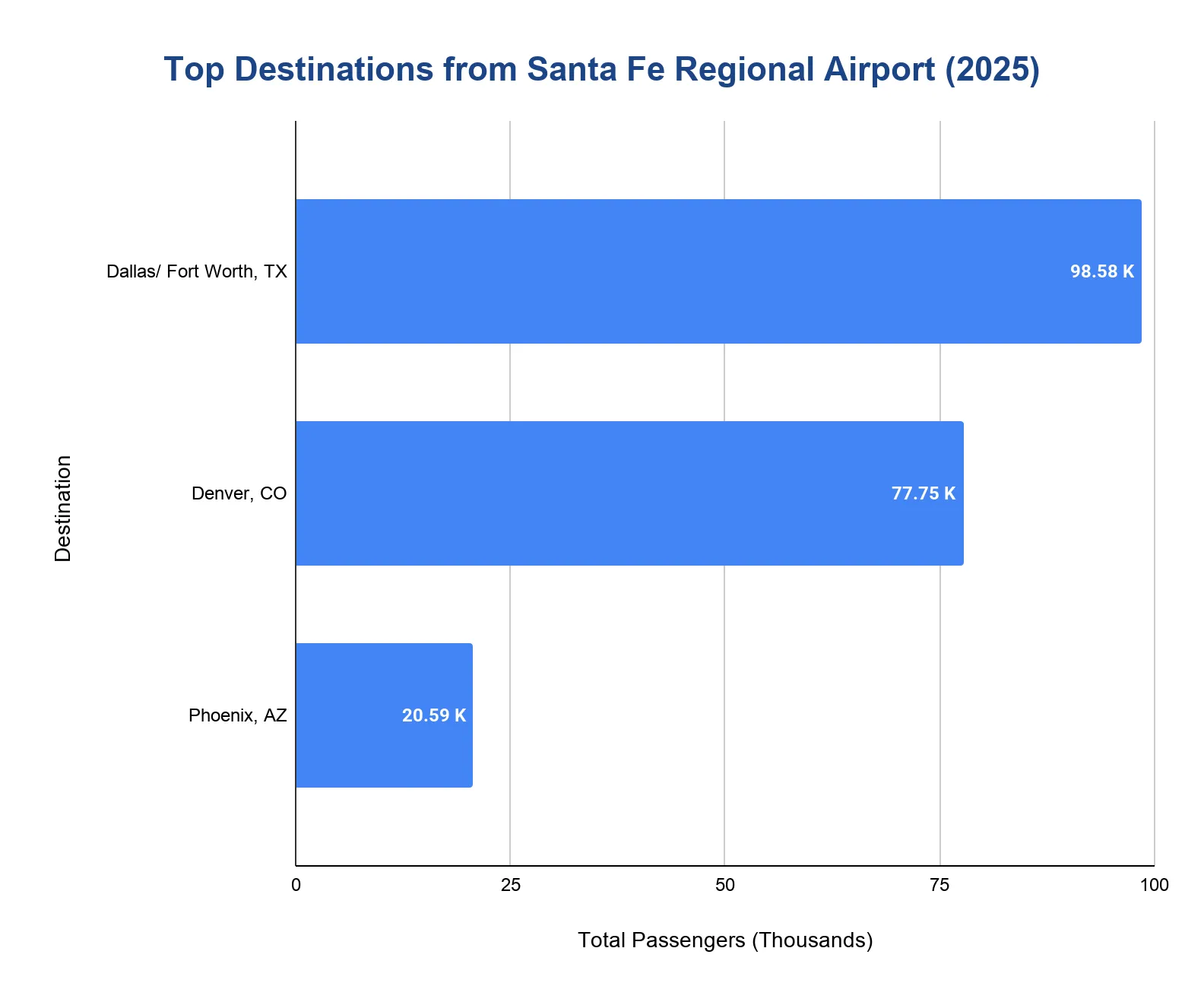
- Dallas/Fort Worth, TX (DFW) accounted for 98,580 passengers in 2025, making it the busiest route via American's hub.
- Denver, CO (DEN) served 77,750 passengers, ranking second with multiple daily United Express flights.
- Phoenix, AZ (PHX) handled 20,590 passengers, offering key regional connections through American's hub.
How much cargo does Santa Fe Regional Airport handle annually?
- SAF supports minimal cargo activity compared to freight hubs, handling under 1,000 tons of freight per year.
- All cargo is domestic only, with no international freight or dedicated cargo flights.
How many cancellations occur at Santa Fe Regional Airport annually?
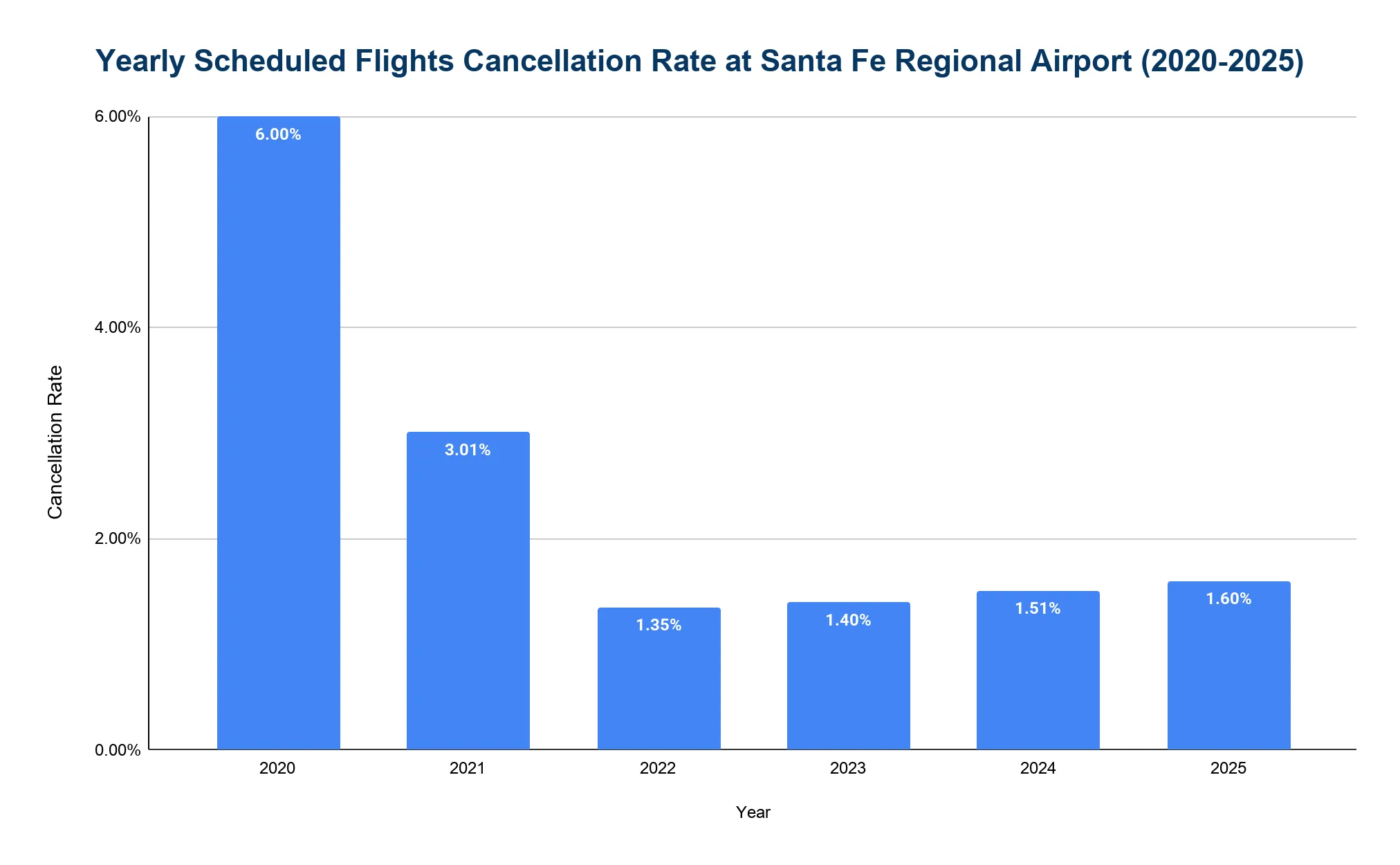
Flight cancellations at SAF remain low and are consistent with rates at other regional airports, typically below 2%.
- In 2025, 1.60% of flights were cancelled, a slight increase from 1.51% in 2024.
- The highest rate occurred in 2020, when 6.00% of flights were cancelled due to COVID-19 disruptions.
- Cancellations dropped to 3.01% in 2021, improving further to 1.35% in 2022 and 1.40% in 2023.
Related Travel Statistics
- Lehigh Valley International Airport Statistics
- Boise Airport Statistics
- Hollywood Burbank Airport (BUR) Statistics
- Burlington Airport (BTV) Statistics
- Fayetteville Regional Airport Statistics
- Grand Rapids Airport (GRR) Statistics
- Los Angeles International Airport Statistics
- Midway International Airport Statistics
- Oakland Airport (OAK) Statistics
- Phoenix Sky Harbor Airport Statistics
- Reno-Tahoe International Airport Statistics
- Salt Lake City International Airport Statistics
What are the main causes of flight disruptions at Santa Fe Regional Airport?
- High-elevation density altitude effects, especially during hot summer days at 6,348 feet elevation, can impact aircraft performance and occasionally cause weight restrictions.
- Weather at connecting hub airports (Dallas, Denver, Phoenix), including thunderstorms and winter storms, frequently causes upstream delays affecting SAF flights.
- Winter weather conditions at Santa Fe, including occasional snow requiring runway clearing and de-icing, though the dry climate minimizes major disruptions.
- Summer afternoon thunderstorms during monsoon season (July-August) can delay departures until weather clears.
- Limited aircraft availability means mechanical issues can result in cancellations rather than quick aircraft swaps, given the small regional jet fleet serving SAF.
What are the notable incidents at Santa Fe Regional Airport?
Santa Fe Regional Airport has no identified fatal scheduled-airline accidents in the reviewed NTSB records, but it has recorded fatal general aviation accidents.
- July 18, 2023: A privately operated Cessna T310R, N5251C, crashed into a residence shortly after departing Runway 20. The pilot, the sole occupant, was killed; no ground injuries were reported. The NTSB attributed the crash to a total loss of left-engine power caused by improperly installed crankshaft counterweight retaining rings, with the pilot’s failure to maintain airspeed also causal1.
- September 15, 1969: A Ted Smith/Piper PA-61 Aerostar 601, N7442S, crashed during takeoff/climb from Santa Fe, killing both occupants. An archived accident summary cited high density altitude, a too-lean mixture setting, failure to abort the takeoff, and insufficient runway among the reported factors2.
References
- NTSB — 2023 Santa Fe Regional Airport accident docket (ProjectID 192652) · data.ntsb.gov ↑
- BAAA — 1969 Ted Smith Aerostar 601 crash at Santa Fe · baaa-acro.com ↑
- BTS TranStats — Airport profiles (route information by airport) · transtats.bts.gov
- FAA OPSNET — George Bush Intercontinental Airport Operations Data · aspm.faa.gov

