

 Popular Countries
 24/7 Support
Published
Page last updated: 8 October 2025
Flight delays are an unavoidable reality of air travel, and major airports across the United States experienced significant flight delays in 2024.
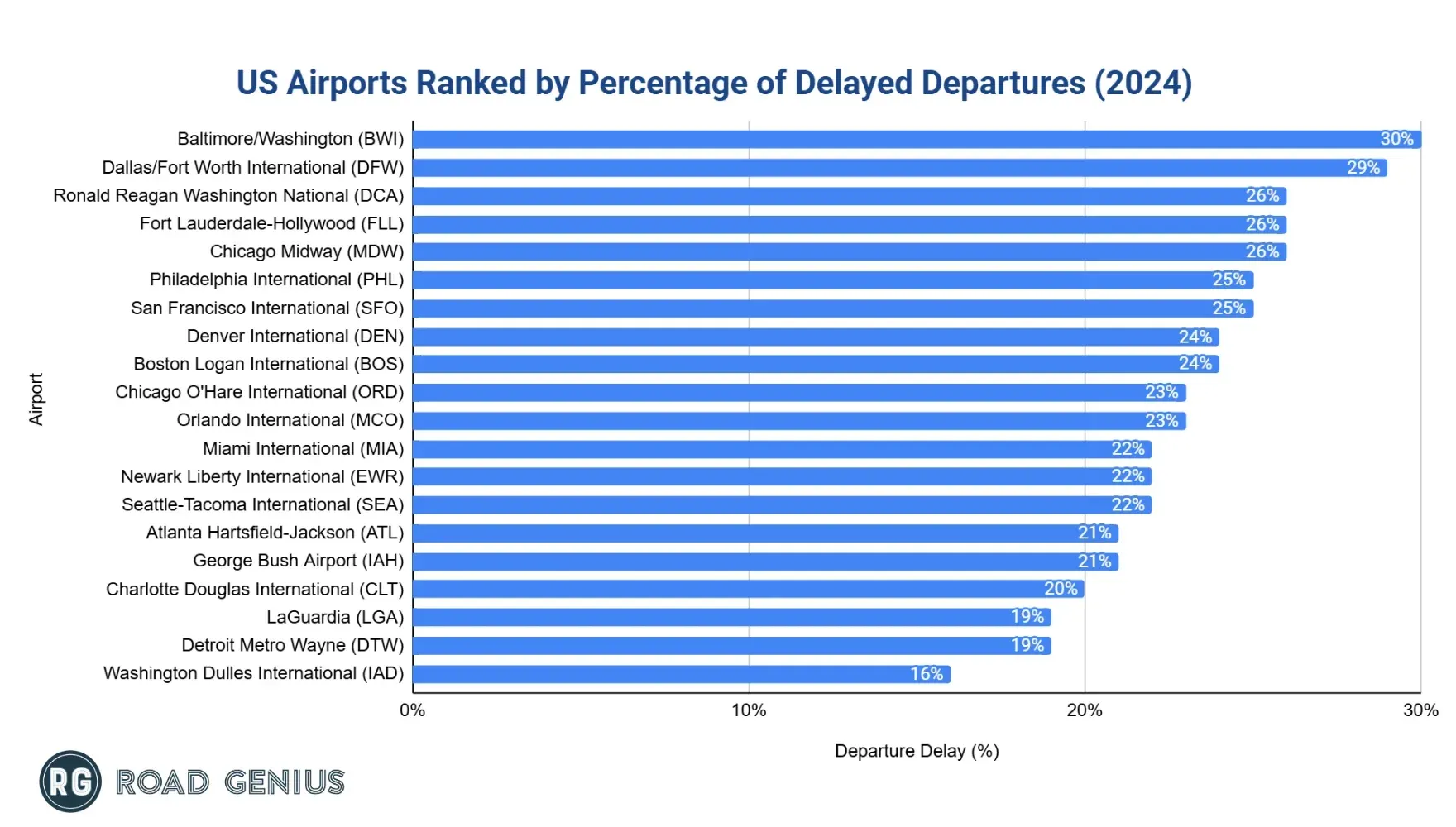
Which US airports experience the most departure delays?
Baltimore/Washington International Airport (BWI) had the highest delay rates in the United States in 2024. 30% of departures were delayed, recording an average delay time of 62 minutes.
Other airports with high delay rates:
- Dallas/Fort Worth International (DFW): 29% departure delays
- Ronald Reagan Washington National (DCA): 26% delay rates
- Fort Lauderdale-Hollywood (FLL) and Chicago Midway (MDW) tied at 26% delayed departures
- Philadelphia International (PHL): 25% departure delays
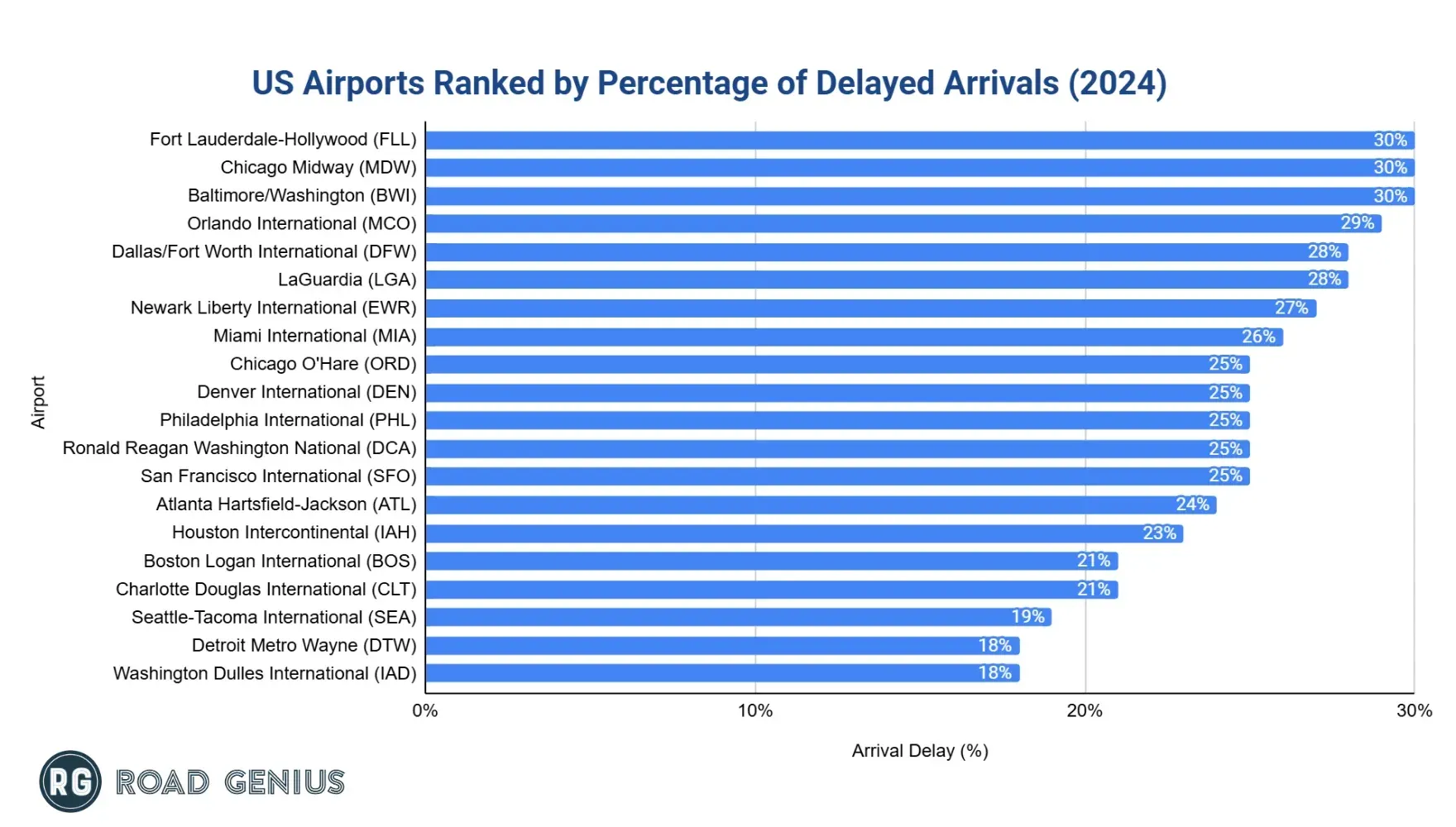
Which US airports had the worst arrival delays in 2024?
Fort Lauderdale-Hollywood International Airport (FLL), Chicago Midway (MDW), and Baltimore/Washington (BWI) tied for the worst arrival delay statistics, recording 30% of incoming flights arriving late.
- Orlando International (MCO) ranked 4th with 29% arrival delays, while Dallas/Fort Worth International (DFW) and LaGuardia (LGA) were tied for 5th with 28% arrival delays.
Which US airlines have the most delays?
Frontier Airlines recorded the worst on-time performance among major US carriers in 2024. It achieved only 71.6% on-time departures, meaning 28.4% of all Frontier flights experienced delays.
Top 10 Most Delayed US Airlines (2024)
- Frontier Airlines: 28.4% delayed, 70 min average delay
- JetBlue Airways: 25.5% delayed, 80+ min average delay
- Allegiant Air: 25% delayed, 70 min average delay
- Spirit Airlines: 23.9% delayed, 70 min average delay
- Southwest Airlines: 22.3% delayed, 60-70 min average delay
- American Airlines: 22.2% delayed, 75-80 min average delay
- Alaska Airlines: 20.8% delayed, 60 min average delay
- United Airlines: 19.1% delayed, 55-60 min average delay
- Delta Air Lines: 16.5% delayed, 50-55 min average delay
- Hawaiian Airlines: 14.2% delayed, 45-50 min average delay
What causes the most flight delays at US airports?
Severe weather events account for the majority of flight delays across US airports. Summer thunderstorms and winter storms create the most significant operational disruptions.
Main Delay Factors:
- Weather-related. Thunderstorms, snow, and fog reduce airport capacity
- Air Traffic Control congestion. The Northeast corridor and major hubs face chronic ATC delays
- Aircraft positioning delays. Late-arriving aircraft force subsequent departure delays
- Infrastructure constraints. Single-runway operations during adverse conditions
Which regions experience the most delays?
The Northeast Corridor demonstrates the highest concentration of delayed flights. Airports serving New York, New Jersey, Pennsylvania and Washington DC consistently rank among the worst performers.
Most Delay-Affected Regions:
- Northeast (NY/NJ/PA/DC): Dense airspace, winter weather impacts
- Southeast/Gulf Coast (FL/TX): Summer thunderstorm activity, high traffic volumes
- Upper Midwest (IL): Winter operations, hub congestion effects
- The Mountain West and Pacific Northwest regions show lower delay rates
- Atlantic City International Airport Statistics
- Billings Airport (BIL) Statistics
- Bozeman Airport (BZN) Statistics
- Burlington Airport (BTV) Statistics
- Jackson Airport (JAN) Statistics
- Midway International Airport Statistics
- Myrtle Beach Airport (MYR) Statistics
- Oakland Airport (OAK) Statistics
- Pittsburgh Airport (PIT) Statistics
- Portland International Jetport Statistics
- Richmond International Airport Statistics
- Salt Lake City International Airport Statistics
What are the most delayed flight routes in the US?
The New York (JFK) to Los Angeles (LAX) route experienced the highest delay rates among domestic US routes, recording 35% of flights delayed and an average delay time of 68 minutes in 2024.
Top 5 Most Problematic US Routes (2024)
- New York (JFK) to Los Angeles (LAX): 35% delayed, 68 min average delay
- Miami (MIA) to New York (JFK): 33% delayed, 65 min average delay
- Los Angeles (LAX) to New York (JFK): 34% delayed, 66 min average delay
- Dallas (DFW) to Chicago (ORD): 32% delayed, 62 min average delay
- Atlanta (ATL) to Dallas (DFW): 31% delayed, 58 min average delay
How to avoid delays when traveling?
You may be able to reduce the likelihood of experiencing delays by strategic flight selection.
Consider:
- Morning departures as first flights in the day face fewer cascading delays
- Reliable carriers such as Hawaiian Airlines, Delta Air Lines show superior performance
- Airport selection - if possible, avoid high-delay hubs during peak travel periods
- Seasonal timing - winter and summer months present the highest delay risks
- Plan connections and allow extended layover times at major hubs

